Never missing a primal issue, accelerating productivity improvement
Kyoto, Japan, July 13th, 2020, Questetra, Inc., the global SaaS provider of Business Process Management (BPM), today announced that they have published the new version 12.1 of the Cloud-based Workflow product “Questetra BPM Suite” on Jul. 13th, 2020. This new version allows displaying a list of your duties narrowing down by conditions you wish such as “new arrival” or “close to deadline” with one click.
Amid growing concerns over labor shortages due to work style reforms and the declining birthrate and aging population, improving productivity is a major issue. In the most business scene, employees themselves are also trying to implement measures to improve their productivity. A huge amount of work is being processed in daily business, and it is one of the ways to improve productivity that processing duties in the order of priority.
Although it was possible to classify by the priority by putting stars on one’s tasks in Questetra BPM Suite, it was troublesome that they had to be manually attached. In the new version 12.1, a feature that allows narrowing down tasks by conditions you like is provided. With this feature, you can one-click display the narrowed down tasks list after saving the criteria that filter by high priority specific task, client, or words in the title, etc.
Questetra BPM Suite
Cloud-based Workflow Questetra BPM Suite is a business platform for realizing paperless environments and remote-working. Business issues are controlled according to a Business Flow Diagram. When a Process reaches a Human Task the user will be asked to add their input. Also, when an issue reaches an automated Step the predetermined processing (server-side processing) such as Generating PDF and Saving to cloud storage is performed automatically. (BPM: Business Process Management))
You can apply it to various business operations such as Approval request flow, Document translation flow, Quality check process, and Invoice issuance process. Process owners of each Business Process can practice the Improvement of Business Processes little by little in daily work.
Filtering function on My Tasks and Offered
On the screens of [My Tasks] and [Offered] that lists tasks, you can now execute searches with setting search conditions and specifying display items. And the configured condition can be named, saved, and displayed on the side menu as a button. Using the button, you can display the search result (the list of filtered tasks) with one click.
Other Improvements
Paging display of My Tasks/Offered
When the number of Tasks in My Tasks or Offered exceeds the specified number, they are displayed on multiple pages. You no longer need to scroll all the way down to the bottom, by specifying the number of items per page appropriately.
Indication of Contract information
You can check the “Edition” and “Payment Plan” on the license information page (viewable only by the system administrator).
Enhanced Script Task
The Script Task is now capable of parsing the XML string and encoding/decoding Bsc64. Also capable of getting the header information of the response to the HTTP request sent in the script.
クラウド型ワークフロー『Questetra BPM Suite』は、ペーパーレス環境やリモートワーク環境を推進するための業務プラットフォームです。業務案件は業務フロー図に従ってコントロールされ、案件が人間工程に到達すれば担当者はアウトプットを求められます。また、案件が自動工程に到達した際には、「PDFの生成」や「クラウドストレージへの保存」といった既定の処理(サーバサイド処理)が自動的に行われます。(BPM: Business Process Management)
Kyoto, Japan, July 1st, 2020, Questetra, Inc., the global SaaS provider of Business Process Management (BPM), today announced that they will start vending Questetra BPM Suite, a cloud-based workflow product, in their new service system.
Background of service system renewal
In recent years, the environment surrounding companies has changed drastically due to the global economic recession caused by COVID-19, diversification of values regarding work styles, and the occurrence of disasters due to climate change. In addition, improvement in productivity has become an urgent issue because of the reduction of working hours due to work style reform and the decrease in the working population due to the declining birthrate and aging population.
Even under these circumstances, companies must continue to grow steadily. To that end, you must work on improving business processes in order to respond to changes in the business environment and to increase productivity. Furthermore, you must continue to make improvements instead of ending it at one time.
We, Questetra Co., Ltd. has decided to renew our service system of Questetra BPM Suite, considering that many companies will promote existing business process improvement efforts.
Concerning the service system renewal, we have taken the following three points into consideration.
Increasing the number of automated processes that would increase productivity
Providing detailed support to users who work on business process improvement
Allows you to choose from four editions with the combination of features and support that meets your needs
By reforming this service system, we believe the users of Questetra BPM Suite will have a greater chance of improving your business processes that will lead to success in business.
Details of new service system
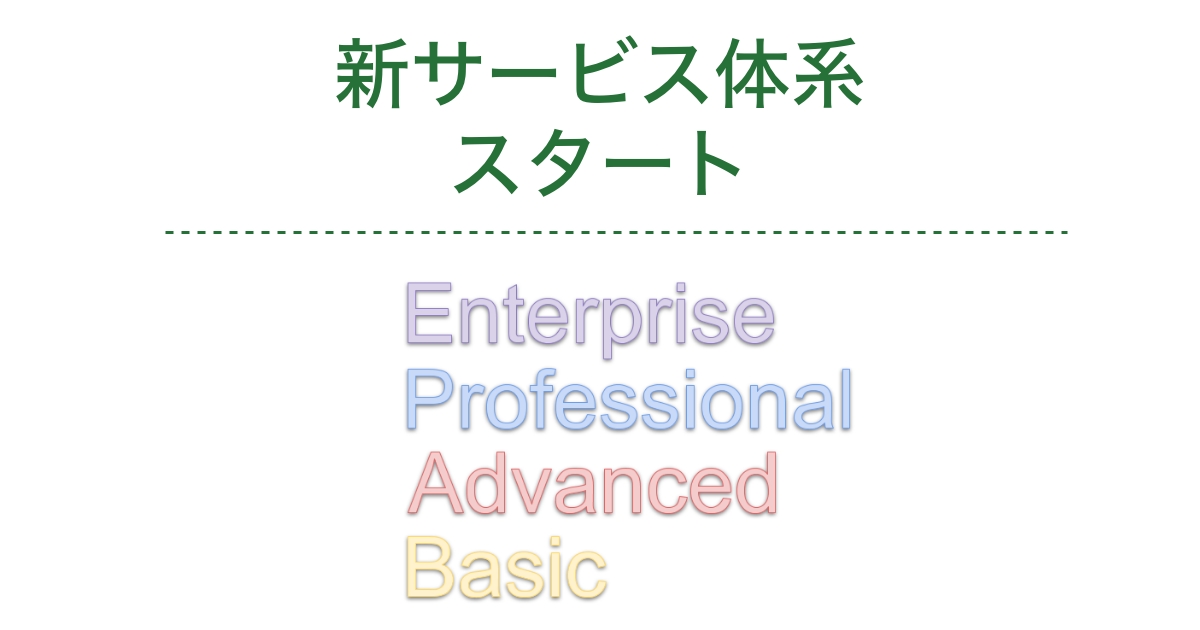
It consists of four editions with different features and support available.
The price is for one month per user. Excluding tax. Separately, there is an annual contract price (20% OFF).
Trial mode: 100 users / 60 days available / Free
If you wish “Don’t want to be affected by other users,” or “Want to access in the domain of my organization,” please consider using the Enterprise edition.
Please also refer to the following page for consideration.
現場監督が担当する「施工」業務を Questetra BPM Suite で管理するようになってからは、台帳に記載するべき情報がすべて Questetra BPM Suite 上に記録されるようになりました。そこで、Questetra BPM Suite に格納されたデータに基づく台帳PDFを、自動的に生成する仕組みを構築しました。こうして、台帳を作成する業務も自動化されました。
一条工務店仙台の社内では、今回の Questetra BPM Suite を利用した BPM の取り組みを通じて、
G Suite と BPM システムを連携させる事で、大幅な事務処理の削減を実現できること
パートさんの手作業に頼っていた事務処理業務の自動化を少しずつ着実に進めていけること
が広く認識されました。
この経験を活かし、G メール・Google ドライブ・Meet・Google フォーム等「G Suite」を使い込んでいる営業部門や設計部門、総務部門などの業務にも、『G Suite の機能と BPM システムを組み合わせて効率化を推進する』 活動が展開されることになっています。
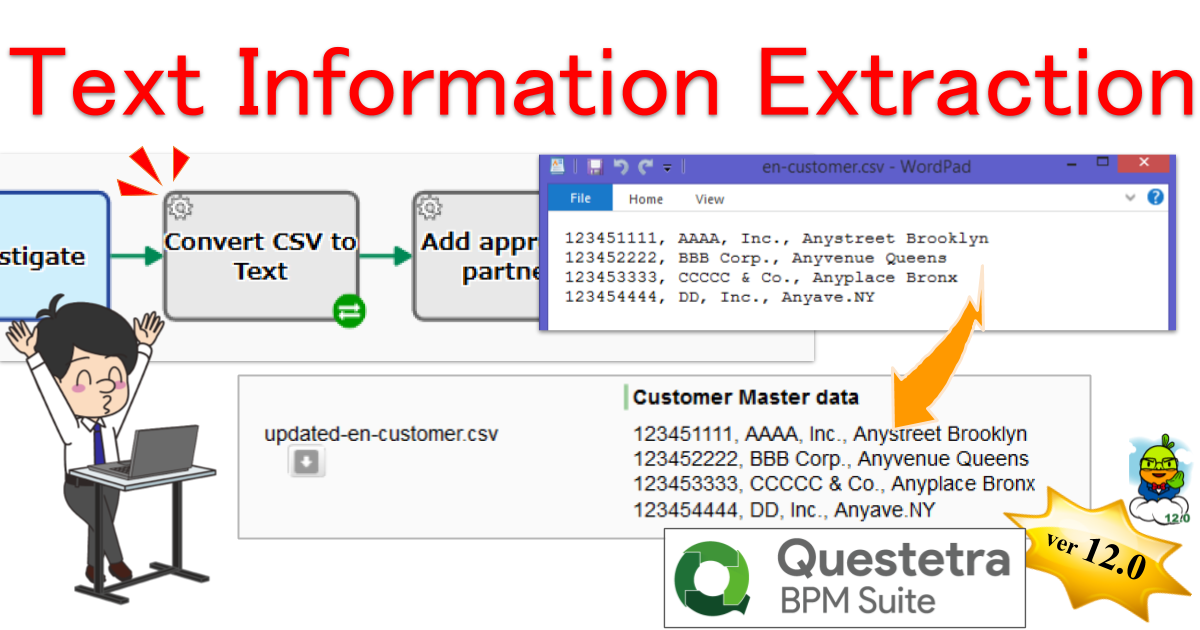
Kyoto, Japan, May 11th, 2020, Questetra, Inc., the global SaaS provider of Business Process Management (BPM), today announced that they have published the new version 12.0 of the Cloud-based Workflow product “Questetra BPM Suite” on May 11th, 2020. This new version is capable of extracting text information from the files, such as CSV, or HTML that are stored in File-type Data Item, and stores it into String-type automatically.
In daily work, various text files are used. Various files such as “master file” that is, for example, Supplier CSV or “Draft file” like newsletter email HTML are used. But the effort of checking the contents of the file is not a few.
With the new version 12.0, an automatic step that converts text files to string data is now available as one of the standard features. By equipping this automatic Step in a business process, the labor of downloading and opening the file is eliminated. In the Credit Check Process of a supplier, for example, the processing of adding the approved supplier information to the existing supplier CSV file will be fully automated using together with other automatic features. It is also possible to eliminate the risk of intentional information deletion or tampering with the contents.
Questetra BPM Suite
Cloud-based Workflow “Questetra BPM Suite” is a business platform for realizing paperless environments and remote-working. Business issues are controlled according to a Business Flow Diagram. When a Process reaches, a Human Task the user will be asked to add their input. Also, when an issue reaches an automated Step the predetermined processing (server-side processing) such as “Generate PDF” and “Save to cloud storage” is performed automatically. (BPM: Business Process Management)
You can apply it to various business operations such as “Approval request flow”, “Document translation flow”, Quality check process, “Invoice issuance process”. Process owners of each Business Process can practice the “improvement of Business Processes” little by little in daily work. (Examples of Business Flow Diagram: https://questetra.zendesk.com/hc/en-us/articles/360012492211 )
Automatic Text Information Extraction
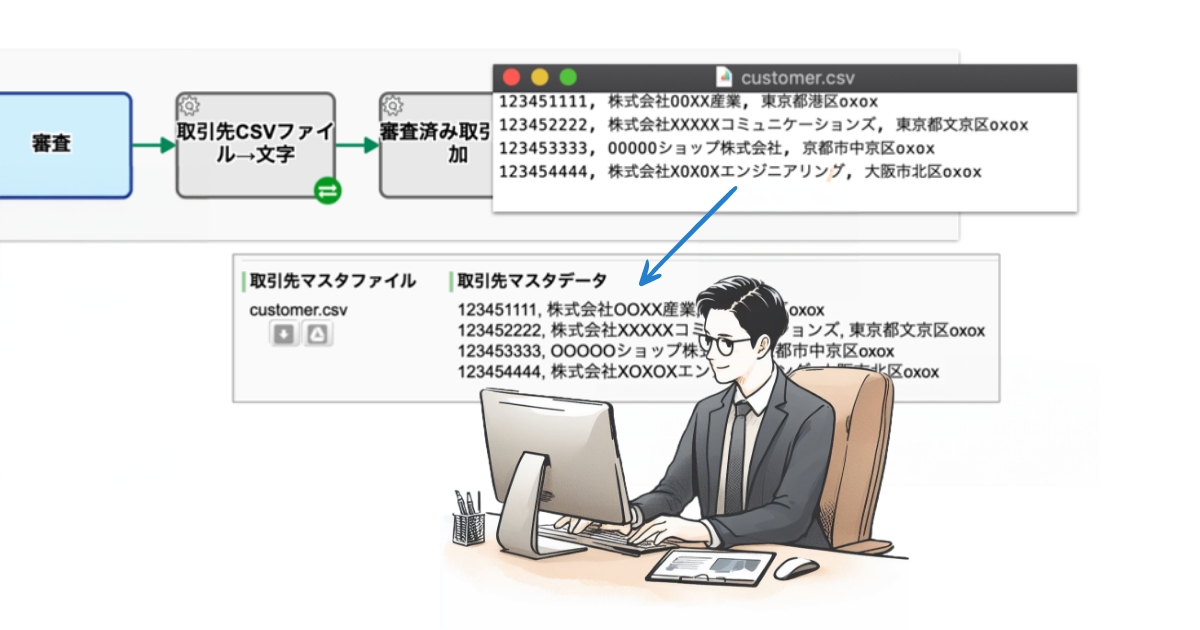
It is now capable of extracting the content of a text file into a String-type Data Item automatically. You can now confirm the contents without downloading the file, for example, the Customer Master that has been set to File-type Data Item. (Converter (Text File to String type data))
Text File Auto-extraction Settings
Other Improvements
Service Task (Throwing Message to Start Event)
It eases the configuration that sending a request to a Message Start Event (HTTP) on the same workflow platform to startup. You do not need to specify the access URL or parameter name, just specify the value of the data to be sent, and you will be able to achieve the “configuration” described above.
Enhanced HTTP request transmission
In the Throwing Message Intermediate Event (HTTP), you can now specify the Content-type when specifying File-type Data Item in the request body. You can set any character string such as “application / octet-stream” so that it will be possible to flexibly respond to API requests of other cloud services.
Official release of HTML5 Modeler
The Flash modeler has been discontinued, and the App editing function (HTML5 modeler) using HTML/Javascript has been officially released.
クラウド型ワークフロー『Questetra BPM Suite』は、ペーパーレス環境やリモートワーク環境を推進するための業務プラットフォームです。業務案件は業務フロー図に従ってコントロールされ、案件が人間工程に到達すれば担当者はアウトプットを求められます。また、案件が自動工程に到達した際には、「PDFの生成」や「クラウドストレージへの保存」といった既定の処理(サーバサイド処理)が自動的に行われます。(BPM: Business Process Management)
最近(2019-10)最大参加者数が、(G Suite Business の場合)、「25人」から「150人」に増えたトコです。加えて、昨日(2020-03-04)、新型コロナウィルス感染症(COVID-19)の流行拡大により、一時的に「各会議の最大参加者数は250人に引き上げ」られたそうです(録画もデキル!)。
As mentioned in the post “Expansion of Service System“, the service system will be changed on July 1, 2020. At that time, reception for the Starter Edition will be closed and a new Trial mode (free) will begin.
Details of the “Trial mode”
Trial mode is a free service for Basic, Advanced, and Professional editions in the new service system from July. When you apply for Trial mode, you will be asked to select the edition to use.
Price: Free
Number of Users that can be registered: 100
Features: Equivalent to the edition you choose (either of Basic / Advanced / Professional)
Period: 60 days (*1)
Service launch: July 1, 2020
*1 The period cannot be extended. *2 The access URL for the workflow platform of Trial Edition is required when applying for the paid Edition.
The expiration date of “Starter Edition” that will be discontinued
The free Starter workflow platform you are using will be closed at the end of December.
Expiration date: The end of December 2020
Reception end date: The middle of July 2020
If you migrate to a paid Edition (either of Basic/Advanced/Professional/Enterprise), you can continue to use the Business Process Definition and Business Data from January 2021 onwards. (Please apply by December 2020)
You can migrate some of the data created in the Starter’s workflow platform to a paid or trial workflow platform for yourself. For how to migrate, please refer to the following “Appendix; Data Migration Procedure”.
*The service of Starter Edition will be automatically stopped if you do not use it for 15 days. Requests for restarting suspended services will be accepted until the end of June 2020.
Appendix; Data Migration Procedure
Data migration is performed in the following procedure.
Export data from Starter’s workflow platform
Import to (migration destination) workflow platform
Some of the data of the workflow platform can be migrated and some cannot.
Organization/Role/User information Can be migrated
Workflow Apps Can be migrated
Business data Export only
Open Chat Cannot export
This section introduces how to export/import Organization/Role/User information and Workflow Apps and how to export Business data.
How to export Organization/Role/User information
Log in to the Starter workflow platform with a User who has “User Manager Authorization” and do the following operations.
After logging in, click on your User name at the top right corner and click on [System Settings] in the dropdown menu
Click [Organizations List] on the left menu
Click on [Download All] above the Organization List and select [CSV Download (UTF-8)]
The organization information CSV file will be downloaded
For the Role/User information, replace “Organization” in the above description with “Role” or “User”.
How to import Organization/Role/User information
Log in to the Starter workflow platform with a User who has “User Manager Authorization” and do the following operations.
After logging in, click on your User name at the top right corner and click on [System Settings] in the dropdown menu
Click [Organizations List] on the left menu
Click on [Import Organization] above the Organization List
Click on [Browse…(or Choose file)] button and select CSV file of Organization information
Click on [Confirm] button after you confirmed the contents of the CSV file has been set into the field [CSV Text]
Click on [Add] button
For the Role/User information, replace “Organization” in the above description with “Role” or “User”. Organizations and Roles related to User information must be registered before importing User information.
How to export Workflow App
Log in to the Starter workflow platform with a User who has “App Administrator” Authorization to the target App and do the following operations.
After logging in, click on your User name at the top right corner and click on [App Settings] in the dropdown menu
Display the details screen of the target workflow App
Click on the [Detail] button of the version you want to export from the version list to display the target version
Click on the button labeled [▼ Version **] just above the Workflow Diagram and select [Export Archive] on the dropdown
The archive file is exported (downloaded)
How to import Workflow App
Log in to the migration destination workflow platform as a User who has “App Creator” authorization, and follow the procedure described in the section “2. Import” on the page linked below.
Log in to the Starter workflow platform as a User who has “Data Viewer” authorization, and follow the procedure described in the page linked below to export (CSV download).
Going Paperless and Cashless, and Others for Improvements in Business Efficiency
I’ve developed a minor service for 12 years which manages business processes (Cloud-type Business Process Management: SaaS BPMS). I have got many opportunities to advise on “process improvement”. However, in some cases, I have some trouble providing an answer because the current process (As-Is Process) is so far removed from the digital era, so of course, they’re forced to use traditional methods. In this article, I reconsider the mindset as an adviser, an expert, and a consultant to handle such cases in the age of digital transformation.
Table of contents of this article
1. Paperless
I think paper documents (e.g. documents for plan, report, approval, estimate, invoice, etc.) are not necessary for the following reasons:
The amount and thickness of the paper can be intimidating.
You will get a sense of relief by seeing the documents stored in a steel library.
You feel a sense of accomplishment just by searching for documents (and copying them).
However, the purpose of paper documents is just to deliver information, their look and feel are meaningless if the business doesn’t proceed smoothly.
Today, there are a lot of communication tools instead of paper documents and most of them require less time to process. However, you may be worried about the following things:
The authenticity is suspicious
IT deployment and operation cost
Learning security cost
Your handwriting may be bad
The sales of the printing shops and stamp shops may drop
Copying and shredding work may disappear
As for history, the “hikyaku messenger” system was replaced by the postal system (and later, the Internet) as a public communication infrastructure because it was quite wasteful and expensive. Paper documents are no different from that. I honestly believe that the traditional way of passing around a paper document will disappear. At least, your routine work should be able to proceed without relying on this.
Basically, paper documents don’t have a “search” function.
The people in charge of promoting business process improvement should first regard “paperless” as the standard.
*In order to digitize these tasks, you should utilize email systems and workflow systems, for example, you need to establish a corporate account based on cloud offices (G Suite, Office 365, etc) plus cloud workflows. In addition, I suggest you use cloud storage (Box, Dropbox, etc) in parallel with these cloud products.
*As for national strategy, I suggest that the government try to change the legal text that values paper documents (It would require a lot of political power, though), which means the government can regard the digital documents as legal documents.
2. Cashless
I think cash (bills and coins, petty cash, change, etc) is not necessary for the following reasons:
The amount and thickness of cash can overwhelm you.
You will get a sense of security by seeing cash stored in a cash box.
Moreover, you feel a sense of accomplishment even by calculating the total.
However, the purpose of cash is just to transfer money (payment) and there are no companies where wages are paid in cash.
Today, there are a lot of payment tools besides cash and most of them require less time to process. However, you may be worried about the following things:
You need petty cash to buy stamps.
You may have a problem with paying on delivery
Some people have to reimburse others for unexpected expenses
You may hesitate to use cashless payment.
You may forget the benefit of sales.
Management of bills and coins may become unnecessary.
(Are you worried somehow?)
As for history, the system of exchanging value (deciding the value by weighing coins) such as using gold and silver was replaced by the “managed currency system” (currency by table: just count the number of notes and coins) by the state power because the former system always starts with weighing and the exchange procedure was complicated. Cash is no different from that. I honestly think that the traditional payment system with cash will disappear. At least, your routine work should be able to proceed without relying on the traditional payment system with cash.
Basically, notes and coins have a cost for their security.
The people in charge of promoting business process improvement should regard “cashless” as the second standard.
*In order to digitize these tasks (both procurement and collection), you need to rely on online services and payment tools provided by financial institutions. For example, you have to open a corporate account based on city banks (Mizuho Bank, The Bank of Tokyo-Mitsubishi UFJ, Sumitomo Mitsui Banking Corporation, etc.) plus direct banks (Rakuten Bank, The Japan Net Bank, etc) or online payment services (PayPal, Stripe, etc). In addition, I suggest you utilize a corporate account of cloud-based accounting systems (Money Forward, freee, Yayoi Online …) to widely manage that data.
*As for national strategy, I suppose cash should be inconvenient and disadvantageous. For example, the government implements the devaluing of currency by continuing to give reward points for cashless payment, discontinuing large denomination bills, and adopting a new currency system. (It will require a lot of political power, though)
3. Meeting-less
I don’t think meetings are necessary. (Strategy meetings, report meetings, and general manager meetings, etc)
# “Meeting” has some elements of an event so it is difficult for me to compare it with paper and cash because they are physical objects. However, the meeting is unnecessary!
I have some reasons:
If you just hold a meeting, you feel like explaining and discussing the project.
You feel like approval has been obtained because no objections were made.
The participants also feel like they are working for some reason.
Actually, the conclusion is often not determined even after the meeting is over, despite the purpose being this determine a conclusion. (Approval of budget, plan, payment, and accomplishment report, etc)
So, Why? I considered some reasons below.
The draft as the input for the meeting has not been refined. (Everyone should improve it)
The draft has only been explained verbally. (Everyone should supplement it)
A draft has basically not been created. (Everyone should consider it)
# Examples: a press release draft, a budget draft for acquiring the certification, a draft of the relocation plan of the office, a draft of the report on advertising effects in the month, and The draft Constitution of Japan, etc.
What you must remember is that the conclusion is only determined based on drafts. You can’t determine the conclusion no matter how many meetings you have: you shouldn’t hold a meeting without any drafts (Input).
As a precaution, you should create a business process where a draft is completed before you hold a meeting. When you draw a business process diagram, you first need to set it up to have the Task of creating a draft complete at the upstream Step, and second, you can set the Task of convening a meeting. Plus, you can set the Task of reviewing the draft as well.
A well-organized draft consequently helps the following things.
Participants only need to express their agreement or disagreement in the meeting.
You only have to ask a few questions.
You just take a majority vote even if there are pros and cons.
(Even if the draft is rejected, its creator can rework it.)
Besides, meetings are tough for those who have a lot of business trips or are in a different time zone (or who are telecommuting).
The people in charge of promoting business process improvement should regard making improvements to become meeting-less as the third standard. (Reducing frequency/time)
Depending on some cases, the meetings may be implemented online or the approval may be done in the workflow system.
4. Aiming for automation and saving
For improving business processes, business knowledge is essential.
Furthermore, much motivation is also required.
Plus, the content of reforms must be supported by colleagues and supervisors.
In other words, improving business processes is a very stressful job.
For example, I think it is a luxury if a railway worker continues to be dispatched to sell tickets even though the automatic ticket gate is invented, a paper invoice is mailed by a seller and a buyer continues to manually enter the data in the mail. And if the commodity manager orders an old computer, a payment order for the warehouse clerk and a receipt order for the section chief are made, moreover, the warehouse clerk manually updates the record book of merchandise in and the department chief manually updates the record book of merchandise in service in response to the order.
An excessive thing destroys an organization. I’m worried that the business process may be obsolete or anachronistic.
Therefore, it is necessary to do a review.
Only reducing excessive operations and automating the tasks can help you to continuously improve business processes.
The people in charge of promoting business process improvement must just keep trying.