Recently, some people told me “I totally don’t understand the necessity of a Workflow.”
I know that ordinary people may have never seen a Workflow diagram, have never worked along a Workflow diagram, so they will never even think about doing a Workflow diagram.
Therefore, going back to basics, I would like to summarize my thoughts about “need of a Workflow diagram and how to draw one.” (It’s gonna be a long one.)
Section 1: What is a “Workflow diagram” for?? Section 2: Reasons why you don’t have a “Workflow diagram” Section 3: Reasons why a “Workflow diagram” is hard to draw Section 4: The way to draw a “Workflow diagram”
Example of Workflow diagram for “Web Contents Creation”
1. What is a “Workflow diagram” for?
First of all, what is a “Workflow diagram”?
Sometimes they are named in different ways: “Workflow diagram,”“Flow Chart” or “Business Process Diagram,” etc. What they are is a “figure that shows in what direction the work goes.” In Japanese official documents, it is described as “Flow Chart of operations.”
The biggest feature of a Workflow diagram is that it is described graphically, whereas a work manual is written in words. A “figure to know the way to go” is shown in the Workflow diagram. The expression ‘flow’ and ‘diagram’ together means “a diagram showing overall flow”. You can understand the entire flow more quickly by seeing a diagram than by reading the words.
The idea of a Workflow diagram is for all the workers to understand the following by themselves.
What part of the process of the entire business am I working on?
What should I receive (INPUT), create (process) and whom should I pass it to (OUTPUT)?
1-1) To share the current state of Flow, or the changes to the flow, within company 1-2) To tell the current state of the Flow internally 1-3) To report the current state of the Flow, externally
1-1. To share the current state of Flow, or the changes to the flow, within company
This is the most important point.
If you try to make progressive discussions about, for example, “increasing the productivity of the entire team by devising the flow of work ” or “Consider the information transmission procedure that does not cause fraud”, a detailed business flow diagram that represents the current situation is indispensable.
Even so… “To share the current state of flow, or the changes to the flow, within the company” is a purpose of usage on quite high-level. If you let workers create a Workflow diagram actually, those will be “individualistic” or different by “styles”, even for day-to-day work that they do casually. In other words, “flow of current situation” varies between individuals. Thus, there could exist the following examples of “individualism” in every company.
1-1-1. Complaint Handling flow
When writing reply emails for complaints, Mr.A asks his Boss to review all of them before transmitting, whereas Mr.B asks only occasionally.
1-1-2. Adding a New Web-contents flow
When adding a new Web page, Mr.A writes a draft after the designer has drawn the illustrations, then again asks for the layout to the designer, whereas Mr.B asks the designer for illustrations and a layout after finishing writing a draft.
Incidentally, you need to be careful with the expression “individual styles in Workflow”, because they often lead to big misunderstandings. Especially, you must not confuse the implications of the following cases.
-A. Individual styles in personal skill; ‘the quality of the deliverables varies from person to person.
-B. Individual styles in communication channels; ‘channels and procedures of transmission of deliverables will vary from person to person’.
I will discuss the “B” case’s ‘no rules for channels or task order’ in this article, but you need to be careful because “A” cases are often a matter of daily conversation. The expression of ‘Individual styles in Workflow’ is used in the cases of for example, “A1”, ‘the results vary from person to person because the Excel skills differ from person to person’, or “A2”, ‘the judgment standards are different for Director A and Director B’. Yet, the Workflow is standardized.。
1-2. To tell the current state of the Flow internally
The need “To tell the current state of the Flow internally” is easy to understand.
In particular, if there is a Workflow diagram, you can include new members to the team. When you have got new employees or personnel change, the newcomers can understand the approximate flow of work immediately if you give them the Workflow diagram saying ‘See? Our team is operating like this.’ A Workflow diagram will be a very effective weapon for companies in the business expansion period that are actively employing, or companies that have many regular personnel changes. There is no comparison with the classic “I will give you a copy of company regulations and business manuals”. (Definitely, they wouldn’t read it…)
You need to be careful with superiors who say “We don’t have Workflow diagram. We do OJT”. Certainly, On Job Training where trainees jump into the real world, might be one of the effective methods to join the work force immediately, on the other hand, it might become a cruel way of training. That is, rookies with less senior employee supervision must learn by themselves, as a result, they might go on without learning the flow of the business expertise. (They will end up building their own methods to do their job.)
1-3. To report the current state of the Flow, externally
Compared to the above two, the third one “To report the current state of the Flow externally” may have a little more of a passive purpose.
The most obvious example would be the internal control reporting system by the SOX Act. The listed companies submit their “Flow Chart of operations” to the Financial Services Agency to report that ‘we have got good governance’. And this helps protect investors. (However, just because we report, it does not mean that the worksite will become lively, nor does it mean that sales will increase…)
2. So, Why Don’t You have a Workflow diagram?
In the 1st section, we confirmed the purpose of the use of Workflow diagrams. Thus Workflow diagrams are indispensable.
Then why don’t you have one in spite of this necessity?
2-1. Incapable of creating. 2-2. Capable of creating, but don’t because it doesn’t make sense. 2-3. Capable of creating, but don’t because you don’t know who should do it.
2-1. Incapable of creating
“Incapable of creating” is comprehensible.
Something cannot exist if it cannot be made.
However, it is often the case. I want you to try to draw an actual familiar Workflow. Even if you are a hard-bitten, veteran employee, when you click on “NEW” in PowerPoint or Visio, you will have nothing to write in the blank canvas in front of you. It’s not because you don’t know the Business. Rather, you know it better than anyone else. Simply, the depiction of the Workflow is difficult.
I myself became capable of drawing a flow of almost all the businesses on the spot now (I’m bragging, I know) because I have experience of modeling about 500 business, but at first, it used to take 5-10 hours to finish just one. Moreover, there were still many points to improve when I woke up the next day. You will be forced to re-write over and over again for the first 10 flows.
2-2. Capable of creating, but don’t because it doesn’t make sense
“Capable of creating, but don’t because it doesn’t make sense” is potentially a serious issue.
However, cases like these are plenty. So, why do you feel ‘it doesn’t make sense’, then? It comes down to two reasons:
A) “Because a Workflow diagram becomes obsolete”, and
B) “Because you cannot control the flow of the business with only a Workflow diagram”.
As for the A) obsolescence of a Workflow, examples can be internal factors such as A1) ’Purchase of a personal computer was decided to procure collectively by Affairs Department’ or A2) ’the organization is reorganized and structure of the Department or team has changed’, and external factors such as A3) ’The need to halve the standard delivery time arose with the emergence of rival companies’, all of these would change the Workflow itself. At that moment, the Workflow diagram made with great pains becomes a thing of the past. I don’t have to say that the maintenance of them is difficult. Also, about B) Workflow is hard to control, although there may be some possible measures such as “sticking the Workflow diagram on the wall” or a “monthly training program”. Still, a Workflow diagram only written on paper is limited.
2-3. Capable of creating, but don’t because you don’t know who should do it
“Capable of creating, but don’t because you don’t know who should do it” is a serious problem.
It’s almost negligence. It may seem surprising, but it often occurs in mature organizations used to Workflow diagrams.
For example, when it comes to a smooth flow of operations between the Sales department and the Manufacturing department, conflicts of interest occur. These are the so-called cross-departmental Workflows. You must take on hard negotiations in a meeting to define, for example: ‘Hey, you guys at the Sales Department should check the order info before us!’. Not only do you need to be well versed about the business of the departments involved, but you also have to arbitrate them in the name of “overall optimization”. It’s human nature to avoid trouble. (This is related to organizational theory. After all, it seems that top management needs to appoint the “process owner (see below)”.
3. Why is a “Workflow diagram” hard to draw?
As I mentioned in “2-1. Incapable of creating,” drawing a Workflow diagram is difficult. Here, I want to study the reason why it is difficult.
By the way, I’m not going to discuss the drawing tools. Just as for painting, brushes and canvas are the tools. Rather, I’d like to discuss the causes of the difficulties of a subject, such as ‘a Galloping horse’ or ‘a nude’.
3-1) In fact, there are no rules 3-2) Wondering about the granularity of the process 3-3) Wondering about the range of exceptions
3-1. In fact, there are no rules
“In fact, there are no rules” is fatal.
Because there is no subject to draw. The Workflow you are going to draw seems like ‘a horse’ or like ‘a car’, or like ‘a temple’. You can’t draw a picture of something when you don’t know what it looks like.
Can a business be done without a Workflow (rule)? Well, yes, it can. All I can say is that humans are just amazing…
3-2. Wondering about the granularity of the process
“Wondering about the granularity of the process” is a phrase that should be spoken by the experts.
I have described the operational process of “replying to a complaint” in section 1, you can further deconstruct it as much as you want including, for example: ‘writing the title’, ‘writing the mail body’, or ‘reviewing’. You can go as detailed as you want to. Various granularities can be considered, but as a principle, the granularity of the process of the Workflow should consider what “an employee gets as input and makes as output corresponding to the aforementioned input.”
3-3. Wondering about the range of exceptions
“Wondering about the range of exceptions” is the ultimate problem. I may say even a never-ending problem.
Here also, as a principle, those exceptions that occur rarely should be omitted. There will be no end if you try to draw all the exception handling that occur rarely. And the more you do it, the harder it will be to see the whole. On the other hand even as I say this, for important businesses, there is a way to think about contingency plans or procedures. Even if they rarely occur, when they do, you would want to address them as soon as possible.
4. The way to draw a “Workflow diagram”
I’d like to discuss how to draw a Workflow diagram and who should draw it, based on the reasons why it is necessary (chapter 1), the reasons why there isn’t one (chapter 2), and the reasons why it is difficult to draw (chapter 3).
The Workflow diagram must be easily maintained, it must be convenient for everyone who uses it, and it must have a good effect on the company.
4-1. Changes in the sophistication of IT tools 4-2. Changes of the International Standard Notation 4-3. Changes in the Process Owner’s Mind
4-1. Changes in the sophistication of IT tools
Of course, I want to use IT tools. Computers are great!
Since 2000, the beginning of the 21st century, Information Technology has been developed based on the idea to “Leave data exchange on the business to the computer”. Even since the 20th century ‘Workflow Systems’ have existed. Now those have been greatly advanced by IT, and although it is not widely recognized it is called “BPM System”.
The concept is simple. It is devised so that if you instruct the computer in the business rules in the Workflow diagram, etc., the computer mediates the exchange of data between humans. That is, the computer determines “what the next step is”, “to whom should this issue go”, and designates the work appropriately. For example, someone creates a quote and registers it on the computer, the computer asks the boss ‘to check and to approve it’. And if someone writes a manuscript in Japanese and registers it on the computer, the computer asks the translator ‘to translate this into English’.
It doesn’t matter if it is 100 or 1000 tasks, the computer handles the progress of all the work in the company and designates the tasks one after another. It might sound bad, but human labor becomes “a piece of gear”. The computer brings the work, humans do as they are told.
By the way, this IT implementation would lead to reducing human jobs greatly as the industrial revolution did. However, humans may take new roles. Smartphones now memorize phone numbers for us, and we are OK with it. Don’t worry if a computer can beat human in a game of chess, writing novels or blog articles. There are lots of other things only humans can do.
4-2. Changes of the International Standard Notation
If possible, the Workflow diagram should be easy to maintain.
People around the world have been thinking about it together with different formats of the Workflow diagram (the way to draw icons and the way to connect them) have been proposed in the past.
Since 2000, a format of BPMN has been decided as the way of drawing the Workflow diagram, in conjunction with the “changes in the sophistication of the IT tools”. Although the format itself is evolving, it has become the de facto standard. It was led by IBM, Oracle, Microsoft and other major IT companies. And, as expected, it is rational enough to be understood by both humans and computers. (Questetra is not the only organization who proposes this format.)
Recently, the U.S. government and the Japanese government showed changes in the adoption of the Workflow. So that their government’s operations will be written in BPMN soon. (Keywords: ‘ Business/System optimization’)
4-3. Changes in the Process Owner’s Mind
‘Should I master the IT tools (BPM system), and learn BPMN?’ The answer is yes.
But there is a matter that is more important. That is to clarify who is responsible for maintenance of the Workflow diagram. They are called Process Owners. In other words, process owners should be determined for each Workflow in the company. Concurrent appointments may be alright in the beginning.
This is the most important issue in this article.
As well as for information systems and quality management, the employment of the Process Owner corresponds to “indirect investment”. It should look for very high return on investment in the medium term, or he or she must be a person who brings high returns on investment. Depending on the organization, they might hire a person who bundles process owners as one of the executives. In fact, many companies have the CPO (Chief Process Officer) position to serve as the person responsible for optimizing the Workflow enterprise-wide, as well as the CTO (Chief Technical Officer), who is responsible for the strategy and technology, and the CIO (Chief Information Officer) who is responsible for the information strategy. (There is also discussion about whether the COO and CFO should be involved or not, but I think a person with specialized knowledge of the “business processes” should govern the entire company.)
By the way, BPMN is for the computers. There is no need to understand BPMN deeply for generalists who want to improve the Workflow (including the process owner end user). However, they do need to work with Workflow diagrams and to be able to read the diagrams roughly.
So, what should process owners do? I think (though my thoughts correspond to 2013), it is a mix between A) “to learn the theory (knack)” and B) “to imitate the good practices”.
4-3-1. To learn the theory (knack)
About A) Theory, there are specialized manuals, for example, “BPM 100 Success Secrets”, but they are not yet the definitive textbook. (Though I think some easy to understand handbooks by the OCEB (OMG Certified Expert In BPM) will come out in the near future.) For now, it may be enough to check a variety of good books and magazine articles about how to draw the Workflow which has been around for a while now.
4-3-2. To imitate the good practices
A good example for B), is hard to find. It is, of course, because the skills to improve operational efficiency are not meant to be shared easily. It is a “source of competitiveness” in some cases. However, recently you can find templates and samples of Workflow diagrams on a web search. Like other companies, Questetra offers a site of operations templates called “workflow sample”. It has more than 500 Workflow diagrams, so I want you to come and visit our site and do a search.
5. Summary
Finally, an advertisement of Questetra, at last.
To tell the truth, Questetra is a company developing a ‘BPM system’, a dream IT tool. And we got the attention from Gartner, the world’s largest survey company, as a “Cool Vendor in the Global BPM”.
Moreover, Questetra is providing a “Free Edition”. I strongly recommend you try it. If you are a small organization or if you are a large company, how about trying it with a small team for free?
It is easy to use. All you need is a Web browser (SaaS BPM). I would like you to visit our “User Support site” see the Manual pages, tutorials, etc. The following are some summaries of its functions.
Determine the Flow.(Drag & Drop) To design a Workflow by placing icons. Each processing step (task) is represented by a rounded rectangle.
Determine the input item(Data Setting) To determine items needed for your business, such as String type, Date type, Select type. e.g. ‘Applicant Name’, ‘Reason for Request’, etc.
Set the Access Level To determine which item can be entered in which handling process. e.g.: ‘”Reason for Request” cannot be edited at the Approval Task’, etc.
Set the personnel To determine who (from which area/team) should handle the task. e.g. ‘Approval Task to Direct superior of the applicant’, etc.
Set the split rules To describe Split condition expressions. e.g. ‘If it is more than 5 million JPY, task must go to the President’
ー Innovating the world’s business through software!!
CEO: IMAMURA, Genichi; Questetra, Inc. (2013-01-18)
「ウチには業務フロー図なんてネーぜ。OJTだ、おー・じぇー・てー!」などと、カタカナ用語でごまかそうとする上司には細心の注意が必要だ。確かに、実際の現場に身をもって飛び込んでいく On Job Training は即戦力化と言う視点で有効な手法かも知れない。が、一方で「獅子の子落とし」的な残酷な教育訓練になってしまうケースも少なくない。すなわち、先輩社員のフォローが少ない新人は、自力でガケから這い上る羽目になり、結果として社内ノウハウとしての「業務の流れ」を教わらずに成長してしまう。(自己流の「業務の流れ」を作ってしまう?)
Kyoto, Japan — December 18, 2012 — SaaS vendor company Questetra, Inc. has published the new version 9.3 of the cloud-based Workflow product “Questetra BPM Suite”, which visualizes both of ‘Business Flow Diagram’ and ‘ Progress of each Project’, on Dec. 17th, 2012. In the new version, features for Business Process Outsourcers (BPO) have been enhanced.
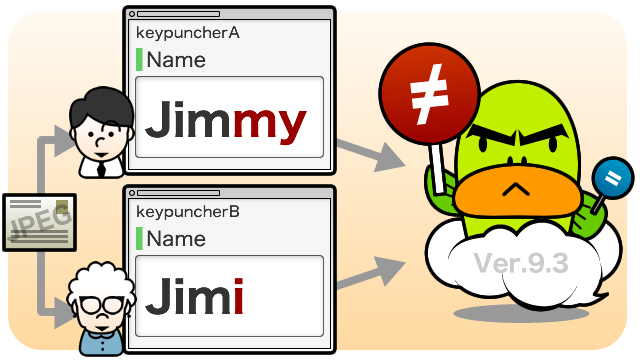
In the BPO process, in order to improve the quality of data, steps of ‘Comparing multiple data’ are installed. For example, supposing a simple commissioned business such as digitizing manuscripts from ‘postcard application’ ‘questionnaire’, or information of characters inside photo image. There a step, that verifying identity of two text data which have been input by two independent operators will be installed. (Verify input method)
Before the version 9.3, it was available only conditional expression by monadic evaluation, such as “the {Billing amount} is less than 1,000,000 JPY”, or “{Home Address} starts with Kyoto prefecture and includes Nakagyo-ku”. But in the new version 9.3, it is available to set conditional expressions by comparing two items, such as “{Billing amount} is greater than {Quote}” or “{Work Address} is the same as the {Home Address}”. From now on, it is possible to automate more verification processes for BPO business companies and other business which needs data verification.
Questetra BPM Suite
The Business process ‘To Be’ is changing day by day along changes in the business environment, penetration of cloud technology, and the evolution of mobile devices. We must aggressively think about “new business flow” that we’ve never thought in the past, such as approval with the Tablet for automatically generated quotes, quick response with the Smartphone to complaints, or manual preparation at home by telecommuting.
Cloud-based Workflow, “Questetra BPM Suite” is a service to build the flow of business on the Internet. Not only the “Workflow Feature (Task Processing function)” which enables to pass project data online, equipped as the standard also “Monitoring Feature” which visualizes the progress of Process, and “Modeling Feature” which is easy modifying the flow of Process with Drag & Drop .Not only providing complex business process quickly to IT, It visualizes processing records of “Who What and When” graphically. No need to know about neither Programming nor Server operation. Is also possible to find “business bottleneck” work “point of mistake” by workers and improve the flow of the business by themselves (Employee driven PDCA cycle). Questetra will contribute to the realization of paperless and eradication of human error.
1. Placing Icon of SPLIT Place a Split icon (Gateway) into Business Flow Diagram with Drag & Drop.
2. Setting SPLIT Condition Expression Open the Condition Rule setting in property, select business data to compare.
Questetra, Inc.
“Enjoy your Routine!” We are start-up company in Kyoto Japan, have been continuing to create Business Software, and working hard to organize the world’s Business Processes.
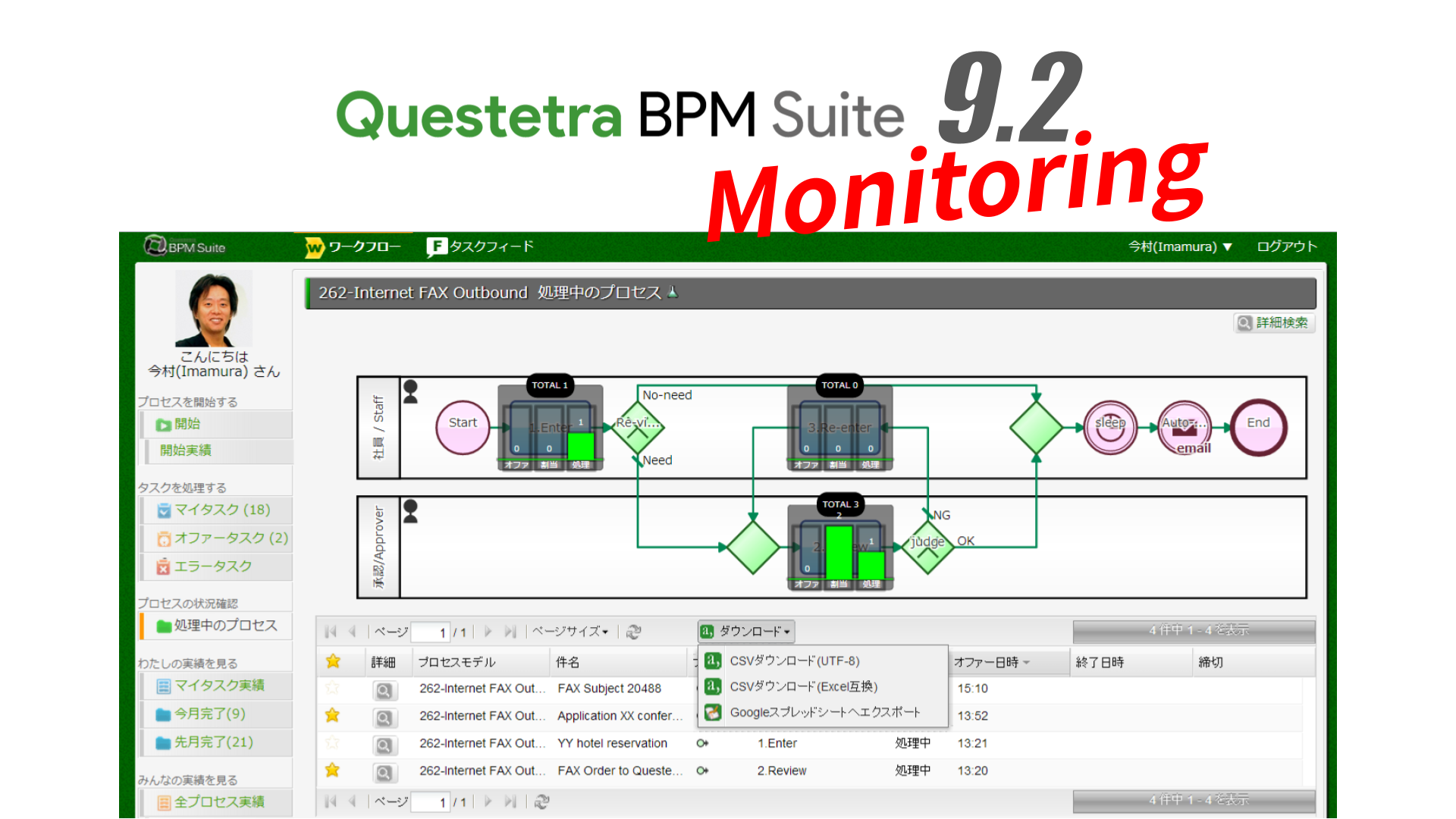
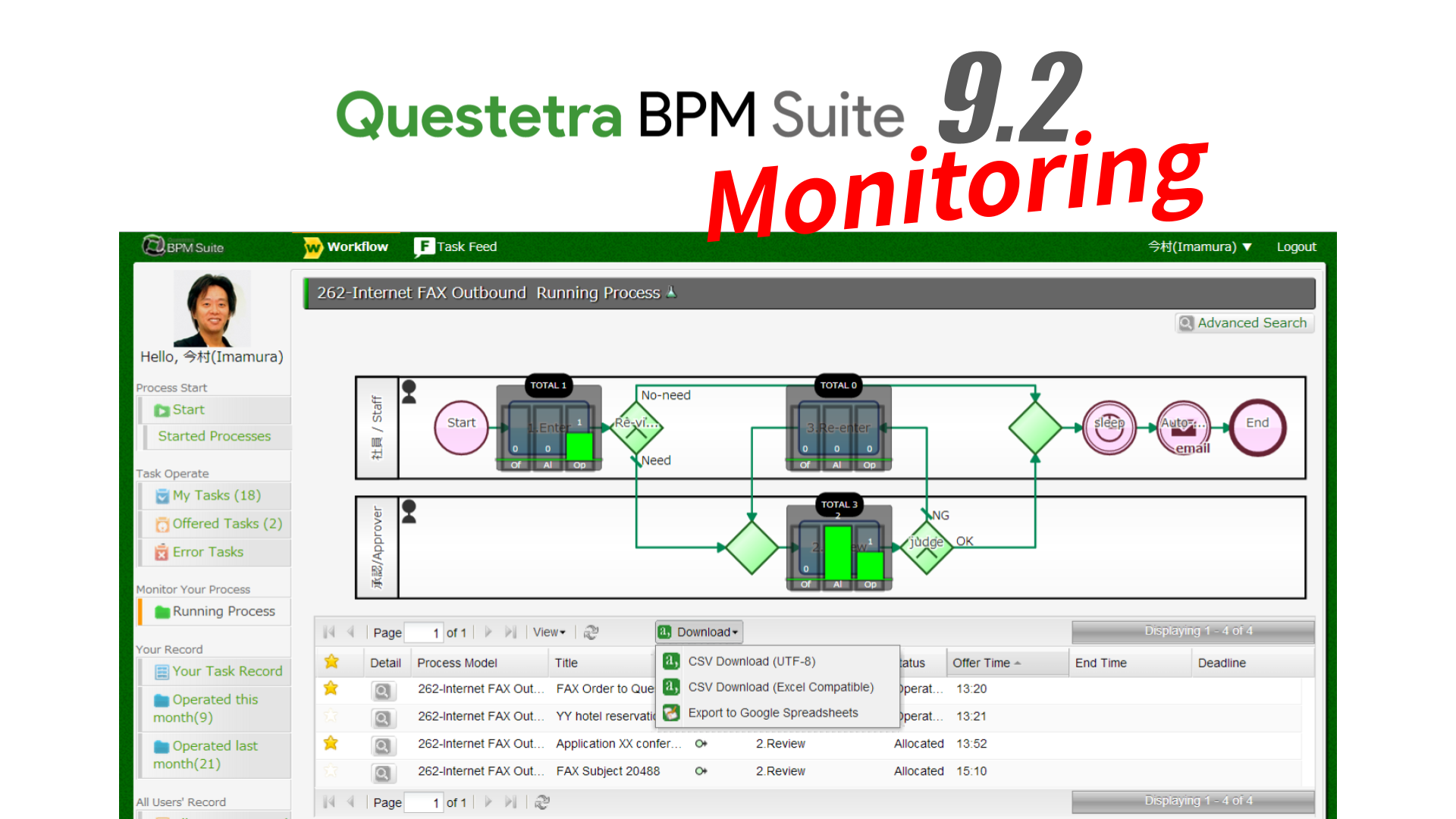
Kyoto, Japan — November 13, 2012 — SaaS vendor company Questetra, Inc. has published the new version 9.2 of the cloud-based Workflow product “Questetra BPM Suite SaaS Edition” on Nov. 13th, 2012. In the new version, it’s available to easily check, the progress of the projects that a User has personally involved, on the work flow diagram. By clicking the business process, it is also possible to display a list of projects that are stuck.
In the “Quote Approval Workflow”, for example, if a salesperson has been submitted for approval on multiple Quotes, the salesperson will be able to check what stage the approval is, easily on the work flow diagram.
Questetra BPM Suite
Questetra BPM Suite SaaS Edition, the cloud based Workflow system, is a service to design a flow of your Business on the Internet. It makes handling business data smoothly in various works such as Decision makings, Expense applications, Complaints support. Also, it helps continuous business improvement by visualizing ‘who did what’ and ‘time spent to process’.
Because it can be designed without programming even complicated conditional split or collaboration between Workflows, not limited to mere approval flow, it can be applied to various other business processes such as Customer Services, Marketing and Product Development. In addition, we are publishing more than 400 business templates which conforming to international standard notation (BPMN 2.0) for Free.
The jobs done by a User oneself will be able to be visualized in a Processes breakdown pie chart. Because the data list is narrowed down in the “click in the chart area”, you will be able to easily see the project you have recently worked with.
Monthly Operation Chart by one click – enhanced
The jobs done by a User oneself will be able to be visualized in a Monthly Task Operation bar chart. Because the data list is narrowed down in the “click in the chart area”, you will be able to easily see the project you have done in certain month.
Notification function to the Social Enterprise – enhanced
In the standard equipped social enterprise feature, a new original mascot character will inform the Task allocation. When the deadline is approaching or has been exceeded, it would tweet to you more gently. Watch out, sometimes it would turn into angry face.
Free Trial
Questetra is always issuing Free accounts on-line. There is neither functional limitation nor Usage expiration. Though, service will be automatically shutdown if not login for 15 days. And the number of users to be register is limited at 5 people.
Questetra, Inc.
“Enjoy your Routine!” We are start-up company in Kyoto Japan, have been continuing to create Business Software, and working hard to organize the world’s Business Processes.
Achieving Paperless Operations and Doubling Communication Speed
Achieving Paperless Operations and Doubling Communication Speed
Digitized the Detailed Plans for Gas Fitting
Q. What kind of operations do you use Questetra BPM Suite for, as a company running a gas business in the Tokai region of Japan?
Toho Gas is a general gas utility company that serves the three prefectures of Tokai. Its service area covers 54 cities, 20 towns and 1 village in Aichi, Gifu and Mie prefectures.
We used to circulate paper-based forms with detailed information from gas construction companies, which were discussed internally. It used to take two whole days for the paper form to circulate through to each office.
By using Questetra BPM Suite not only has the process become paperless, but it can be completed in one day. Unlike paper forms we can easily check how each case is being processed, and also corrections can be done on the system which is very satisfying.
Q. Are only employees using the system?
Since this is a system for discussing construction plans, not only the employees of TOHO Gas Co., Ltd. but also some of the construction companies participate in the workflow as well.
Easy and Intuitive Modeling Functions
Q. How satisfied are you with Questetra?
Because of the ability to freely configure the workflow and data, we feel it is possible to apply it to a variety of tasks. In particular, I like the modeling feature because it is very intuitive and easy to understand.
On the other hand, there are many tasks which have to be recorded on paper documents eventually. So we would welcome if it supported paper output as a standard feature.
In addition, it would be great if there was some kind of mechanism where we can enter addresses into Questetra and have a map displayed that indicates the construction site.
Q. Please tell us your future prospects.
For the time being, we are at the stage of using Questetra in only a few offices, but we want to expand the use to various other operations and other offices in the future.
Consignment IT consulting, IT support, system development, and system operation and maintenance
Industry
Hitech
User Departments
Accounting, Approval Flows
Modeling the Complex Circulation Flow of Expense Procedures
A System in which Business Rules are Complied with Naturally
Q. Which business are you applying Questetra BPM Suite for?
JTB group are developing a variety of businesses with travel business as its core, and we are going to celebrate our 100th anniversary in 2012. JTB SYSTEM SOLUTION, INC. (JSS) are in charge of providing IT services to the JTB Group companies.
We are applying the Business Process Management system (BPM) to tasks such as Expense planning (drafting) and Settlement, and using it in conjunction with Google Workspace (formerly G Suite). Before introducing the system we circulated paper documents to make decisions, which led to problems with the time spent confirming the circulation route and the time required to complete circulation. Now we can visualize who processed what and when.
*The name of “G Suite” was changed into “Google Workspace” in October 2020
Q. Does It Help to Strengthen Compliance?
At JTB SYSTEM SOLUTION, INC. we are aiming to ensure compliance with internal rules and regulations under the compliance message of acting with fairness.
Sometimes it took time to verify and correct, because the drafters themselves needed to determine who was responsible for making settlements in accordance with the business rules, and had to make paper documents according to this. But after applying BPM they naturally follow the business rules since the content of business rules are incorporated into the workflows. In addition, we believe that internal controls have been strengthened by recording the processing date of each step unaltered, etc.
Balancing Compliance and Operational Efficiency
Q. Has the time taken to make a decision been reduced?
I think the biggest contribution to the reduction in processing time was the decrease in reworkings due to mistakes. That is, it was difficult for all employees to keep track of the different approval routes for different expense items and amounts.
I also think the ability to detect a bottleneck in operations and the ability to do approvals from out of the office with smartphones is contributing to improved business efficiency.
Q. Please tell us about your future developments.
We are trying to extend the scope of coverage to include the approval process for contract documents.
In particular, contract documents of the orders are frequently exchanged between the headquarters and the local offices. We would like to challenge them together by eliminating paper.
Kyoto, Japan, September 19, 2012, SaaS vendor company Questetra, Inc. has published the new version 9.1 of the cloud-enabled Workflow product “Questetra BPM Suite SaaS Edition”. We have enhanced the auto-assignment of business data for this new version. More specifically, in addition to “the ability to assign an initial value (the default value) at the start workflow” and that “the ability to automatically calculate the aggregate value at the time of data entry, etc.” so far, we have added ‘the ability to assign a data at any business point’.
For example in the ‘Quote Approval flow’, it provides the auto-processing on ‘Calculation of consumption tax for the entered estimated amount’ or ‘Setting the quote expiration according to the estimated amount’ after entering the details of the Quotation. You can reduce the time with data entry, reduce miscalculation or reduce errors in applying in-house rules.
Questetra BPM Suite
Questetra BPM Suite SaaS Edition, the cloud based Workflow system, is a service to design a flow of your Business on the Internet. It makes handling business data smoothly in various works such as Decision makings, Expense applications, Complaints support. Also, it helps continuous business improvement by visualizing ‘who did what’ and ‘time spent to process’.
Because it can be designed without programming even complicated conditional split or collaboration between Workflows, not limited to mere approval flow, it can be applied to various other business processes such as Customer Services, Marketing and Product Development. In addition, we are publishing more than 400 business templates which conforming to international standard notation (BPMN 2.0) for Free. (Workflow Samples: https ://en.workflow-sample.net/)
New Features of Ver. 9.1
Data Assignment function – Enhanced
We have enhanced the ‘Service Task (data assignment)’ which can be layout in the middle of the Workflow. Business data is automatically assigned according to the mathematical expression and calculation formulas, when the process has reached the “(setting data) service tasks”. Combined with a split conditional (gateway), you can build a business processing environment that complies with business rules. Values that can be assigned are as follows.
‘Numeric type’ business data (e.g. total estimate, consumption tax, the total cost …): Arithmetic operation result
‘Datetime type’ business data (e.g. payment deadlines, reply deadline): Combination of the beginning or the end of a month, and adding days or subtraction of time
‘String type’ business data (e.g. reception number, quote ID …): String concatenation and The results of date and numerical data format conversion
Business Data Search function – Enhanced
We have enhanced the Search filter function of business data that flows through the workflow. You can create a search filter which behaves differently depending on the person who performed the search, such as ‘Approval document which the approver is “me”‘. And you can create a search filter which behaves differently depending on the time when search is performed, such as ‘Projects which begin on or after “Today”‘. It is also possible to share relatively and complex search filter, such as ‘Quotes which I had issued as the sales representative, and have not expired in that moment’.
Other Additional Functions and Specification Changes
Enhanced sorting to the list of search results (e.g. Sort by Workflow step name; Task name)
Capability to control auto-post to SNS-house per Workflow, etc.
Free Trial
Questetra is always issuing Free accounts on-line. There is neither functional limitation nor Usage expiration. Though, service will be automatically shutdown if not login for 15 days. And the number of users to be register is limited at 5 people.
“Making Fun out of Routine!” We are start-up company in Kyoto Japan, have been continuing to create Business Software, and working hard to organize the world’s Business Processes.
Kyoto, Japan, August 21, 2012 SaaS vendor company Questetra, Inc. has published the new version 9.0 of the cloud-based business process management “Questetra BPM Suite SaaS Edition”. Since the publishing of version 8.0 which equipped with Enterprise Social, it has been major upgraded after about 1 year.
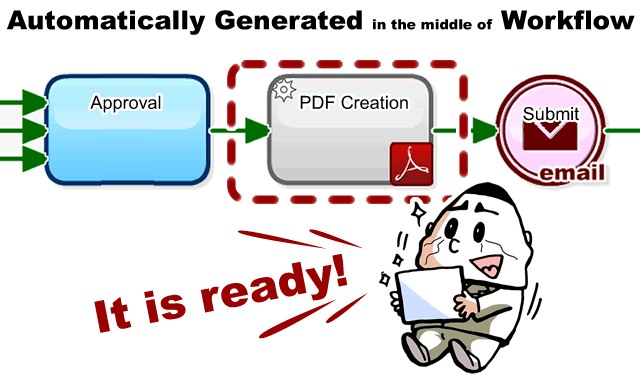
The new version has added features to streamline the daily business such as automatically generate a “PDF forms that business data has been inserted”. That is for example, it makes possible to automate process such as, generating Quotation PDF from quote data which has been approved in a Workflow, attach it to an email and send to the Sales person in charge.
Questetra BPM Suite
Questetra BPM Suite SaaS Edition, the cloud based Workflow system, is a service to design a flow of your Business on the Internet. It makes handling business data smoothly in various works such as Decision makings, Expense applications, Complaints support. Also, it helps continuous business improvement by visualizing ‘who did what’ and ‘time spent to process’.
Because it can be designed without programming even complicated conditional split or collaboration between Workflows, not limited to mere approval flow, it can be applied to various other business processes such as Customer Services, Marketing and Product Development. In addition, we are publishing more than 400 business templates which conforming to international standard notation (BPMN 2.0) for Free.
New Features of Ver. 9.0
Automatic Generation of PDF Document
‘Service Task (PDF generation)’ is available to place in the middle of Workflows. Different from ‘Normal Tasks’ that allocate Tasks to human on Process arrival, it processes automatically by itself within the System. The System automatically inserts business data into where specified by the template (PDF Form), and save it as a new PDF file. It makes available to automate various document creation, not only Quotations or Invoices, even “year-end adjustment declaration form” or “letter of appointment”, as well. Sorry not available for Download Edition.
Email Conjunction Process Start Feature
‘Message Start Event (email)’ is available to place in the middle of Workflows. Email reception at specific email address will trigger to start a New Process automatically. Available to capture the Subject, From, and Body of the email, etc. as business data. Sorry not available for Download Edition.
Other Additional Functions and Specification Changes
Many other features have been added such as the feature that any “Workflow Designer” can manage Choices type data (Master File) across Business Processes, the feature of repeatedly alert when exceeded deadline, and so on.
Free Trial
Questetra is always issuing Free accounts on -line. There is neither functional limitation nor Usage expiration. Though, service will be automatically shutdown if not login for 15 days. And the number of users to be register is limited at 5 people. See the detail of Free SaaS HERE. https://questetra.com/en/free-trial-en/
Questetra, Inc.
“Making Fun out of Routine!” – We are start-up company in Kyoto/Japan, have been continuing to create Business Software, and working hard to organize the world’s Business Processes.