Digitization of service application forms that have frequent format changes
Q. What kind of business are you using Questetra for?
We, Synergy Marketing Inc., are providing cloud services that support corporate CRM activities. Among them, our main product “Synergy!” is utilized for about 3,000 customers in various industries and business types.
We are using Questetra for the acceptance of new applications for services and requests to change service options.
Q. Please tell us how you are utilizing it specifically.
Previously we were working using paper application forms. Therefore, I had to ask around to the people in charge in more than one department when I wanted to know the progress status of an issue or the contents of an application, so I thought it was inefficient. Moreover, sometimes we got into trouble when urgent requests occurred or when the person in charge was absent.
By using Questetra to systematize the application handling process, we can now visualize the content of applications and the progress of cases. Also, since there are many requests for adding or changing the options menu on cloud services like Synergy!, Questetra is very helpful since we can easily modify the configuration (Process Model).
Moreover, we are using the Questetra’s SNS feature (Open Chat) for communications about Issues in progress. Thanks to that I think that we have been able to prevent mistakes and improve the accuracy of our work.
Data linkage with your own services using APIs
Q. Is there anything you have devised?
We are managing information concerning our customers using our own cloud CRM service, Synergy!
We have built the following scheme to make maximum use of that data, and make it possible to feed back the information entered in Questetra.
Input application details into Synergy! web form
Pass to Questetra to manage case progress
Return the processing result to Synergy!
This scheme allows us to eliminate wasteful double data input and to reduce mistakes or missing data.
Q. Please tell us what you think of Questetra.
Due to the complicated business requirements I had a hard time setting up Questetra, but I was able to successfully introduce it thanks to the accurate and speedy support of Questetra’s sales representative and customer service.
Also, half a year after introduction several requests have come up. Although some of them are difficult to deal with in Questetra’s current specification, we hope that the version update will help us deal with these requests promptly.
Information-sharing with Oversea sites used to be inadequate
Q. What kind of business do you use Questetra for?
Prime Polymer Co., Ltd. is a corporation that manufactures and trades synthetic resin.
You might have seen the abbreviations “PP” or “PE” in daily life. We manufacture polypropylene and polyethylene resins, which are widely used as raw materials for products such as plastic containers for liquid detergents or even reinforced car bumpers.
We introduced Questetra to manage product development requests from our overseas sites. We accept a wide variety of product development requests from our sites in North America, Thailand, China, India, Brasil and in Europe. We have systematized the procedures between the request and the response.
Q. What kind of challenges did you face?
For products led by overseas offices, each office considers specifications and production quantities, and then makes a request to the head office.
Previously, those requests had been filed in the workflow “Notes”. However, since we were operating Notes on the domestic intranet, it could not be accessed directly from overseas offices. Therefore, we had to summarise the request in Excel and email it to the person in charge in Japan, who would then register it in Notes on behalf of the requester.
However, we also had the following challenges:
Staff at overseas sites were unable to see how far their requests had been processed
A proxy applicant had to constantly provide feedback
There was a duplication of work in entering the request details in the first place
There was a delay due to the time difference
Now, we can eliminate unnecessary progress checks thanks to being able to understand the progress of all the requests easily. Also, I think we have become able to work more quickly.
In addition, now the duty of the person in charge of accepting requests is just to confirm the requests, so we don’t have to do the same work twice.
Collaborations with Other Cloud Services in the Future
Q. What kind of comments have you heard from Users?
I have heard someone say ‘I don’t have to worry about whether or not I’ve forgotten to do some tasks’.
In Questetra the work you must do will arrive in “My Tasks” automatically. So I suppose that the workers have peace of mind when they see the My Tasks list empty, which means all their jobs have been done and there is nothing left to do.
Q. Please tell us about what are your plans for the future.
In Prime Polymer Co., Ltd. we have been promoting improvement in productivity, and developed a system environment that contributes to the convenience of customers by collaborating with multiple business systems and databases.
Henceforth, we are planning to expand the use of Questetra to a wider range of departments and business operations. In this plan, we are going to build up the collaboration of the internal system with various Cloud services to find the best combination of services based on understanding each of their advantages, so that all the employees will be able to use each service seamlessly. That is our ideal.
Questetra has a variety of APIs, so in the end you can do anything you want with it, but we hope that it will evolve to be simpler and easier to use from the user’s point of view.
Stripe is an American IT company, operating in over 25 countries, that allows both private individuals and businesses to accept payments over the Internet. (Wikipedia)
Even though most articles focused on “…merchants and other businesses in Japan can use Stripe to sell goods in around 130 different currencies”, I thought its “Connect feature”, which allows us to automate “intermediary exploitation” (?), or its “Protection racket fee” (??), is ‘Super cool!’.
For instance, the desk work in a sales agency could become unmanned.
Well, this industry is always like that, even if they announce the “Landing in Japan!”
(Nobody expects…)
2. Impressions of the reference
It’s good.
I could skim it without getting lost, compared to Google’s reference in which I get lost in the links every time I visit it. To understand the functions overview, I would say it takes 30 minutes for the tutorials and one hour for the API references (as long as you are familiar with APIs).
Although, on the reference page, they tell you to “throw this CURL command in your own terminal!” when you haven’t even logged in. I don’t know how to say it, but I thought it’s very “pushy” or “masculine”…
Regarding to the sample codes, they insist “This is the simplest way!”…
It’s “manly” or “brisk” or…
However, I think it would be good for me to learn their ways.
Although this is my very personal and irresponsible opinion, I think people who are “admire burly young Stripe, rather than PayPal –which is getting old.” will come up.
# By the way, if there is anything you absolutely do not understand, I recommend you to make a functional comparison (or pre-learning) with “WebPay”, which is popular within Japan (which I also recommend), on their Website…
3. Basic structure of Stripe
To roughly summarize it, it manages:
A, Customer information / Credit card information in [Customers]
B, Billing information in [charge]
(That’s simple.)
Putting it simply, it registers A, and sends billing information of B1 B2 B3 B4 B5 B6 B7 B8 B9 to A.
4. Characteristics of Stripe
Even though I have experienced various APIs, such as Google APIs, mainly, kintone APIs, or “Corporate Number System Web-APIs”, etc. I think “Stripe APIs” are distinctive somehow…
Notably, the “Test Mode” is very easy to use.
Honestly, I thought Questetra (Cloud-based Workflow) should emulate its interface (or rather its design concept).
In fact, for implementers who are still anxious even after conducting tests to try the “utilization of APIs”. I suppose this system design, which handles in parallel “Test Mode and Live Mode” be contributing to push up the speed and the quality of the implementation to a higher level.
# More specifically, it distinctively uses the four keys (Basic authentication) and bravely disregards the “Grant Flow for OAuth”.
5. To call from Workflow
Well, naturally, in my role,
I tried accessing Stripe APIs from an auto-step in Questetra BPM Suite, a Cloud-based Workflow.
* The gray rectangles are auto-steps, and the blue rectangles are human steps.
The point is to delegate all the “information of Credit cards or email addresses” to Stripe, and Questetra storages only “A. Customer information”. (Steps in the first half)
* The actual data is like “cus_9K3Z1YSdyG6mvV”.
And after that, it will send “B. Billing information” to Stripe each time charge occurs. (Loop in the last half)
* As a matter of fact, the method of directly delivering information to Stripe from a browser using “Stripe.js”, and delivering only “cus_foobar” to the server, is the “Royal road”. (Even though there is a Cross site issue…)
Additional Notes (2017-09): For information on how to make browser communication with Stripe Elements, please see the following.
Incidentally, the Workflow diagram above seems quite a plain sample. However, it will become a full-fledged business Process by adding, for example, human steps such as “Confirmation of Completion schedule” or “Shipping of goods”, or auto-steps such as “Sending Thank-you mail” or “Sending invoice PDF”, etc. (This is a so-called “Modeling of a Business Process”.)
By the way, even though the ‘Credit card number should not be stored’ it is a quite important knack for the Credit card settlement business, you should record at least the last four digits of the number. (In cases where you could be requested “the card you charged to”) So in this example, I recommend you to make it overwrite the ‘Credit card number’ with the ‘last 4 digits of the card number’.
6. Concrete API calls
Here, I have packaged this automatic processing step.
This package will allow people who are not capable of writing Script to POST to Stripe APIs.
The following are brief explanations of the contents of the Add-on for people who want to create their own package.
At the first Step, information of [A, Customers], that is “information of a customer and Credit card” is sent in 8 parameters.
var responseJson = "";
var uri = "https://api.stripe.com/v1/customers";
var response = httpClient.begin()
  .basic( secretKey, "" )
  .formParam( "description", stripeDesc )
  .formParam( "email", stripeEmail )
  .formParam( "source[object]", "card" )
  .formParam( "source[exp_month]", expMonth )
  .formParam( "source[exp_year]", expYear )
  .formParam( "source[number]", stripeCardNum )
  .formParam( "source[cvc]", stripeCardCvc )
  .formParam( "source[name]", stripeCardName )
  .post( uri );
var httpStatus = response.getStatusCode() + "";
It POSTs ‘Name of the contract’ in “description”, ‘Credit card number’ in “source[number]”, and so on… Soon a reply “O.K. Memorized!” will be returned, then it will store the necessary information among that Response (JSON) into the Workflow side. (Customer ID and Last four digits)
At the second Step, information of the [B, Charge], that is the “Billing information” is sent in 4 parameters.
var responseJson = "";
var uri = "https://api.stripe.com/v1/charges";
var response = httpClient.begin()
  .basic( secretKey, "" )
  .formParam( "description", stripeDesc )
  .formParam( "customer", stripeCusId )
  .formParam( "amount", stripeAmount )
  .formParam( "currency", stripeCurrency )
  .post( uri );
var httpStatus = response.getStatusCode() + "";
It POSTs ‘Contents of providing service’ in “description”, amount of the fee in “amount”, and so on… Soon a reply “O.K. it’s charged!” will be returned, then it will store the necessary information among that Response (JSON) into the Workflow side. (Charge ID and Last four digits)
7. Conclusion
As for e-commerce systems of this kind, they used to build them on their own. (Until recently…)
There used to be projects to develop this kind of systems which cost $50K, $100K, $200K, all over the world. (Maybe still now?)
However, now we are able to build it easily, only with Stripe and Questetra. Something greater could be done if you connect to other Cloud services.
Thus, you are able to build up a system which would cost hundreds of thousands of dollars a few years ago, by yourself, in a few days, for Free!
(Of course, you must have a business idea, separately!)
I truly think it is becoming an awesome era…
Oh, one more important thing at the end…
Questetra, a Cloud-based Workflow, is FREE of charge!
せっかくなので、この自動処理工程をパッケージ化しておきました。これを使えば「スクリプトなんて書けないよー」という方でも、Stripe API への POST ができます。以下は「自分用のパッケージを作るんだー!」という方のために、Addon の内容をカンタンに説明します。(詳しいマニュアルはコチラ: M415自動工程業務プロセス定義で利用可能な自動工程を追加する)
Determine the priority of work by auto-detection of delayed projects
Q. What kind of business are you utilizing Questetra for?
MonotaRO Co., Ltd. is an Online mail order company that operates a mail order site called “MonotaRO”.
We sell all kinds of indirect materials on the internet, from common tools such as pliers or screwdrivers to electricity generators which cost tens of thousand dollars. Nowadays, we handle ten million products for the purpose of supporting manufacturing.
We are using Questetra as a platform for various day-to-day operations, such as product development and general requests.
Q. Please tell us about how you use it more specifically.
For private brand products for example, we plan products that reflect the needs of our customers day by day.
Specifically, we are planning products such as dry cell batteries and walkie-talkies under the MonotaRO brand, and there are always approximately 100 projects that are in the pipeline. We used to manage these projects using Excel, so it was difficult for us to determine which projects were delayed or which should be given priority. Since many of the projects have several Steps such as selection of suppliers or quality checks, the planning period can take several months.
Now, we have built a mechanism in Questetra to automatically detect delayed projects which greatly reduces the burden on the administrators.
Utilization range from Non-IT Departments to Auto-processing using advanced IT technology
Q. Please tell us the reasons why you chose Questetra.
Above all, it is excellent to enable employees outside of the IT system Department to design Business flows.
Actually, in the past we had to give up a company-wide deployment of a system, which had been used by the IT system Department, because it was very difficult for regular employees to use. In contrast, we are very thankful for Questetara because even regular administrative and operational staff are able to configure complex business rules by themselves.
As a result, workers in the IT department can focus on activities such as supporting the embedding of Script Steps (automated processes).
Q. Please tell us your plans of use expansion in the future.
Currently, Questetra is used differently by different departments.
I realized that there are still many inefficient in-house operations because their Business Processes are not well defined. I would like to promote further use of Questetra in these departments and business operations, specifically for activities such as in-house workshops based on best practices.
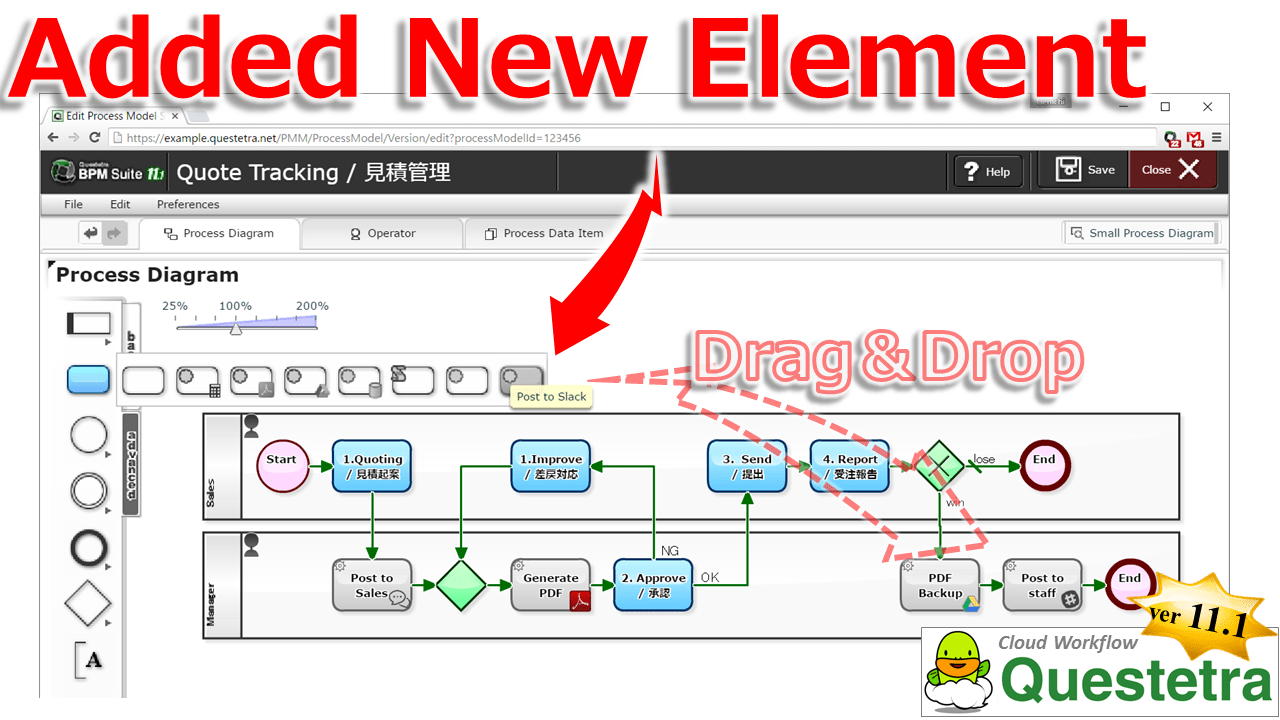
Kyoto, Japan – September 5th, 2016 – Questetra, Inc., the global SaaS provider of Business Process Management (BPM), today announced that they have published the new version 11.1 of the Cloud-based Workflow product “Questetra BPM Suite” on Sep. 5th, 2016. In this new version 11.1, Modelling Elements which were not included as standard functions, such as “Automatic submission to other Cloud” or “Automatic conversion to CSV format” are now available. (Service-Task add-on feature)
To formulate a “Quotation submission” into Workflow (Business system), for example, a Process-owner (administrator of business operation) would arrange several human-processing Steps and automated Steps to create a Business Process Definition (Modelling). Specifically, to define by drag & drop placement of Step-icons, such as #1) Drafting, #2) Approving, #3) Submitting, #4) Reporting the Result, #5) Storing the PDF of Winning Quotation into File Server.
Thus far, it was also possible for anyone to undergo the automation of processing easily with icons of pre-equipped Auto-processing Steps, such as “Auto-generation of PDF” and “Auto-storing to Google Drive”. However, in order to create an Auto-step icon for a processing that is not prepared as a standard Modelling Element, advanced configurations were required, such as writing a Script. With the new version 11.1, you are able to add Modelling Elements by importing Add-ons that specify data treatment and request procedures. That will allow you an easy drag & drop placement of Auto-processing Step icons, such as “Sharing Win-loss information with other departments on Slack”. This will help Questetra users to promote “Improvement of productivity” by using automated Steps.
Questetra BPM Suite
Cloud-based Workflow “Questetra BPM Suite” is a business platform for achieving paperless and telework environments. When a business issue “arrives” at a Step, a User (worker) processes it in a previously specified manner and enters the work result, then the issue goes on to the next step automatically. Its most outstanding feature is its drag & drop feature used in the configuration of the “Business flow”. This feature allows a Process-owner to iterate the Improvement cycle on his/her as a part of the day-to-day work. (BPM: Business Process Management).
Since it is applicable not only to simple business operations such as “Decision-making request” or “Document translation”, but also more complicated operations such as “Pre-shipment Quality check” and “Invoicing-Payment confirmation”, it allows to centrally visualize the progress of various in-house businesses.
Service-Task Addon feature
By importing Service definition files (Add-on XML) in advance, custom Service Steps (Service Tasks) will become available for Business Modelling. It is also possible to create definition files (Add-on XML) on your own, in case where you could not find what you want.
Other Improvements
Enhancement of Script Step
In [Script Task] (Script Step) for Auto-processing, “Method of HTTP request transmission” and “Method of Email transmission” are now available. This enables to complete external communication processing only by [Script Task], which had been thus far separately arranged as [Throwing Message Intermediate Event]. Also, due to the addition of external communication functions, time-out period of the Auto-processing Step will be extended to 30 seconds from two seconds. (Likewise, [Service Task] that has been added by Add-on XML will have a 30 seconds limitation.)
Renewal of Collective setting Functions in the Editing permission on all Human Steps
We have changed the access level configuration (read/write setting) which used to be a matrix structure of Processing-step and Business data, to a more graphical configuration screen. Moreover, the configuration of Access level is now able to be imported and exported in CSV format.
OAuth 2.0 for [Developer APIs]
Concerning [Developer APIs] which responds to requests from outside (Workflow APIs and System Settings APIs), OAuth 2.0 communication is available now. Although communication in Basic Authentication and in OAuth 1.0 is currently available, OAuth 1.0 has become deprecated and will not be supported in future versions.
technavio: GLOBAL BUSINESS PROCESS MANAGEMENT AS A SERVICE MARKET 2016-2020
… Business processes that are integrated with cloud services like software as a service (SaaS), platform as a service (PaaS), and infrastructure as a service (IaaS) are commonly referred to as BPMaaS. In recent times, it has been observed that many organizations have started adopting BPMaaS solutions to maintain product quality, remove inefficiencies in manufacturing processes, check errors, track design changes, enhance overall productivity and reduce costs, ensure time management, boost ROI, and improve time-to-market.
Exchanges JSON with Cloud Services via OAuth2 or Custom-Headers
Kyoto, Japan – May 23rd, 2016 – Questetra, Inc., the global SaaS provider of Business Process Management (BPM), today announced that they have published the new version 11.0 of the cloud-based Workflow product “Questetra BPM Suite” on May 23rd, 2016.
In this new version 11.0, it has become capable of communicating with more External APIs, for its automatic communication function has been enhanced. Specifically, it allows data federation with Core system which requires “Custom HTTP header” such as a Cloud database service “kintone”. This feature will allow configurations, e.g., automatic reference to “Client Master information” which exists external in the middle of “Estimate approval Process”, and automatic update of Common options file by “Daily synchronization Process”.
Questetra BPM Suite
“Questetra BPM Suite” is a multipurpose Cloud-based Workflow product (SaaS product) which is capable of “PDF Auto-generation” and “External connectivity”, etc. Using this product, you will be able to make various in-house processes going Online, not only simple business operations such as “Application procedure”, “Decision-making request”, or “Document translation”, also complicated operations such as “Service provisioning Process” or “Process of sequential operations to Bill issuance from Order acceptance”. (BPM: Business Process Management)
Its most outstanding feature is Mouse-driven configuration of “Business flow”. This feature allows a Process-owner, who knows the business should be, to continue to iterate the Improvement cycle on his/her own in day-to-day work. (Free for up to 10 Users)
Enhancement of HTTP Request Transmission function
Regarding Setting property of “Throwing Message Intermediate Event (HTTP)”, an optional “HTTP header” becomes available to be added. With this function, it is now capable of communication methods which adding header such as “X-Cybozu-API-Token:” or “X-ChatWorkToken:”, instead of having been capable of secure communications only Requests that were authorized by “OAuth 2.0 communication” or by “Basic Authentication” until now.
Regarding the feature to indicate current progress (current Step) on a Business Flow Diagram, “Route that passed through up to that point in time” has become obvious. In addition to “Current location of the Issue” and “Operator of the upstream Step” that have been indicated with icons, “Pass route” is shown in red arrow.
Dashboard
Regarding [Dashboard] feature which concurrently displays multiple Aggregation graph, it is now available to display, e.g. a line graph such as “Monthly change in the total amount of the order”, or a bar chart of “Weekly changes in total amount of Reimbursed expenses (Department breakdown)”. You are now able to display graphs from various aspects, in addition to being limited to “the number of Issues that operated by own” or “Bottlenecking in Decision-making Process (Heat map)” so far.
Hierarchical Select-box
You are able to set up hierarchical relation (dependency) among Select type data items. For example, when you select an option of “8: East Asia” at a Selection form for “Area” (out of 1: North America/2: Africa…./8:East Asia), in a Select form for “Country”, only “81: Japan/82:Korea/852:Hong Kong/86: China…” will be displayed. So far, additional description of JavaScript was required to achieve this, you are now able to set up easily by specifying the dependency. (Forward Match of [Options ID])
『Questetra BPM Suite』は、「自動PDF生成」や「外部接続」等をサポートする高機能なクラウド型ワークフロー製品(SaaS製品)です。「申請手続」「稟議承認」「文書翻訳」といったシンプルな業務だけでなく、「サービス提供プロセス」や「受注報告から請求に至る一連の業務プロセス」といった複雑な業務に至るまで、様々な社内プロセスを幅広くオンライン化することができます。(BPM: Business Process Management)