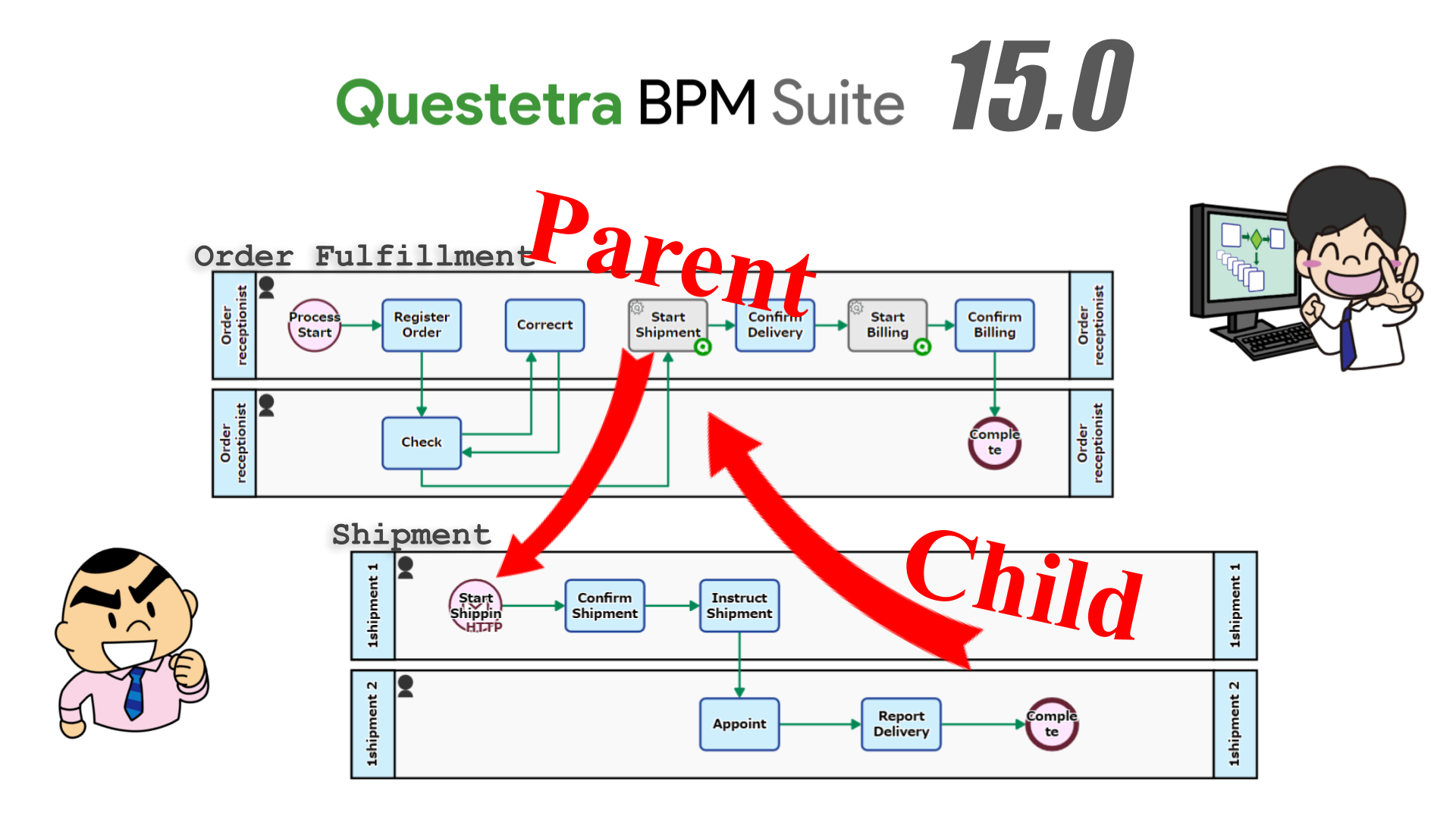
Kyoto, Japan, Apr. 16th, 2023, Questetra, Inc., the global SaaS provider of Business Process Management (BPM), today announced that they have published the new version 15.0 of the No-Code development platform Questetra BPM Suite. With the new version 15.0, data in Child Processes (Subprocesses) can be referenced from Parent Processes, enabling efficient division of business processes.
A business process, for example, that starts with order acceptance and ends up through billing, contains many detailed works such as customer registration, and multiple departments are concerned with those works. In such a large-scale business process, there were many needs to improve the process for each detailed work or to manage business data by each department. Questetra BPM Suite has responded to such needs with the function of dividing large-scale processes (sub-processing). However, it can be said that there was a problem that the management of divided data became difficult.
In the new version 15.0, the data of multiple divided child processes can be referenced from the parent process, so in addition to managing data for each child process, it is now possible to collectively manage data for all large-scale processes.
What is Questetra BPM Suite
Questetra BPM Suite is a cloud-based business process management system (SaaS BPMS). It has functions such as business flow designing, task automation, and progress management. Visualized business processes and API linkages improve business efficiency and contribute to the improvement of internal communication and collaboration. Because it is easy to customize, it is possible to manage business processes according to each organization. In addition, since it is cloud-based, it can reduce operating costs and be used in a remote environment.
Reference the Child Process data from the Parent Process
When the Child Process terminates, the data of the Child Process is automatically conveyed to the Parent Process. Only the data allowed in the Child Process can be seen from the Parent Process.
Waits for Child Process to complete
It is now possible to set to wait for Child Process to complete in the interprocess linkage settings. That is, for example, if you have built a mechanism that automatically starts the Shipment Process (Child Process) in the middle of the Order Fulfillment Process (Parent Process), the data (Delivery date, etc.) entered in the Shipment Process (Child Process) can be reflected on the Order Fulfillment Process (Parent Process) side.
Hello, this is Hayashi from the Marketing Department.
ChatGPT is on a roll, and continues to make headlines with the release of its latest version, GPT-4 in March 2023.
On the other hand, in the past few years, there have been whispers of AI unemployment, and jobs that will disappear as a result of such AI advances are often discussed.
As I wrote in a previous blog, I have a certain sense of crisis about this current situation from my perspective as a writer.
In this paper, I would like to consider AI unemployment, coexistence with AI, and how to utilize AI in business, using my own familiar job as a writer as a subject matter.
What jobs are (or are said to be) disappearing with the rise of AI?
In 2013, Michael Osborne, an associate professor at Oxford University in the U.K. and his colleagues published a paper indicating that;
47% of U.S. workers are at risk of losing their jobs in 10 or 20 years.
In 2014, Larry Page, then CEO of Google, and Bill Gates, founder of Microsoft, also spoke about the impact of technology on human jobs. Add to these trends the recent advances and practical application of AI, and it can be said that AI unemployment is now a real term that is being whispered about.
Under such circumstances, various media and people have predicted jobs that will disappear due to advances in AI. Of these jobs, those such as cashiers at convenience stores and supermarkets, train drivers, and call center operators are the ones that are most likely to be automated.
Other predictions include the commercialization of security robots and the decrease in cash transactions, which will affect the work of security guards and bank employees. Other jobs that are predicted to be taken over by machines include office workers, construction workers, cleaners, parcel delivery workers, and many others.
So what about the work of writers?
Especially after ChatGPT’s debut, there have been whispers about the possibility of AI unemployment in the writing profession. Not only ChatGPT, but other AI-based writing tools are already in use in the business world, and some newspapers and news agencies have begun to use such tools for their articles.
There are many different types of writers. Typical examples are interview writers who conduct interviews and write articles, copywriters who create advertisements, web writers who create text for the Web, and technical writers who create specialized text for instruction manuals and other documents.
I have experience as an interview writer, copywriter, and web writer, and I would like to consider what AI could be used for in each of these writing jobs.
Can AI do Interviews?
First of all, the most important part of an interview writer’s job is, of course, the interview. Hmmm, this seems like a difficult task to be left to AI alone, doesn’t it? However, at the 2018 Winter Olympics held in Pyeongchang, South Korea, an attempt was made to have AI create and distribute breaking news on competition results. There are also examples such as JX News Agency’s FASTALERT, which has AI collect and analyze information on disasters, accidents, incidents, etc. from SNS and distribute it as news.
More than 15 years ago, I was working as a news editor for a mobile site. My job was to select articles for the site from the many news items distributed by news agencies, create catchy headlines, and arrange the topics on the top page of the site. I also created and distributed news bulletins when there were results of high-profile sports games or obituaries of celebrities.
This is exactly the kind of work that AI can now perform.
Is ad copy AI’s forte?
Copywriters, on the other hand, usually create advertisements by incorporating keywords such as product or service features.
For example,
Producing sentences based on keywords
is where AI excels. Today, many novels and blogs are being created using text generation tools such as ChatGPT.
Humans will not be able to match the speed of AI, especially in cases such as EC sites and catalogs, where a large amount of ad copy is required for each product. Also, if it becomes as good as ChatGPT-4, it may be able to create advanced copywriting such as corporate PR. At the very least, ChatGPT could provide some useful ideas for copywriting.
When I was a copywriter, I often had to increase or decrease the number of words in a piece of text once it was created to match the space available for publication. Such rewrites can amount to an enormous amount of work when creating e-commerce sites and catalogs, requiring a great deal of time and effort on the part of the writer. Such work can be made dramatically more efficient by making better use of AI.
Also, I have no experience as a technical writer, but creating instruction manuals and specifications from specifications and other necessary data is another area where AI excels.
What Work Must Be Done by Human Beings?
Looking at it this way, it seems to me that most of the writer’s work can be replaced by AI. So, on the other hand, what are the tasks of writers that need to be done by humans?
If you are an interview writer, ChatGPT seems to be able to dig deeper into a story to some extent by repeatedly asking questions. However, the work of listening to a deeper story while sensing and empathizing with the feelings of the other person may currently only be possible by human beings.
I think this explains why counselors and medical/welfare-related jobs are said not to disappear even with advances in AI.
In the case of a copywriter, it is the human who decides the concept and direction of the advertisement. Conversely, however, it is possible for an AI to proceed with the rest as long as a human decides the direction. In other words, the director and AI will be able to produce advertisements, and writers will no longer be needed…
AI Replaces Tasks, Not Professions
Well, that aside, every job has various aspects, and there are parts that can be left to AI and parts that cannot. There have been some arguments against simply assuming unemployment will be caused by advances in AI, and some have suggested that such matters should be considered on a task basis, rather than by occupation.
The most famous of these is a study published by Melanie Arntz and her colleagues at the ZEW Research Institute in Germany, who pointed out that jobs themselves are not being replaced by machines, but only some of their tasks.
As already mentioned, a study by Oxford University in the U.K. reported that 47% of the workforce in the U.S. is at high risk of being replaced by machines within 10 to 20 years. However, a 2016 report by the Organization for Economic Cooperation and Development (OECD), based on the task-based theory of Arntz and colleagues, reported that an average of 9% of occupations in 21 OECD countries have a greater than 70% chance of being automated. Although there are differences in terms of conditions, 47% and 9% are quite a different impression.
Questetra BPM Suite as a Means to Coexist with AI
Now, looking at the above-mentioned task-based discussion, at the current stage, the question is ultimately,
What part of the business should be entrusted to AI?
And how should we incorporate AI processing into the operation? It’s important to think about that.
What is useful here is software called workflow systems or BPM tools that enable visualization and verification of business processes by means of diagrams.
Questetra BPM Suite is a BPM tool that allows you to easily create a business flow diagram on your PC using the mouse, and to automatically progress your business along the created flow diagram. Of course, it is also possible to incorporate task processing by AI and RPA tools into the automated business process. In the second part of this article, we will introduce the flow of incorporating AI task processing into business processes with Questetra BPM Suite.
If you are interested in this software, please try the free trial and experience the visualization and automation of your business with Questetra BPM Suite. You can start using it right away.
というのは AI の得意とするところです。現在では、ChatGPT を始めとする文章生成ツールを使用して小説やブログを作成している例が多く見られるようになりました。
特に ECサイトやカタログのように、商品ごとに大量の広告コピーが必要となるケースでは、人間は AI のスピードにはかなわないでしょう。また、ChatGPT-4ぐらいの性能になれば、企業 PR のような高度なコピーライティングも作成可能かもしれません。少なくとも、ChatGPT はコピー作成に役立つアイデアは提供してくれそうです。
私はコピーライター時代、いったん作成した文章の文字数を掲載するスぺースに合わせて増減させる作業をおこなうことが多々ありました。こうしたリライト作業は、EC サイトやカタログの制作においては膨大な量になることもあり、そうした場合ライターは多くの時間や労力を割くことになります。こうした作業も AI を上手く活用すれば、飛躍的に効率化できるでしょう。
またテクニカルライターについては私は経験がありませんが、スペックなどの必要なデータから取扱説明書や仕様書を作成するのは、これまた AI の得意とするところですね。
人間でなければならない仕事とは?
さて、こうして見てみると、ライターのほとんどの仕事は AI に「置き換え」が可能な気がしてきます。では逆に、ライターの仕事のうち「人間でなければならない作業」はなんでしょうか?
Questetra BPM Suite はマウス操作によってパソコン上で業務フロー図を簡単に作成でき、作成したフロー図に沿って業務を自動で進行させられる BPM ツールです。もちろん、こうして自動化した業務プロセスの中に AI や RPA ツールによるタスク処理を組み込むことも可能です。後編では、Questetra BPM Suite で業務プロセス中に AI によるタスク処理を組み込むフローもご紹介します。
Hello, this is Hayashi from the Marketing Department.
Remote work seems to have taken root to some extent in Japan, but on the other hand, there may be more than a few people who feel that remote work does not suit them.
Based on what I have seen and heard about remote work, I will explain the characteristics of those who are suited and unsuited to remote work and how to manage the use of remote work and office work in a workflow.
Are these People Not Suited to Remote Work?
Many people around me are working remotely, and I hear many stories.
While some people see the benefits of remote work, others see an extreme drop in the quality and efficiency of their work once they start working remotely.
Is Remote Work a Battle Against Loneliness and Anxiety?
Remote work became popular because of the COVID pandemic, but we have seen cases where people feel lonely and anxious about remote work, especially if they live alone.
Indeed, no matter how much chatting and emailing you do, if you continue to not see or talk to people, it may not be good for your mental health. In addition to such an environment, there were people around me who became anxious and wanted to stop working remotely because of the daily news reports about COVID.
In the case of these individuals, it is necessary to consider countermeasures before they become mentally and physically ill.
If You’re Not Good at Communicating in Writing…
In the above section, I mentioned chat and email, but in remote work, there is no face-to-face communication, so these tools are often used to communicate with others.
Because you are not working in the same place, remote workers need to communicate more frequently than office workers. If you work remotely and cannot see the other person’s face, lack of response or lack of communication can affect the relationship of trust.
However, for those who are not good at written communication, using tools such as chat and email to communicate and report can be a major burden. It is also important to note that these people may not be able to accurately convey what they want to say in writing, which may lead to misunderstandings.
It’s Tough if You Don’t Have Self-Discipline
By the way, in the COVID pandemic situation many people inevitably made their homes their workplaces.
However, it is also true that there are many temptations at home that interfere with work. Some people are able to concentrate on their work in the office under the watchful eye of their bosses, but when they are alone, they are instantly unable to concentrate.
This is why it is said that self-discipline is important in remote work.
So with remote work, you have to manage yourself, including the environment in which you work. The same is true for the content of your work. In the office, you may be able to proceed with your work while receiving instructions from your supervisor or leader, but this is not the case when you work remotely. You need to actively think about the content of your work and how to proceed by yourself.
What are the Requirements for People Suited to Work Remotely?
So far we’ve discussed people who aren’t suited to working remotely, but on the other hand, there are some people who:
Can manage themselves well
Do not mind communicating via chat or email
Can work alone in silence (tolerate solitude)
If you meet these conditions, you are suited to remote work.
For example, people who feel highly stressed by commuting and can work systematically alone may find it easier to work remotely from home. On the other hand, those who feel strongly lonely or anxious when working alone or who need constant direction and supervision by a supervisor or leader may be better off working in an office. If you are not good at communicating via email or chat, you may be able to solve the problem by setting up more places where you can exchange ideas in person, such as online meetings.
Consider an Environment in which Each of Us is Comfortable to Work
Incidentally, even though remote work has become widespread, many people still use both office work and remote work as needed. Although the ratio of office work to remote work varies depending on the industry, type of job, and nature of the work, it would be ideal for workers if their needs and aptitudes are reflected.
On the other hand, managers need to know who is in the office or working remotely on any given day, and they need to plan the allocation and progress of work. For the workers, the time-consuming process of applying and registering for remote work can be stressful in itself.
Utilize the Work Location Registration Process
Now Questetra BPM Suite offers a number of workflow templates that can be used free of charge, and one of them is Work Location Registration Process.
Sample workflow diagram of the Work Location Registration Process
This workflow allows each employee to register their work location for the day, making it easy to manage and track their office work and telecommuting status. For example, if an employee chooses to go to the office when starting their work, they will be automatically added to the Role “Office Worker” in the workflow platform. Once the Role “Office Worker” is defined, other business processes can use this user group to get their work done.
Sample of “Work Place Registration Process” Entry Screen
This clear grouping by work location will make it easier to assign and progress work according to each working style. Also, since workers can easily register their work locations, they will be freed from the stress of these procedures and applications, making it easier for them to choose the work style that suits them best.
Enabling Diverse Work Styles with Questetra BPM Suite
In the end, the key to avoiding failure in implementing remote work is to determine the ratio of remote work to office work according to each individual’s aptitude and business needs, and to create a work environment that facilitates the implementation of such a flexible work style.
With Questetra BPM Suite, you can easily access the same system at home as at the office as long as you have an Internet connection. Of course, the same conditions apply when you are at a cafe or on the train on your way to work. Please take this opportunity to experience adaptability in remote work with Questetra BPM Suite. You can also try it for free.
重要なのは、オフィスにいても自宅にいても同じように業務に取り組めること。Questetra BPM Suite なら、インターネット環境さえあれば、自宅にいてもオフィスと同じシステムに簡単にアクセスして業務を進められます。もちろん通勤途中の電車の中や、カフェなどでも条件は同じです。 この機会にぜひ、Questetra BPM Suite で「リモートワークのフットワークが軽くなる」のを実感してみてください。無料トライアルも可能ですよ。
これらの API を活用した仕組み(アプリ、システム)を作ると、前述したような作業を自動化することができますが、それにはプログラミング等のスキルが必要です。また、スキルがあったとしても、APIの仕様を理解したり、仕組みを作り上げたりすることに時間がかかってしまいます。
次節で紹介する「Questetra BPM Suite」では、上記 API を使った自動化アイテムが用意されています。それらのアイテムを利用すると、ノーコードで、コラボレーションや共有リンクの設定を自動化したり、時期が来たら自動的にそれらの設定を解除したり、というようなことが自動化される仕組みを構築できるようになります。
Hello, this is Hayashi from the Marketing Department.
Recently, we have seen an increase in the number of cases in which local governments, such as prefectures and municipalities, are promoting DX in partnership with private companies. This trend is based on the “Municipal Digital Transformation (DX) Promotion Plan” announced by the Ministry of Internal Affairs and Communications (MIC) for 2020.
The Ministry of Internal Affairs and Communications plan calls for local governments to first:
Improve convenience for residents by utilizing digital technology and data for the administrative services they are responsible for
Improve operational efficiency through the use of digital technology, AI, etc., and lead human resources to the further improvement of administrative services
and in response to this plan, local governments are currently promoting Municipal DX. As part of such efforts, “Digital City Hall,” which enables online procedures such as applications and notifications that previously required a visit to the city hall, is now in operation.
However, the reality is that there are various issues to be addressed in order to reform the past approach and develop it into the municipal DX that the government has set forth.
In this issue, we will focus on the theme of DX in local governments and explain how BPM (Business Process Management) and software called BPM tools can be useful in this context.
What is DX Anyway?
As of February 2023, the Digital Governance Code 2.0, published by the government, defines DX in companies as
A radical transformation of the business model
In other words, DX is not just about digitizing and automating business operations, but also about transforming the way business operations are done and having a significant impact on society and people’s lifestyles. In other words, the DX framework includes digitization, automation, online, etc., as means and processes to achieve DX.
For example, Toyonaka City in Osaka is promoting 100% online access to administrative procedures. The ability to complete various administrative procedures without going to city hall may lead to a revolution that will have a significant impact on society and our lifestyles.
The “Analog City Hall” People I Met
By the way, the “Digital City Hall” mentioned above is only a part of DX in local governments. Naturally, the scope of administrative services handled by online city halls varies from municipality to municipality, and there may be some tasks that are difficult to handle online.
It was about 10 years ago when I moved to a new place in the same city. After completing the procedures related to my family register, I went to change the address on my insurance card. The city hall is a very nice building, and for insurance-related procedures, you have to go to a different floor. When I arrived at the insurance counter, there were many people waiting for their turn.
After waiting 20-30 minutes for my turn, I finally went to the window and told them that I wanted to change the address on my insurance card. The person who answered me at the counter was a fairly experienced employee who appeared to be nearing retirement. However, he did not seem to understand the procedure for changing the address on my insurance card. He took the insurance card that I had given him and went into a back room, then wandered around with his head tilted.
I watched his behavior wondering ” Why would he do that, even though he is a veteran?” Finally, he came back to me after checking with other staff members on how to change his address, and what he did was a very analog procedure of drawing a bar line with a ruler, erasing the previous address, and writing in the new address by hand. It was a terribly simple process, but he looked very serious. The process took only one minute. But I waited for nearly an hour for this procedure.
Well, there must have been some paperwork that I didn’t see, but this is the kind of work that I would like to see automated and online.
Incidentally, local governments currently have their own communication system called LGWAN (Local Government Wide Area Network), which plays a major role in realizing the Digital City Hall. On the other hand, there are still many issues that need to be resolved in the field of municipal DX, such as the lack of IT human resources.
The Role of BPM in DX
Now, what I am concerned about when I hear about Municipal DX and the Digital City Hall is the gap between the goal and the reality of these government offices.
In order to convert application and notification processes at government offices to an online system it is necessary to identify and verify each and every one of these processes. Some of these operations may not be defined in manuals, as mentioned above. For such operations, it is necessary to start with the codification of the operations. This is a steady and difficult task, but it is unavoidable if you are going to carry out business reforms such as computerization, automation, and online operations with a view to DX. It is a big task.
Incidentally, this kind of work is also indispensable in the private sector as a step toward DX. This is where BPM (Business Process Management) methods are useful, regardless of industry.
BPM is a business management method that aims to continuously optimize operations through the PDCA cycle*.
Specifically, we will repeat the process of:
Organizing, defining, and visualizing the flow of business operations
Discovering problems and issues by operating the business
Improving the business processes
By incorporating all operations into this BPM cycle, codification will become easier, and digitization, automation, and online operations will also become easier.
However, the reality is that there are many different types of operations in companies and government offices, and accordingly, there are many different business processes. It would be a painstaking task to incorporate each and every one of them into such a cycle and investigate them one by one.
Software called BPMS (BPM System/BPM Suite) provides powerful support for this painstaking task.
* PDCA cycle…A cycle consisting of four steps: Plan→Do→Check→Act. The PDCA cycle is the process of improving operations by repeating these steps.
Centralized Management of Business Processes with Questetra BPM Suite
BPM emphasizes “modeling”, which is the process of graphically representing business operations, and with Questetra BPM Suite you can easily create a process diagram by placing icons on the computer screen. Once a process diagram is created, work proceeds automatically according to the diagram, so there is no need to manually hand over work and it becomes simple for work to proceed smoothly, even across multiple departments.
Another feature of Questetra BPM Suite is that business processes can be easily verified and changed after operation.
For example, when introducing RPA tools to automate operations, it is important to determine which parts of the operations to automate. Since Questetra BPM Suite stores data such as the processing time of operations, it will be easy to select the points to be automated by verifying these data. Normally, there are multiple business processes in a company or government office, but Questetra BPM Suite’s strength is its ability to centrally manage them.
Finally…
If business processes are well defined and visualized, it will be possible to identify tasks that are not easily automated or done online, as well as tasks that must be done by human resources.
For example, it is important for humans to provide face-to-face consultation services related to welfare, isn’t it? In this way, DX may be required to focus on tasks that require more human resources by collaborating with AI and robots.
Incidentally, Questetra BPM Suite can be used in conjunction with RPA tools to build a system that smoothly transfers tasks between humans and robots. Why don’t you take this opportunity to take the first step toward DX by visualizing your business processes? Questetra BPM Suite is a cloud-based system, so you can start using it immediately after you apply for it, and you can also try it for free.
Questetra BPM Suite では、RPA ツールと連携して、人間とロボットの間でスムーズに仕事を受け渡すシステムを構築できます。この機会に、まずは業務プロセスの「見える化」から、DX への第1歩をスタートしてみませんか?Questetra BPM Suite はクラウド型なので初期費用不要で即利用できて、無料トライアルも可能です。ぜひ一度お試しください。
Questetra BPM Suite では業務の流れ図(ワークフロー図)の作成を通じて、業務システムが構築されます。構築されたシステムでは、業務データが電子化されるだけではありません。人への業務情報の受け渡しが自動化されるとともに、文字変換、数値計算、メール送信、なども自動化されます。更に、他のクラウドサービスへのデータ連携も自動化されます。
Questetra BPM Suite では業務の流れ図(ワークフロー図)の作成を通じて、業務システムが構築されます。構築されたシステムでは、業務データが電子化されるだけではありません。人への業務情報の受け渡しが自動化されるとともに、文字変換、数値計算、メール送信、なども自動化されます。更に、他のクラウドサービスへのデータ連携も自動化されます。
以前、「自動化のススメ – Google ドライブにファイルアップロード」という記事で、承認された見積書ファイルが Google ドライブに自動アップロードされる方法を紹介しました。Google ドライブでは、フォルダの共有設定を「リンクを知っている全員」としておくと、そのフォルダにアップロードされたファイルは、社外の人とも共有が可能です。
Hello, this is Hayashi from the Marketing Department.
Recently, I have had several opportunities to stay at an extended stay hotel. There seems to be an increasing number of such hotels in Kyoto that offer lower rates if you stay several nights in a row.
But here’s where we ran into a bit of a problem.
First, there is hotel A. This hotel has a policy of cleaning the room every three days and changing the sheets once a week, and when I made the reservation, I had requested that the room be cleaned on Sunday when I was out of town. However, it seems that this was not communicated, and the front desk clerk at check-in asked “When do you want the room cleaned?” Well, so far this is fine.
After I checked in, I asked the staff to bring a desk and chair, which I could rent as an option, to my room. The staff who brought them in asked me when I wanted to have them cleaned. The next day, another staff member called me on my cell phone and said, “I just want to confirm…” and asked me when the cleaning would be done. I was a little fed up with the lack of information sharing among the staff, and repeated the same response, “Sunday, please”.
Then, on Sunday, when I returned from my outing…to my surprise, the room had not been cleaned. The sheets had not been changed, and the room was exactly as I left it. I called the front desk and told them that the room had not been cleaned despite their repeated insistence (the front desk staff rushed over and did a minimal amount of cleaning that day).
Then there was another hotel; hotel B. I told them I did not need cleaning services when I made the reservation, but every morning at exactly 11:00 a.m., the cleaner came in with the key to the room. What is strange is that even though I told them the first time that I did not need it to be cleaned, the cleaner came the next day and the day after that, as if nothing had happened. I wondered if the information was not conveyed at all.
This is a long preamble, but this time I would like to discuss how to prevent mistakes caused by such communication errors with a workflow system.
What are Communication Errors?
Communication errors refer to problems that occur in the communication of information and can be broadly classified into the following two types.
Errors due to lack of information transfer
Errors due to misinformation being communicated
The incident at the hotel mentioned at the beginning of this article is clearly an error due to the lack of communication of information. In the case of the second error, there are cases where the sender not only communicates incorrect information, but also where the receiver misinterprets the information.
In any case, such communication errors can be a source of operational failures and problems, and can cause damage to the company’s credibility. In addition, in the medical and nursing care industries, they can lead to accidents that could result in loss of life. Preventing communication errors is an indispensable requirement for smooth business operations.
What Causes Communication Errors?
As human beings, inadvertent mistakes and misunderstandings can happen to anyone.
On the other hand, environmental factors also play a significant role in communication errors.
For example, if your workplace is;
Too busy to communicate information
There is a lack of cooperation between departments
There is an atmosphere that makes communication difficult
Communication errors are more likely to occur in such situations.
As a side note, I spoke with the staff at the extended stay hotel I mentioned at the beginning of this article, A, and they seemed to be suffering from a chronic shortage of staff. At this hotel, there was often no one at the front desk. When I asked, I was told that the front desk clerk was in charge of cleaning, or that one person worked at several hotels in the same group, traveling around by bicycle.
Indeed, as mentioned above, busyness and understaffing can cause communication errors. However, even under these circumstances, if a system for sharing information had been established, it would not have been a situation where the staff had to confirm the cleaning date and time over and over again to the guests (that’s me). In the hotel business, mistakes caused by such communication errors can lead to complaints and customer attrition, so they should be avoided somehow.
Similarly, communication errors are more likely to occur when the organization is structured vertically, or when work is assigned to individual employees. Furthermore, if the workplace has an atmosphere in which it is difficult to ask questions or speak up, new employees may proceed with their work without fully understanding the information given to them.
Workflow Template called “Information Sharing in Shift Work”
By the way, we have released many free workflow templates that can be used with Questetra BPM Suite. One of them is called “Information Sharing in Shift Work”.
Information Sharing in Shift Work Workflow Template Sample Diagram
This workflow is designed for cleaning and customer service in hotels. When a guest checks out, the front desk clerk enters the checkout information, and the process flows to the cleaning staff, who can immediately implement the cleaning process.
Another key point of this workflow is that the night shift supervisor can leave an internal memo for the front desk staff when there are guest complaints or other information that needs to be shared. When an internal memo is left, the front desk staff is automatically notified by email, making it easier to avoid communication errors due to oversight.
Another key point of this workflow is that it can be easily processed from smartphones and tablets. This should make it easy to use even for staff members like in Hotel A mentioned earlier, who are busy running around onsite.
Open Chat Communication Tool
Incidentally, in recent years many companies and organizations have been using LINE as a means of information sharing. Particularly in the service industry, such as restaurants, we often see cases where part-time or casual employees use LINE for business communication.
However, using personal LINE accounts for business purposes entails various risks, such as information leakage due to erroneous transmission. Therefore, it is safer to use specialized chat tools or internal SNS for sharing information on the job, from the perspective of account and log management.
Questetra BPM Suite also comes standard with an internal SNS function called “Open Chat”. Open Chat allows users to post messages like a bulletin board, but it is also possible to post messages to specific people or groups. In addition, when there is a post addressed to you or your group, you will be notified by email so that you won’t miss any important posts.
Questetra BPM Suite Open Chat Sample Screen
For example, discrepancies in communication, such as what was said or not said, are one of the most common communication errors, but since past posts can be easily referenced in Open Chat, such misunderstandings are less likely to occur.
Another advantage of Open Chat is that communication can be facilitated even if you are not in the office due to remote work or field work. With email it takes time and effort to start up email software and check the inbox, and phone calls cannot be answered while the work is in progress. With Open Chat, however, you can immediately post what you need to know, and the recipient can see your post at any time.
Open Chat can be used to improve the communication environment, making it easier for departments to work together and for newcomers to ask questions and speak up.
Improve Your Internal Communication with Queastetra BPM Suite
Questetra BPM Suite is a BPM tool that streamlines operations in three steps: Visualization, Automation and Optimization. Workflow diagrams can be easily created on a PC screen, and operations proceed automatically according to the created diagrams.
In addition, Questetra BPM Suite makes it easy to share the business processes that have been established, and when problems or issues are found in the business processes, they can be easily changed or corrected. Furthermore, by making full use of the workflow app’s memo and bulletin board functions, as well as the above-mentioned Open Chat, communication errors can be avoided.
Why don’t you take this opportunity to start improving your internal communication and business processes with Questetra BPM Suite?
In addition to the already introduced workflow template “Information Sharing in Shift Work”, Questetra BPM Suite offers a number of workflow templates that can be used free of charge. By choosing the template that best suits your business situation, you can more easily implement business improvement activities.