Questetra, Inc. (Head Office: Nakagyo-ku, Kyoto; CEO: Genichi Imamura), provider of the cloud-based business process management system (SaaS BPMS) “Questetra BPM Suite,” has published a customer success story featuring CLARA, Inc. (Head Office: Minato-ku, Tokyo; President & CEO: Kentaro Iemoto), a cloud services provider operating primarily in Japan and China.
As digital transformation accelerates and the number of SaaS applications in use continues to grow, many organizations are facing increasing operational burdens and governance challenges in account management processes. Using Questetra for more than a decade, CLARA successfully established a framework that clearly separates human decision-making from system-driven automation. As a result, the company reduced the lead time required to prepare accounts for new employees from a cumulative one week to effectively half a day.
In this case study, Mr. Yamazaki of the Corporate IT Group, Cloud Solution Division at CLARA, discusses the company’s challenges, implementation approach, and the operational improvements achieved through Questetra.
Issues: The Limits of Manual Operations and Fragmented Progress Management Amid Rapid SaaS Expansion
At CLARA, account lifecycle management for employee onboarding and offboarding had long been administered on Questetra, enabling smooth coordination among HR and various other departments. However, following the widespread adoption of remote work during the COVID-19 pandemic, the number of SaaS applications in use increased dramatically. Although the workflows themselves were visible and standardized, the actual account provisioning tasks still depended heavily on manual operations, such as copying and pasting data across multiple administrative interfaces.
As a result, not only did operational workloads increase, but challenges also emerged in tracking progress and coordinating among stakeholders in a remote working environment. For the Corporate IT Group, a critical priority became how to automate provisioning processes without human intervention while maintaining proper governance and operational control.
Why Questetra: A Foundation Capable of Reliably Governing Complex Business Processes
While alternative tools were evaluated, CLARA ultimately decided to continue leveraging its existing Questetra platform. The primary reason was Questetra’s ability to represent complex business processes as they are, including interdepartmental dependencies and operational relationships across teams. In workflows involving multiple departments, dependencies naturally arise, such as situations where downstream tasks cannot proceed until upstream processes are completed. When managed solely through email or chat, these handoffs tend to become highly dependent on individuals and informal coordination, increasing the risk of delays, bottlenecks, and missed actions.
Questetra enables these interactions and parallel processes to be directly modeled as workflows, clearly visualizing who needs to do what, and when. One of its greatest strengths lies in its ability to handle real-world operations “as-is,” including complex decision-making and exceptional cases.
CLARA evaluated various workflow platforms; however, no other solution was able to represent and reliably control such sophisticated branching logic, human decision points, and parallel processing structures without operational breakdowns.
Building upon this foundation, CLARA integrated Questetra with external services, enabling human approval processes and automated operations—such as account provisioning—to be seamlessly orchestrated within a single unified workflow.
Implementation Results: Achieving Both Dramatic Lead Time Reduction and Elimination of Human Error
By positioning Questetra as the central orchestration hub and integrating it via APIs with various SaaS platforms—including Okta for automated account provisioning, Jira for IT service request handling, and Slack for notifications and communication—CLARA achieved the following results:
Significant Reduction in Lead Time:
Account preparation processes that previously required a cumulative lead time of approximately one week can now be completed effectively within half a day.
Elimination of Manual Entry Errors:
Data entered by HR is transferred directly to each SaaS platform, completely eliminating human input and transcription errors caused by manual operations.
Improved Real-Time Visibility and Bottleneck Detection:
Workflow progress is now visualized in real time, enabling immediate detection of stalled tasks. Once processing is completed, results are automatically communicated back to HR, ensuring employees can begin work on their first day without operational concerns.
Another key success factor was the flexible extensibility of CLARA’s internally developed add-ons that support integration with external tools. By leveraging generative AI to learn implementation rules and development patterns, CLARA significantly lowered development barriers and established a framework capable of rapidly delivering features tailored to highly specific operational needs.
Overall Architecture of Tool Integrations
Future Outlook: Process Governance Will Become Even More Critical in the AI Era
As AI increasingly takes over repetitive operational tasks, CLARA believes that a model in which AI performs processing while humans make final decisions will become the standard operating approach.
Based on the assumption that even if certain tasks are replaced by AI, there will always remain critical points requiring human judgment when viewed from the perspective of the overall process, CLARA intends to continue positioning Questetra as the central platform connecting people, AI, and SaaS systems.
Going forward, the company will continue building business processes aligned with its corporate mission of “paving the way for the next era.”
About Questetra BPM Suite
Questetra BPM Suite is a cloud-based Business Process Management System (SaaS BPMS).
The platform enables organizations to develop and operate workflow applications entirely through a web browser, without requiring programming expertise or coding skills. Business departments themselves can continuously improve operational processes independently.
Standardized business workflows—such as approval requests, quotation submissions, and inquiry handling—can be created as no-code workflow applications. Furthermore, by incorporating generative AI capabilities, organizations can automate knowledge-intensive tasks such as draft document generation and response proposal creation.
About Questetra, Inc.
Questetra, Inc. is a Kyoto-based SaaS BPM vendor dedicated to optimizing business processes worldwide.
Company Name : Questetra, Inc. CEO : Genichi Imamura, Chief Executive Officer Head Office : Oike Building 4F, 206 Takamiya-cho, Oike-dori Manjuji Higashi-iru, Nakagyo-ku, Kyoto, Japan Established : April 2008 Capital : 184,057,500 JPY URL : https://questetra.com/
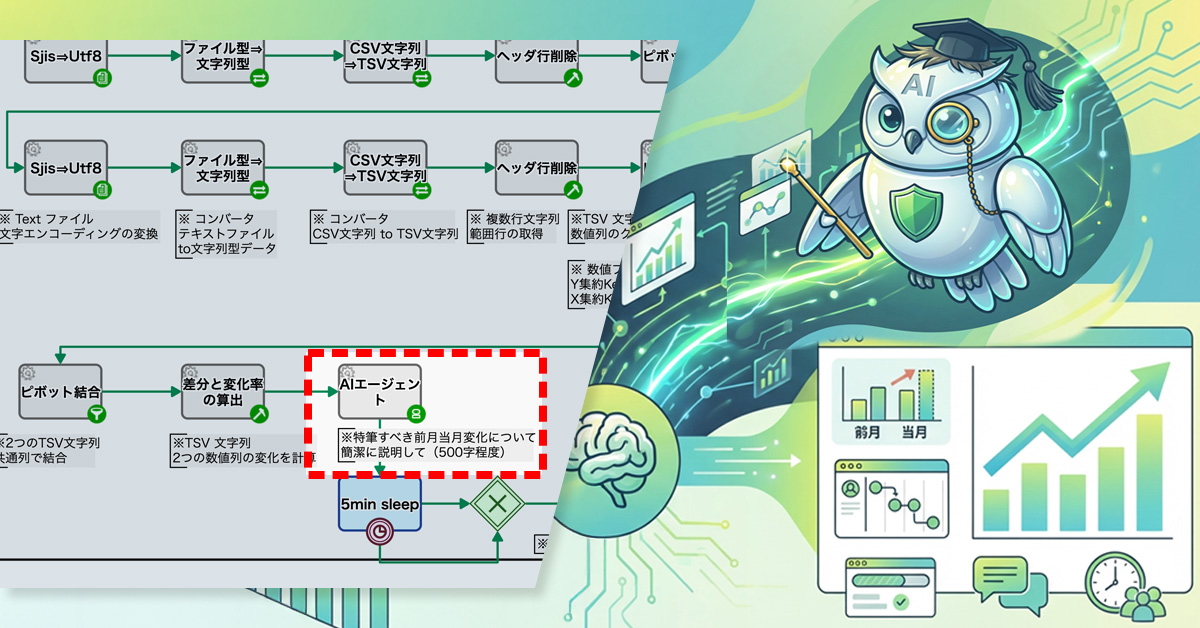
AI summarizes notable client sales changes, helping teams quickly detect important trends and anomalies.
1. Issue: Growth in client-specific sales data makes changes harder to detect
The accounting department of a cloud services company operated with a three-person team and had already systemized processes ranging from importing accounting data to generating monthly client-specific sales summaries and month-over-month comparisons. These routine operations were running stably, and the aggregated results were regularly shared with executive management and the sales department.
However, as the number of clients increased, the client-specific sales report with month-over-month comparisons grew to several hundred rows. Even when accounting staff manually reviewed the report, it became difficult to determine which clients required closer attention.
In actual monthly review operations, the team could still track sales amounts and month-over-month changes for a few major clients. On the other hand, for medium-sized clients, even significant month-over-month fluctuations tended to be buried within the large report, making it difficult to identify and share important changes with the sales department and executive management.
2. Solution: Use AI to Generate Narrative Explanations of Key Sales Changes
The process owner added an AI agent after the aggregation step so that, in addition to the numerical report, the details of sales changes are output as text.
Specifically, the AI agent was given a prompt to “briefly explain notable sales changes based on the difference data between the previous month and the current month.” This allows the AI to extract major changes and distinctive trends from the difference data. Each time the monthly process is executed, the AI summarizes changes in client-specific sales in narrative form.
AI highlights major client sales changes instantly before reviewing detailed reports.
Before
View details of workflow diagramRegister 2 files
Register the current month file and the previous month file, then start the monthly comparison process.
Pivot Aggregation
Aggregate sales amounts by business partner and subaccount, and list the monthly sales structure.
Pivot Merge
Join the current month and previous month aggregation results using common fields to create comparable data.
Calculate Differences and Change Rates
Calculate the month-over-month difference and change rate to clearly quantify sales changes.
email
The key points organized by AI are automatically notified and shared with executive management and the sales department.
After
View details of workflow diagramRegister 2 files
Register the current month file and the previous month file, then start the monthly comparison process.
Pivot Aggregation
Aggregate sales amounts by business partner and subaccount, and list the monthly sales structure.
Pivot Merge
Join the current month and previous month aggregation results using common fields to create comparable data.
Calculate Differences and Change Rates
Calculate the month-over-month difference and change rate to clearly quantify sales changes.
AI Agent
Based on the difference data, AI summarizes notable sales changes from the previous month to the current month in narrative form.
It extracts important changes not only for major clients but also for medium-sized clients.
email
The key points organized by AI are automatically notified and shared with executive management and the sales department.
CLARA, Inc. specializes in cloud infrastructure development and operations, business consulting, and human resource services, primarily focusing on Japan and China. Since our founding in 1997, we’ve helped enterprises grow their cross-border businesses. Within CLARA, Inc., the Corporate IT Group, part of our Cloud Solutions Department, manages the company’s entire information system infrastructure. In today’s environment, where SaaS is widely accessible, our goal is to create seamless collaboration between people and systems, preventing the IT department from becoming a bottleneck.
Challenges in Managing Diverse SaaS Applications
For some time, we’ve used Questetra to manage account administration tasks related to employee onboarding and offboarding, ensuring smooth coordination with HR and other departments. However, the rapid shift to remote work following the COVID-19 pandemic led to a dramatic increase in SaaS usage, significantly increasing the workload associated with issuing new accounts. Although our processes were visible in Questetra, the actual configuration required manual work: accessing each service’s management interface, copying and pasting information, and executing commands. In a remote setting, checking progress through informal communication became difficult, leading to increased workload and communication issues.
This situation highlighted the need to automate account provisioning while maintaining control and minimizing reliance on manual intervention.
Why We Chose to Continue Using Questetra as the Foundation
Instead of replacing our existing tools, we decided to build upon Questetra to address these challenges. Questetra is more than just a workflow system; it provides robust control over complex tasks and inter-departmental dependencies. For example, our “Order Fulfillment Process” involves sales, contract management, finance, and multiple engineering teams (server, network, SSL), resulting in complex branching and parallel processing. Critical dependencies, such as not being able to bill until the server is activated, are deeply integrated into our operations. Managing these processes via email or chat inevitably leads to delays and errors.
Questetra allows us to directly define these cross-departmental handovers and parallel processes within the workflow, clearly outlining who does what and when. We explored other workflow systems, but none matched Questetra’s ability to represent and control such complexity, human decisions, and parallel execution. With this control as our foundation, we’ve successfully integrated automation to solve our current challenges.
Questetra’s Integration of Human-Centric Processes and Automation
Our focus was on avoiding complete automation. We aimed for a system that eliminates unnecessary manual tasks and data entry errors while maintaining control by incorporating human judgment and confirmation points within the processes. Instead of forcing a single system to handle everything, we adopted an architecture that leverages each tool’s strengths in its optimal location.
The architecture is designed with Questetra as the central hub, orchestrating the automated actions of various backend tools. The roles are divided as follows:
Human Process and Progress Management: Questetra BPM Suite
Notifications and Communication: Slack
IT Task Management and Audit Logs: Jira Service Management
HR initiates a workflow in Questetra, and upon approval, a ticket is automatically created in Jira via an API, triggering automatic account provisioning in Okta. Previously, these manual tasks introduced delays; now, results are immediately returned to Questetra upon completion, and HR is promptly notified.
Overall Structure of Tool Integration
Implementation Benefits
Integrating various SaaS tools using Questetra as a central hub has yielded significant quantitative and qualitative benefits. Preparing a new employee’s account, which used to take about a week, can now be completed in half a day. While automation through Okta and other tools is crucial, Questetra’s role as the process’s starting point allows us to directly transfer accurately entered HR data to each system, eliminating wasteful manual transcription steps and errors.
Improved real-time capabilities have also enabled progress visualization and bottleneck detection, creating an environment where we can confidently prepare for an employee’s first day.
Useful Features of Questetra BPM Suite
To further enhance integration with third-party SaaS applications, we actively use custom add-ons. In addition to integrating with external tools such as automatic task creation in Jira, we’ve tailored features to specific needs, such as supplementing Slack notifications with custom logic to accommodate holidays. This development is guided by internal guidelines summarizing Questetra’s unique implementation rules and characteristics. Employees have uploaded these guidelines to AI systems for enhanced usability.
As a result, the challenges of differing specifications and constraints that we previously struggled with have become far more manageable, enabling efficient development. We can now respond quickly to even the most specific needs of our users, demonstrating that Questetra’s flexibility to add business-specific add-ons is critical for maximizing its utility.
Process Control in the AI Era and Initiatives for Building the Next Era
In an era where AI manages repetitive tasks, we expect Questetra to function as the central hub connecting people, AI, and SaaS. We anticipate a future where AI handles processes while humans make final decisions.
Within this framework, expectations for Questetra are growing as a process platform that seamlessly integrates decisions among various SaaS, AI systems, and humans. Even if some tasks are replaced by AI, assuming that human judgment is always necessary at certain points when looking at the overall picture, the value of Questetra, which allows for overseeing and controlling the entire process, remains unchanged.
In line with CLARA, Inc.’s mission of building the next era, we will continue to partner with Questetra to develop business processes tailored for the future.
Return-for-revision enables feedback, reduces rework, and improves organizational decision quality.
1. Issue: The division manager cannot provide feedback on the section manager’s decision
In the approval process for equipment purchases, a hierarchical workflow was used in which the applicant submitted a request, the section manager reviewed it, and the division manager made the final decision. This process included an “AI assessment” step to check application details, significantly reducing returns due to formal deficiencies.
However, as operations continued, another issue emerged. Cases approved by the section manager were repeatedly rejected by the division manager, the final decision-maker. The division manager could only choose between “approval” and “rejection,” and once rejected, the case was closed at that point.
This structure created the following problems:
Since the reasons for rejection were not shared, the basis for decisions was not accumulated or learned by section managers or the organization as a whole
Rejected cases were terminated, requiring applicants to recreate and resubmit them from scratch
2. Solution: Addition of a return-for-revision route
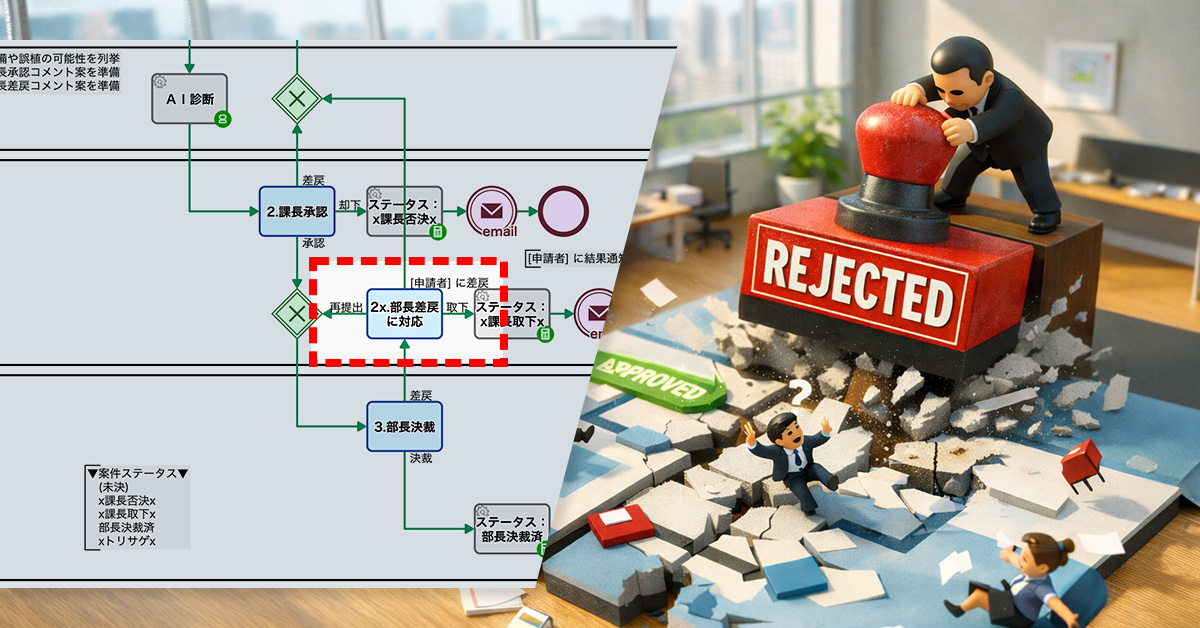
The process owner designed a new “return-for-revision route” that allows cases to be sent back from the division manager to the section manager.
With this design, the division manager can now choose either “approval” or “return for revision” at the decision stage. When returning a case, providing a reason is mandatory, and the case is sent back to the section manager instead of being closed.
As a result, the section manager can review the reason for return and decide whether to resubmit, request revisions from the applicant, or withdraw the application.
Sharing clear feedback builds organizational knowledge and improves decision-making.
Before
View details of the workflow diagram1.Apply
The applicant initiates a request for equipment purchase. They enter the requested amount and details, and start the approval process.
AI Assessment
For the application details, AI checks for possible omissions and formal deficiencies. At the same time, it automatically generates draft comments for the section manager to reference during approval.
2.Section Manager Approval
The section manager reviews the application details and decides whether to approve or return it for revision. They make the decision efficiently while referring to the AI-generated comment suggestions.
3.Division Manager Approval
The division manager makes the final decision, choosing either approval or rejection.
Result Notification
The decision result is automatically notified to the applicant. Whether approved or rejected, the outcome is shared promptly.
After
View details of the workflow diagram1.Apply
The applicant initiates a request for equipment purchase. They enter the requested amount and details, and start the approval process.
AI Assessment
For the application details, AI checks for possible omissions and formal deficiencies. At the same time, it automatically generates draft comments for the section manager to reference during approval.
2.Section Manager Approval
The section manager reviews the application details and decides whether to approve or return it for revision. They make the decision efficiently while referring to the AI-generated comment suggestions.
3.Division Manager Approval
The division manager makes the final decision, choosing either approval or return for revision.
2x. Respond to division manager’s return (request for revision)
Based on the feedback returned by the division manager, the section manager can choose to request resubmission from the applicant, resubmit the application, or withdraw it.
Result Notification
The decision result is automatically notified to the applicant. Whether approved or rejected, the outcome is shared promptly.
Auto-branching by contract length skips unnecessary emails, reducing workload and errors.
1. Issue: Burden of reviewing the renewal confirmation email list
A company currently, approximately 30 client companies have outsourcing contracts related to DX promotion support. Contract periods range from one month to about one year, and around 80% of clients renew their contracts. The sales department’s contract management staff send renewal confirmation emails to clients 60 days and 30 days before the contract end date, based on customer information registered in the system.
These sending schedules are automatically set in advance based on the contract end date. Staff members check the delivery list ყოველდღ and send emails to the relevant clients after confirming there are no errors. However, for contracts with short durations, there is a possibility that renewal confirmation emails may be sent shortly after the contract begins, which is not appropriate.
Therefore, staff needed to check not only the number of days remaining until the contract end date but also the contract duration each time to determine whether the email should be sent. Since this verification task occurs daily, it created a significant workload and introduced risks of judgment errors and oversight.
2. Solution: Automatic branching based on contract duration
The process owner incorporated a branching event before the renewal confirmation email sending step, where a decision is made based on the contract duration.
Specifically, if the contract period is less than two months, the workflow branches to a route that skips the 60-day prior email sending step. If the contract period is less than one month, it is configured to skip the 30-day prior emailsending step as well.
Automation reduces manual checks and improves contract management efficiency.
Before
View details of the workflow diagramCustomer Registration
The sales representative registers the customer information.
x1.Scheduled Sending Date and Time
The scheduled date and time for sending contract renewal confirmation emails are automatically set based on the registered customer information.
2.Sending Approval (60 days prior)
The contract manager reviews the email content and scheduled sending date 60 days before the contract end, and approves the email for sending after confirming there are no errors.
Pending (60 days prior)
The process waits until 60 days before the contract end date.
Send 60-day prior notification email
Send an email to the customer.
3.Sending Approval (30 days prior)
The contract manager reviews the email content and scheduled sending date 30 days before the contract end, and approves the email for sending after confirming there are no errors.
Pending (30 days prior)
The process waits until 30 days before the contract end date.
Send 30-day prior notification email
Send an email to the customer.
After
View details of the workflow diagramCustomer Registration
The sales representative registers the customer information.
x1.Scheduled Sending Date and Time
The scheduled date and time for sending contract renewal confirmation emails are automatically set based on the registered customer information.
Branching
If the contract period is two months or longer, the process proceeds to the “2. Sending Approval (60 days prior)” route. If it is less than two months, the process moves to the next branching point.
2.Sending Approval (60 days prior)
The contract manager reviews the email content and scheduled sending date 60 days before the contract end, and approves the email for sending after confirming there are no errors.
Pending (60 days prior)
The process waits until 60 days before the contract end date.
Send 60-day prior notification email
Send an email to the customer.
Branching
If the contract period is one month or longer, the process proceeds to the “3. Sending Approval (30 days prior)” route. If it is less than one month, the process proceeds to the end.
3.Sending Approval (30 days prior)
The contract manager reviews the email content and scheduled sending date 30 days before the contract end, and approves the email for sending after confirming there are no errors.
Pending (30 days prior)
The process waits until 30 days before the contract end date.
Amount-based routing reduces bottlenecks by limiting division manager approvals to high-value cases only.
1. Issue: Decision-making concentrated on the division manager
In the approval process for equipment purchases, a hierarchical workflow was used in which the applicant submitted a request, the section manager reviewed it, and the division manager made the final decision.
AI-based checks for errors and the generation of draft comments had been introduced, reducing formal mistakes in applications. However, the approval workflow itself had not been revised, and the division manager consistently remained responsible for the final decision. As a result, the bottleneck in the approval process was not structurally resolved.
Since all cases, regardless of amount, required the division manager’s approval, requests were constantly concentrated at that level. The division manager had to process a large number of cases in a short time, making it difficult to secure sufficient time for careful review—especially for high-value cases that would normally require more thorough consideration.
2. Solution: Branching approval routes based on amount thresholds
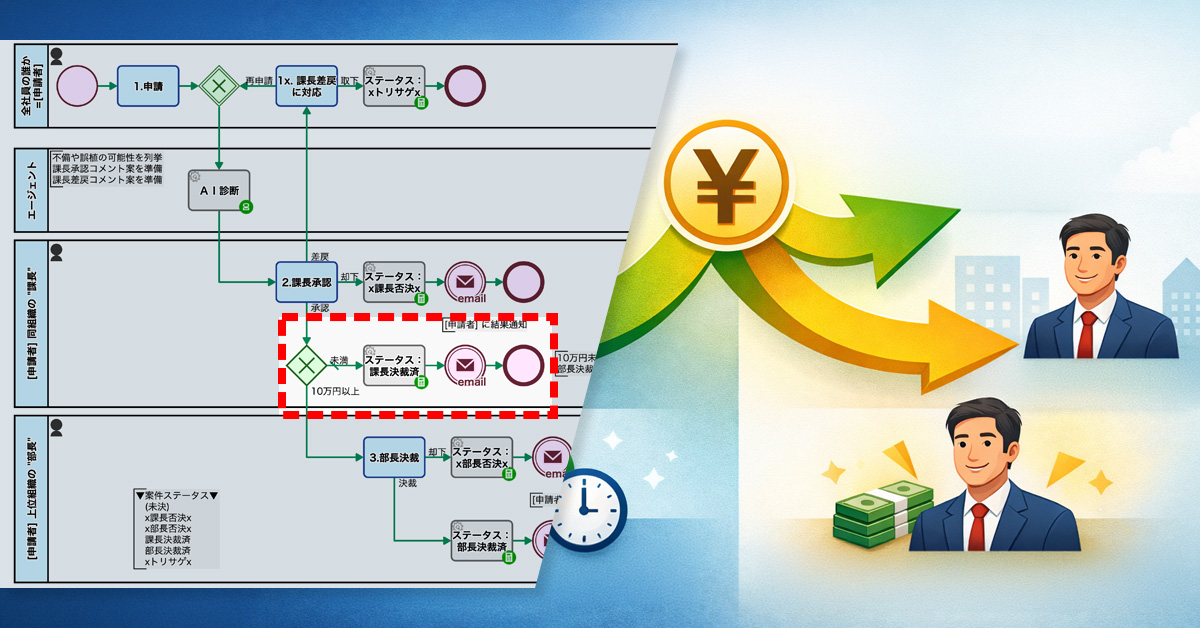
The process owner incorporated amount-based branching into the approval workflow. The approval route is automatically determined based on the amount entered by the applicant.
As a result, cases under 100,000 yen are completed with section manager approval, while only cases of 100,000 yen or more proceed to division manager approval.
Faster processing by completing small cases at the section manager level.
Before
View details of the workflow diagram1.Apply
The applicant initiates a request for equipment purchase. They enter the requested amount and details, and start the approval process.
AI Assessment
For the application details, AI checks for possible omissions and formal deficiencies. At the same time, it automatically generates draft comments for the section manager to reference during approval.
2.Section Manager Approval
The section manager reviews the application details and decides whether to approve or return it for revision. They make the decision efficiently while referring to the AI-generated comment suggestions.
3.Division Manager Approval
The division manager makes the final decision.
Result Notification
The decision result is automatically notified to the applicant. Whether approved or rejected, the outcome is shared promptly.
After
View details of the workflow diagram1.Apply
The applicant initiates a request for equipment purchase. They enter the requested amount and details, and start the approval process.
AI Assessment
For the application details, AI checks for possible omissions and formal deficiencies. At the same time, it automatically generates draft comments for the section manager to reference during approval.
2.Section Manager Approval
The section manager reviews the application details and decides whether to approve or return it for revision. They make the decision efficiently while referring to the AI-generated comment suggestions.
Branching based on amount thresholds
After the section manager’s approval, the approval route is determined based on the requested amount. Requests under 100,000 yen are completed with section manager approval, while only requests of 100,000 yen or more proceed to division manager approval.
3.Division Manager Approval (for cases of 100,000 yen or more)
Only when the requested amount is 100,000 yen or more does the division manager make the final decision. This setup allows the division manager to focus on high-value or exceptional cases.
Result Notification
The decision result is automatically notified to the applicant. Whether approved or rejected, the outcome is shared promptly.
[Release Date: March 24, 2026 / Source: Questetra, Inc.]
Questetra, Inc. (Headquarters: Nakagyo-ku, Kyoto; CEO: Genichi Imamura), provider of the cloud-based Business Process Management Suite (SaaS BPMS) “Questetra BPM Suite,” has published a case study detailing Nippon Light Metal Company, Ltd.’s (Headquarters: Minato-ku, Tokyo; President: Ichiro Okamoto) successful implementation of their system.
Nippon Light Metal’s Quality Assurance Group at the Kambara Electrical Material Center has digitized processes previously managed with paper and email, enabling real-time progress tracking. They have already developed around 20 applications, including solutions for complaint handling and blueprint registration, significantly accelerating business improvements driven by employees in the field. We interviewed key personnel to understand the reasons behind the implementation and its specific benefits.
Background: Breaking Down Progress “Black Boxes” and Reducing Data Entry Burden
The Quality Assurance Group is responsible for managing the quality assurance system, issuing inspection reports, and handling customer complaints. Addressing reported issues requires collaboration across multiple departments.
Previously, relying on paper and email made it difficult to track progress, leading to a “black box” effect where it was unclear which tasks were stalled, where, and why, resulting in delays. Furthermore, redundant data entry and transcription placed a significant burden on staff.
Why Questetra: Focusing on Flow Management, Not Just Task Management
After evaluating various tools to advance business reform through digital transformation (DX), we selected Questetra. A key deciding factor was Questetra’s design philosophy, which emphasizes viewing business processes not simply as record management, but as a continuous flow connecting seamlessly to subsequent stages.
Nippon Light Metal also highly valued the platform’s flexibility, allowing field personnel to create applications independently without the need for coding skills, and the ability to quickly identify bottlenecks using features like heatmaps and search functions.
Starting with a simple “Attendance Report” application, Nippon Light Metal has now developed approximately 20 applications, including “Defect Notifications”, “Calibration Management”, and “Drawing Registration”, with about 10 currently in active use.
Real-Time Progress Tracking: Visualizing the status of each process has enabled timely follow-up and effectively identified bottlenecks.
Significantly Improved Operational Efficiency: Digitalization has reduced the time-consuming tasks of data transcription and cumbersome approval procedures.
Empowered Field Improvement Discussions: Leveraging web form functions allows them to gather feedback even from workers without a Questetra account, fostering field-driven discussions on continuous improvement.
About Questetra BPM Suite
Questetra BPM Suite is a cloud-based Business Process Management System (SaaS BPMS).
Users can develop and operate workflow systems entirely through a web browser, without requiring any programming knowledge (coding skills). This empowers business departments to continuously improve their business processes independently.
Typical business processes, such as approval requests, quotation submissions, and inquiry handling, can be created as workflow systems using a no-code approach. Furthermore, integration with generative AI allows for the automation of tasks such as automatic draft document generation and generating draft response proposals.
Company Info
Nippon Light Metal Company, Ltd.
Location
Minato-ku, Tokyo
Representative
Ichiro Okamoto
Business Activities
Manufacture and sale of alumina, aluminum hydroxide, various chemicals, and aluminum ingots/alloys. etc.














![[Case Study] Nippon Light Metal Streamlines Quality Assurance with Questetra, Eliminating Bottlenecks and Driving Business Process Reform](https://questetra.com/wp-content/uploads/2023/12/ogp-singlepage-en.png)
