株式会社クエステトラ(本社:京都市中京区、代表執行役CEO:今村元一)が提供するクラウド型業務プロセス管理システム「Questetra BPM Suite」が、「ITreview The Best Software in Japan 2026」のカテゴリー別部門「The Best Software by Category」において、BPMツールカテゴリーで選出されたことをお知らせします。
「ITreview The Best Software in Japan 2026」は、アイティクラウド株式会社が運営するレビュープラットフォーム「ITreview」に投稿された実際のユーザーレビューをもとに、日本企業から高く評価され、ビジネスの最前線で注目を集めているSaaS・ソフトウェア・ITサービスを表彰する企画です。
Questetra BPM Suite が選出された「The Best Software by Category」は、各カテゴリーで特に高い評価を獲得した製品を表彰する部門です。レビュー件数や製品満足度、サポート品質、市場での検索数、ITreviewサイト内での閲覧数・比較数などをもとに算出されたスコアに基づき選出されています。
「ITreview The Best Software in Japan 2026」は、2025年4月から2026年3月までの1年間に ITreview に投稿されたユーザーレビューをもとに、日本企業から高い評価を得た製品を表彰する企画です。
表彰は、総合部門「The Best Software TOP100」、カテゴリー別部門「The Best Software by Category」、新人賞部門「The Best Software Rookie of the Year」、AI機能評価部門「The Best Software for AI-Powered Features」の4部門で構成されています。
Questetra BPM Suite が選出された「The Best Software by Category」は、各カテゴリー内で最も高く評価された製品を表彰する部門です。
Questetra BPM Suiteとは
Questetra BPM Suite は、クラウド型の業務プロセス管理システム (SaaS BPMS) です。ワークフローシステム(ワークフローアプリ)の開発および運用が、Webブラウザだけで完結します。プログラミングの知識(Codingスキル)は必要ありません。業務部門が主体となって、継続的に業務プロセスを改善できます。
Questetra, Inc. (Head Office: Nakagyo-ku, Kyoto; CEO: Genichi Imamura), provider of the cloud-based business process management system (SaaS BPMS) “Questetra BPM Suite,” has published a customer success story featuring CLARA, Inc. (Head Office: Minato-ku, Tokyo; President & CEO: Kentaro Iemoto), a cloud services provider operating primarily in Japan and China.
As digital transformation accelerates and the number of SaaS applications in use continues to grow, many organizations are facing increasing operational burdens and governance challenges in account management processes. Using Questetra for more than a decade, CLARA successfully established a framework that clearly separates human decision-making from system-driven automation. As a result, the company reduced the lead time required to prepare accounts for new employees from a cumulative one week to effectively half a day.
In this case study, Mr. Yamazaki of the Corporate IT Group, Cloud Solution Division at CLARA, discusses the company’s challenges, implementation approach, and the operational improvements achieved through Questetra.
Issues: The Limits of Manual Operations and Fragmented Progress Management Amid Rapid SaaS Expansion
At CLARA, account lifecycle management for employee onboarding and offboarding had long been administered on Questetra, enabling smooth coordination among HR and various other departments. However, following the widespread adoption of remote work during the COVID-19 pandemic, the number of SaaS applications in use increased dramatically. Although the workflows themselves were visible and standardized, the actual account provisioning tasks still depended heavily on manual operations, such as copying and pasting data across multiple administrative interfaces.
As a result, not only did operational workloads increase, but challenges also emerged in tracking progress and coordinating among stakeholders in a remote working environment. For the Corporate IT Group, a critical priority became how to automate provisioning processes without human intervention while maintaining proper governance and operational control.
Why Questetra: A Foundation Capable of Reliably Governing Complex Business Processes
While alternative tools were evaluated, CLARA ultimately decided to continue leveraging its existing Questetra platform. The primary reason was Questetra’s ability to represent complex business processes as they are, including interdepartmental dependencies and operational relationships across teams. In workflows involving multiple departments, dependencies naturally arise, such as situations where downstream tasks cannot proceed until upstream processes are completed. When managed solely through email or chat, these handoffs tend to become highly dependent on individuals and informal coordination, increasing the risk of delays, bottlenecks, and missed actions.
Questetra enables these interactions and parallel processes to be directly modeled as workflows, clearly visualizing who needs to do what, and when. One of its greatest strengths lies in its ability to handle real-world operations “as-is,” including complex decision-making and exceptional cases.
CLARA evaluated various workflow platforms; however, no other solution was able to represent and reliably control such sophisticated branching logic, human decision points, and parallel processing structures without operational breakdowns.
Building upon this foundation, CLARA integrated Questetra with external services, enabling human approval processes and automated operations—such as account provisioning—to be seamlessly orchestrated within a single unified workflow.
Implementation Results: Achieving Both Dramatic Lead Time Reduction and Elimination of Human Error
By positioning Questetra as the central orchestration hub and integrating it via APIs with various SaaS platforms—including Okta for automated account provisioning, Jira for IT service request handling, and Slack for notifications and communication—CLARA achieved the following results:
Significant Reduction in Lead Time:
Account preparation processes that previously required a cumulative lead time of approximately one week can now be completed effectively within half a day.
Elimination of Manual Entry Errors:
Data entered by HR is transferred directly to each SaaS platform, completely eliminating human input and transcription errors caused by manual operations.
Improved Real-Time Visibility and Bottleneck Detection:
Workflow progress is now visualized in real time, enabling immediate detection of stalled tasks. Once processing is completed, results are automatically communicated back to HR, ensuring employees can begin work on their first day without operational concerns.
Another key success factor was the flexible extensibility of CLARA’s internally developed add-ons that support integration with external tools. By leveraging generative AI to learn implementation rules and development patterns, CLARA significantly lowered development barriers and established a framework capable of rapidly delivering features tailored to highly specific operational needs.
Overall Architecture of Tool Integrations
Future Outlook: Process Governance Will Become Even More Critical in the AI Era
As AI increasingly takes over repetitive operational tasks, CLARA believes that a model in which AI performs processing while humans make final decisions will become the standard operating approach.
Based on the assumption that even if certain tasks are replaced by AI, there will always remain critical points requiring human judgment when viewed from the perspective of the overall process, CLARA intends to continue positioning Questetra as the central platform connecting people, AI, and SaaS systems.
Going forward, the company will continue building business processes aligned with its corporate mission of “paving the way for the next era.”
About Questetra BPM Suite
Questetra BPM Suite is a cloud-based Business Process Management System (SaaS BPMS).
The platform enables organizations to develop and operate workflow applications entirely through a web browser, without requiring programming expertise or coding skills. Business departments themselves can continuously improve operational processes independently.
Standardized business workflows—such as approval requests, quotation submissions, and inquiry handling—can be created as no-code workflow applications. Furthermore, by incorporating generative AI capabilities, organizations can automate knowledge-intensive tasks such as draft document generation and response proposal creation.
About Questetra, Inc.
Questetra, Inc. is a Kyoto-based SaaS BPM vendor dedicated to optimizing business processes worldwide.
Company Name : Questetra, Inc. CEO : Genichi Imamura, Chief Executive Officer Head Office : Oike Building 4F, 206 Takamiya-cho, Oike-dori Manjuji Higashi-iru, Nakagyo-ku, Kyoto, Japan Established : April 2008 Capital : 184,057,500 JPY URL : https://questetra.com/
AI summarizes notable client sales changes, helping teams quickly detect important trends and anomalies.
1. Issue: Growth in client-specific sales data makes changes harder to detect
The accounting department of a cloud services company operated with a three-person team and had already systemized processes ranging from importing accounting data to generating monthly client-specific sales summaries and month-over-month comparisons. These routine operations were running stably, and the aggregated results were regularly shared with executive management and the sales department.
However, as the number of clients increased, the client-specific sales report with month-over-month comparisons grew to several hundred rows. Even when accounting staff manually reviewed the report, it became difficult to determine which clients required closer attention.
In actual monthly review operations, the team could still track sales amounts and month-over-month changes for a few major clients. On the other hand, for medium-sized clients, even significant month-over-month fluctuations tended to be buried within the large report, making it difficult to identify and share important changes with the sales department and executive management.
2. Solution: Use AI to Generate Narrative Explanations of Key Sales Changes
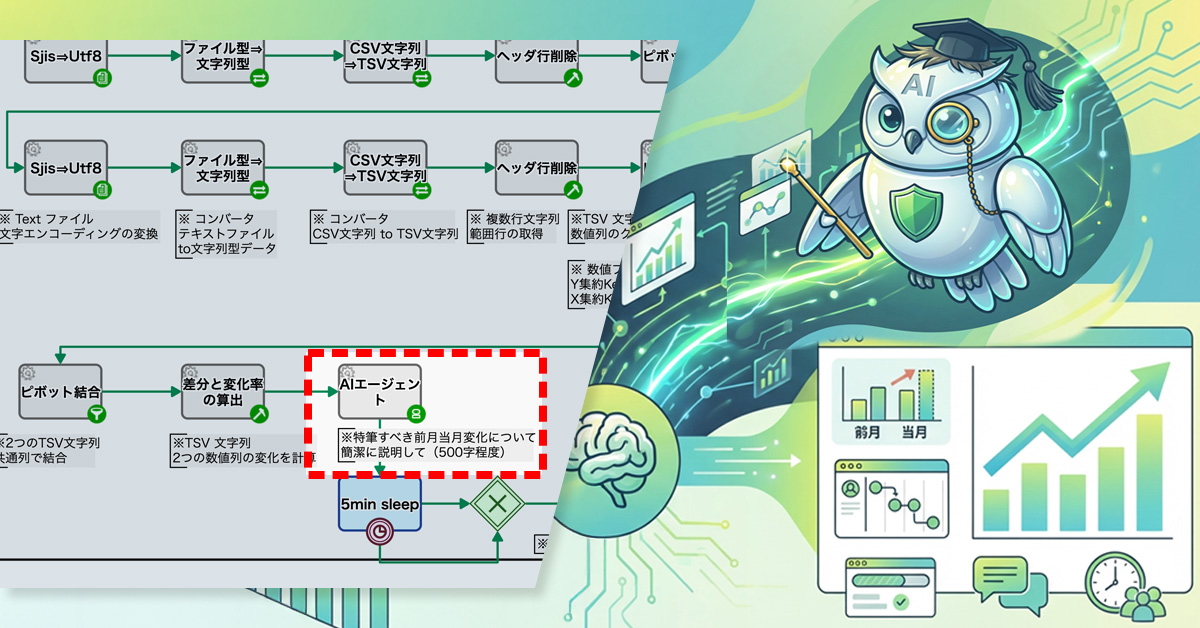
The process owner added an AI agent after the aggregation step so that, in addition to the numerical report, the details of sales changes are output as text.
Specifically, the AI agent was given a prompt to “briefly explain notable sales changes based on the difference data between the previous month and the current month.” This allows the AI to extract major changes and distinctive trends from the difference data. Each time the monthly process is executed, the AI summarizes changes in client-specific sales in narrative form.
AI highlights major client sales changes instantly before reviewing detailed reports.
Before
View details of workflow diagramRegister 2 files
Register the current month file and the previous month file, then start the monthly comparison process.
Pivot Aggregation
Aggregate sales amounts by business partner and subaccount, and list the monthly sales structure.
Pivot Merge
Join the current month and previous month aggregation results using common fields to create comparable data.
Calculate Differences and Change Rates
Calculate the month-over-month difference and change rate to clearly quantify sales changes.
email
The key points organized by AI are automatically notified and shared with executive management and the sales department.
After
View details of workflow diagramRegister 2 files
Register the current month file and the previous month file, then start the monthly comparison process.
Pivot Aggregation
Aggregate sales amounts by business partner and subaccount, and list the monthly sales structure.
Pivot Merge
Join the current month and previous month aggregation results using common fields to create comparable data.
Calculate Differences and Change Rates
Calculate the month-over-month difference and change rate to clearly quantify sales changes.
AI Agent
Based on the difference data, AI summarizes notable sales changes from the previous month to the current month in narrative form.
It extracts important changes not only for major clients but also for medium-sized clients.
email
The key points organized by AI are automatically notified and shared with executive management and the sales department.
CLARA, Inc. specializes in cloud infrastructure development and operations, business consulting, and human resource services, primarily focusing on Japan and China. Since our founding in 1997, we’ve helped enterprises grow their cross-border businesses. Within CLARA, Inc., the Corporate IT Group, part of our Cloud Solutions Department, manages the company’s entire information system infrastructure. In today’s environment, where SaaS is widely accessible, our goal is to create seamless collaboration between people and systems, preventing the IT department from becoming a bottleneck.
Challenges in Managing Diverse SaaS Applications
For some time, we’ve used Questetra to manage account administration tasks related to employee onboarding and offboarding, ensuring smooth coordination with HR and other departments. However, the rapid shift to remote work following the COVID-19 pandemic led to a dramatic increase in SaaS usage, significantly increasing the workload associated with issuing new accounts. Although our processes were visible in Questetra, the actual configuration required manual work: accessing each service’s management interface, copying and pasting information, and executing commands. In a remote setting, checking progress through informal communication became difficult, leading to increased workload and communication issues.
This situation highlighted the need to automate account provisioning while maintaining control and minimizing reliance on manual intervention.
Why We Chose to Continue Using Questetra as the Foundation
Instead of replacing our existing tools, we decided to build upon Questetra to address these challenges. Questetra is more than just a workflow system; it provides robust control over complex tasks and inter-departmental dependencies. For example, our “Order Fulfillment Process” involves sales, contract management, finance, and multiple engineering teams (server, network, SSL), resulting in complex branching and parallel processing. Critical dependencies, such as not being able to bill until the server is activated, are deeply integrated into our operations. Managing these processes via email or chat inevitably leads to delays and errors.
Questetra allows us to directly define these cross-departmental handovers and parallel processes within the workflow, clearly outlining who does what and when. We explored other workflow systems, but none matched Questetra’s ability to represent and control such complexity, human decisions, and parallel execution. With this control as our foundation, we’ve successfully integrated automation to solve our current challenges.
Questetra’s Integration of Human-Centric Processes and Automation
Our focus was on avoiding complete automation. We aimed for a system that eliminates unnecessary manual tasks and data entry errors while maintaining control by incorporating human judgment and confirmation points within the processes. Instead of forcing a single system to handle everything, we adopted an architecture that leverages each tool’s strengths in its optimal location.
The architecture is designed with Questetra as the central hub, orchestrating the automated actions of various backend tools. The roles are divided as follows:
Human Process and Progress Management: Questetra BPM Suite
Notifications and Communication: Slack
IT Task Management and Audit Logs: Jira Service Management
HR initiates a workflow in Questetra, and upon approval, a ticket is automatically created in Jira via an API, triggering automatic account provisioning in Okta. Previously, these manual tasks introduced delays; now, results are immediately returned to Questetra upon completion, and HR is promptly notified.
Overall Structure of Tool Integration
Implementation Benefits
Integrating various SaaS tools using Questetra as a central hub has yielded significant quantitative and qualitative benefits. Preparing a new employee’s account, which used to take about a week, can now be completed in half a day. While automation through Okta and other tools is crucial, Questetra’s role as the process’s starting point allows us to directly transfer accurately entered HR data to each system, eliminating wasteful manual transcription steps and errors.
Improved real-time capabilities have also enabled progress visualization and bottleneck detection, creating an environment where we can confidently prepare for an employee’s first day.
Useful Features of Questetra BPM Suite
To further enhance integration with third-party SaaS applications, we actively use custom add-ons. In addition to integrating with external tools such as automatic task creation in Jira, we’ve tailored features to specific needs, such as supplementing Slack notifications with custom logic to accommodate holidays. This development is guided by internal guidelines summarizing Questetra’s unique implementation rules and characteristics. Employees have uploaded these guidelines to AI systems for enhanced usability.
As a result, the challenges of differing specifications and constraints that we previously struggled with have become far more manageable, enabling efficient development. We can now respond quickly to even the most specific needs of our users, demonstrating that Questetra’s flexibility to add business-specific add-ons is critical for maximizing its utility.
Process Control in the AI Era and Initiatives for Building the Next Era
In an era where AI manages repetitive tasks, we expect Questetra to function as the central hub connecting people, AI, and SaaS. We anticipate a future where AI handles processes while humans make final decisions.
Within this framework, expectations for Questetra are growing as a process platform that seamlessly integrates decisions among various SaaS, AI systems, and humans. Even if some tasks are replaced by AI, assuming that human judgment is always necessary at certain points when looking at the overall picture, the value of Questetra, which allows for overseeing and controlling the entire process, remains unchanged.
In line with CLARA, Inc.’s mission of building the next era, we will continue to partner with Questetra to develop business processes tailored for the future.