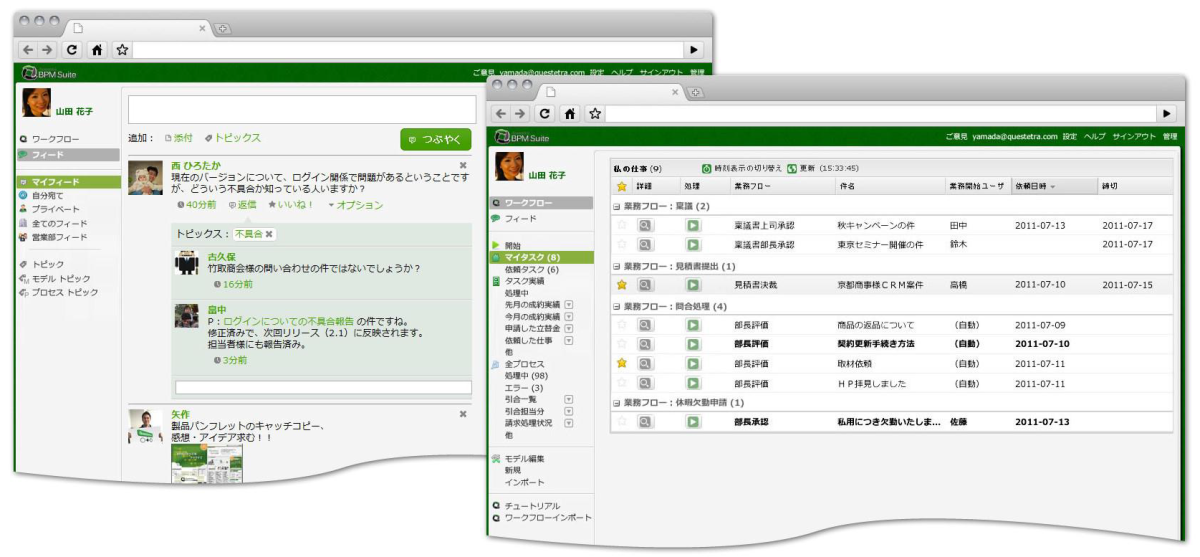
当たり前の話ではありますが、通勤が困難な方でもスキルの高い方は沢山おられます。また、時期によって在宅勤務に切り替えたいと考えるケースもあると思います。メールやカレンダーは G Suite を使い、業務データの受け渡しを Questetra で行う様にする事で、「会社に来なければできない仕事」を減らす事ができました。
ちなみに仕組み自体に、特別な投資を行っている訳ではありません。既存の業務プロセス定義に開始ポイントを追加し、Questetra の接続 API とクラウド電話APIサービス『Twilio』を連携させるだけと言う、とてもシンプルな拡張で実現しています。いわゆる「業務改善サイクル」を実感しているところです。
Kyoto, Japan — July 1, 2011 — Enterprise software developer Questetra Inc., will publish the new version 8.0 of the cloud-enabled business process management “Questetra BPM suite SaaS Edition” simultaneously worldwide on August 8. The new version will allow facilitating the processes more than ever with newly added “in-house tweet feature” that makes easier to discuss with other department of the company or to place a check on the workers upstream.
Business process management system, today
Business Process Management (BPM) system is an application development environment that requires no programming knowledge. It has modeling feature of business workflow as well as monitoring feature of progress.
For:
Companies which want to achieve an internal controlled workflow
Companies wishing to promote a paperless work environment and telecommuting environment
Companies want to make use of records of operating procedures on analysis on orders and miss orders
Companies want to prevent business stagnation by monitoring business progress in real-time
Effects:
Can standardize the information of business flow and transfer
Can clarify business rules as split conditions or allocate conditions
Can always overlook the past work history
Can discover the waste of rework and inefficiencies
Questetra BPM Suite SaaS Edition
Questetra BPM Suite SaaS Edition is a cloud-enabled business process management system, which won “Cool Vendor 2010” prize, and every its features, Workflow function, Modeling function and Monitoring function can be used On-line. It has features of Lightweight modeling that designing Process Model to operation can be completed in two hours and Google Apps Integration, and can start any time with more than 400 business model templates. Free Trial: https://questetra.com/en/free-trial-en/
Micro-blogging in the enterprise, today
Enterprise Micro-blog is a communication environment in an organization that staff can freely post short sentences. Recently, an open micro-blog Twitter and Social Networking Service spread so explosively, that many companies put micro-blogging to practical use in communicating inside. Enterprise Social Networking Service brings active info exchange beyond departments and workers share their ideas and feelings. There are many products provided, such as Yammer (Yammer, Inc.), Jive (Jive Software), Chatter (Salesforce.com), Sales OnDemand (SAP), Lotus Connections (IBM).
Questetra BPM Suite SaaS Edition Version 8
Questetra BPM Suite SaaS Edition version 8 will be released on August 8, 2011, with “Questetra Feed”, which is a standard equipment enterprise micro-blogging combined to workflow. And also be enhanced in a variety of its functions.
Enterprise micro-blogging combined to workflow: “Questetra Feed”
Workers are able to “Tweet” which tied with individual Process ID easily. They will be able to efficiently process the work through the workflow by activating communications such as the idea outgoing beyond the divisions and teams, advices and suggestions, confirmation of personnel working in the upstream, prior negotiations to the settlement. And in addition “Visualization of progress” and “Accelerating the improvement cycle” is promoted because progress of work colleagues or the workflow designer’s improving policy are indicated.
SAML Single Sign-On
Supports single sign-on with SAML 2.0
Process modeler
Easier designing Web forms, less stress on browser when Data item increases or Model becomes huge
Search Conditions
More free to set a condition in searching business process, and free setting format for search result
Comments from Genichi IMAMURA, CEO
”Often in cases, we use Collaboration tool like internal twitter to open the company. However, it is essential that workflow and collaboration features get together, for example, consolidating ideas and knowledge instantly to deal with complainant. Questetra continuously suggest smooth business process environment with enhancement on Collaboration features.”
Questetra
Questetra, Inc. is a software development company established in April 2008, located in Kyoto, JAPAN. Questetra’s mission is to optimize human tasks around the world. https://questetra.com/
法人ソフト開発の株式会社クエステトラ(京都市、代表執行役 CEO 今村元一)は、クラウド型業務プロセス管理『QuestetraBPM Suite SaaS Edition』の新バージョン 8.0 を、8月 8日に世界同時公開いたします。新バージョンでは「社内つぶやき」を発信する機能(マイクロブログ機能)が装備され、業務プロセスを処理する際に、他部署に相談をしたり上流作業の処理者に確認を入れたりすることが容易になり、これまで以上に業務を円滑に進める事ができる様になります。
個別のプロセス ID と紐づかせた「つぶやき」を気軽に発信する事が可能になります。部門やチームを超えたアイデアの共有、部下への助言、上流作業の担当者への事実確認、決裁者への事前交渉(根回し)と言ったコミュニケーションが促進され、ワークフローを流れる仕事を効率よく処理する事ができるようになります。また、同僚の作業進捗や、ワークフロー設計者のフロー改善方針などの情報も表示され、「業務進捗の可視化」や「改善サイクルの加速」が促進されます。
企業向けシングルサインオン基盤への対応
企業の ID パスワード管理基盤に連携させることが可能になります。SAML2.0 に対応したシングルサインオン製品と連携させることで Questetra BPM Suite 専用の ID パスワードを設定して頂く必要が無くなります。
「社内の風通しを良くする試みとして、Questetra BPM Suite から社内ツイッターなどのコラボレーションツールに情報を書きだす事例は、しばしばありました。しかし、例えば滞留中のクレーム対応業務に関連するアイデアやナレッジを、瞬時に集約させるためには、ワークフロー機能とコラボレーション機能の融合が不可欠です。クエステトラでは今後もコラボレーション機能の強化を通じて、スムーズな業務処理環境を提案していきたいと考えています。」
Kyoto, Japan — September 15, 2010 — Japanese software development company Questetra, Inc., launches the newest version of its cloud BPM application “Questetra BPM Suite SaaS Edition: September 2010 Version 7” on September 15.
The new version comes with APIs that enable connectivity with third party software, so companies will be able to create original apps according to their unique business requirements; for example, an iPhone app for issuing quotations or a desktop app for facilitating approvals.
Questetra BPM Suite SaaS Edition is a global cloud application hailing from Japan designed to promote transparency of company processes and performance. Managers can create and edit workflows easily by drag-and-drop, and instantly update the necessary improvements to the system. This makes it possible to pull BPM out of dead-end discussions and have real, on-site demands drive change. (Free up to 5 users)
The software can handle general office and payment processes (for instance, applying for an advance), as well as complex workflows such as requesting the accounting department to confirm a quotation before submission to a client, or having multiple peers pre-check an important presentation simultaneously and effectively. (Selected in Gartner’s Cool Vendor List, e27’s Asia’s Top 50 Apps, etc.) http ://store.questetra.com/en/
Questetra BPM Suite SaaS Edition Version 7
Today’s IT world, including the SaaS market, is riding the cloud computing revolution and seeing a shift from “ownership” to “utilization” of information systems. Questetra BPM Suite SaaS Edition Version 7 comes with a further enhanced API package. Companies will find it easier to develop apps for Android, iPhone, iPad, Widgets, Gadgets and interoperation apps within mission-critical systems. Questetra will also provide open source sample codes for iPhone and Android.
Some ways the APIs can be used include:
Initiating processes from mission-critical system and automatically acquiring info from mission-critical system (BPMN Catching Event API, with secure key);
Sending info to mission-critical system by POST method, sending out automatic emails, and connecting with ECM system (BPMN Throwing Event API);
Displaying various tasks in Smartphone app or office screen (Execute Process API, with user authentication);
Deleting and adding users and groups (User Management API, with user authentication).
Basic authentication and OAuth can be used for user authentication. http ://support.questetra.com/ja/questetra-bpm-suite
Comments from Questetra CEO
“In this age of cloud computing and mashups, we consider offering APIs to be an extremely important part of our business. Questetra will continue to improve on its workflow engine and process modeler, while simultaneously expanding its API library to promote a win-win relationship with consulting and integration partners.”
Questetra
Questetra, Inc. is a software development company established in April 2008, located in Kyoto, Japan. Questetra’s mission is to optimize human tasks and contribute to businesses around the world. https://www.questetra.com/
「クラウド」をキーワードに、情報システムの『所有』から『利用』へのシフトが益々加速する中、クラウドの一形態である SaaS(Software as a Service)も、その接続性が問われる時代になっています。バージョン 7においては、API(Application Programming Interface)機能が大幅に整備拡充され、
Questetra は、米 IT 調査会社ガートナーの「Cool Vendors in BPM, 2010」において『Cool Vendor(注目ベンダー)』に選定されました。
※ BPM: Business Process Management (ビジネスプロセス管理) ※ Gartner “Cool Vendors in Business Process Management, 2010” by Michele Cantara, Jim Sinur, Janelle Hill, and Kimihiko Iijima. (2010-04-09)
This is “not as simple as it seems,” and we often get stuck when finding the answer. Probably, it may be “a combination of several elements that play a certain role as a whole.” For example, “an integrated kitchen system,” stoves, a sink, and storage space help cooking, while “a physical distribution system” is a system in which those who are responsible for pickup, storage, and shipping deliver things.
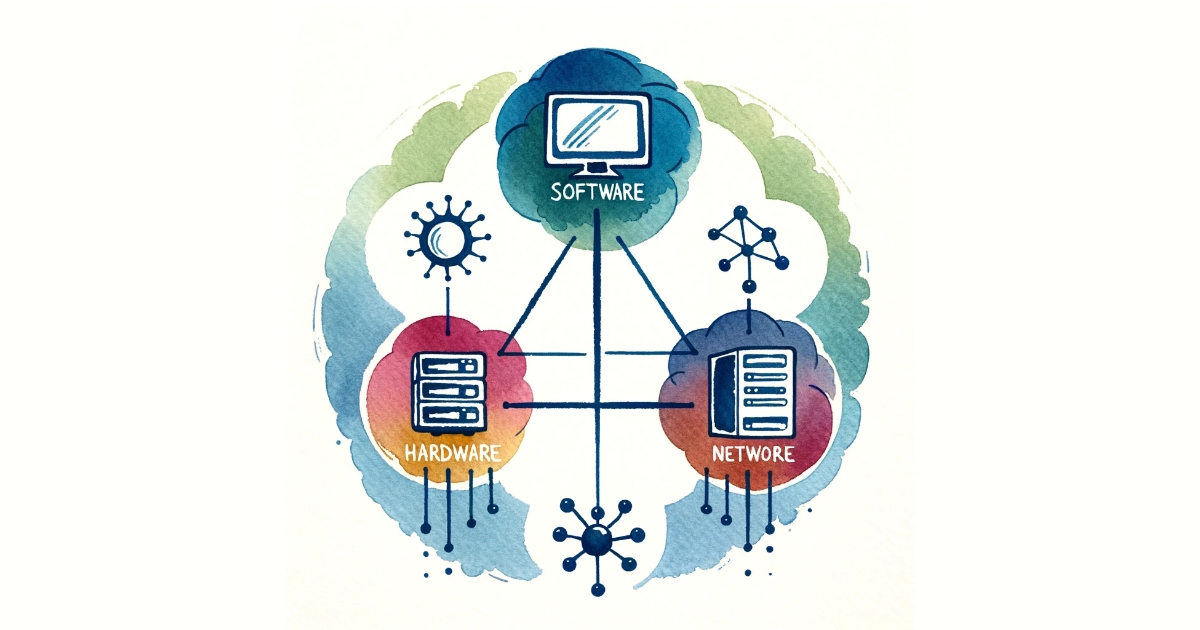
Likewise, “an information system” is merely “a mechanism to output information”, involving hardware, software, and communication networks.
Figure 1
However, “sales,” “list of royal customers,” “a latest business manual,” and “Top 3 of customer’s comments on the new product,” … As we may know, information that humans would want to know is not enumerable. That’s why numerous system integrators are needed in the society.
Complaints of Entrusters
Here are Top 4 of the moments when entrusters feel dissatisfied!
[Proposal Stage] Low quality of proposals. There is almost no proposal
[Design Stage] I don’t know what’s happening with the latest specification.
[Acceptance Stage] Low quality of products. I want to know how it was tested
[Operation Stage] Late response to inquiries. Sometimes responses are totally irrelevant
These are all based on my experiences, but not more than my personal guess. I do not have any statistical data at all. And, needless to say, of course, entrusters must feel dissatisfied at various moments, for example, when they receive a technical explanation, when they sign a contract, when they see an estimate (!), and so on.
Well, to begin with, I would like to meet “entrusters’ dissatisfaction” by focusing upon a Process related to “delivered product inspection.” The reason why I chose this is simple; that is because, compared to other Processes, many Tasks in this Process are almost independent of human ability. For example, even if the Process related to “Proposal” is not well-organized, some people win “the entruster’s satisfaction.”
Here, members make reports to their project manager upon completion of each “outcome” in the fields that they are engaged in, such as module development, module integration, establishment of production environment, etc. Triggered by those reports, the Inspection Process starts.
Figure 2
In this Process, after the brief confirmation by the project manager, two inspectors, who are chosen arbitrarily, inspect the outcomes and record the inspection reports. Of course, the project manager has to decide, based on his/her experience and discretion, how often and at which timing the outcome reports are to be made.
Contents of Tests
“Including the intermediate inspection report, all should be delivered.”
There are few project managers performing such an act of chivalry. But, as a general rule, “the inspection report per element” of delivered products should be submitted with the system time stamp on it.
Figure 2 (Reprinting)Table 1
In fact, anyone would hesitate to say, “Let’s take CMMI(*).” But, we have to be brave enough to say, “Let’s submit the inspection report of products.” In this case, if there are 100 elements in a product, because there are two inspectors for each element, “(100 + # of re-inspections) * 2 sheets” of the inspection report will be generated.
For your information, as a whole SI business, necessary cost for tests and inspection should occupy at least 20% of the total cost. Roughly speaking, there should be 20 inspectors in an organization of 100 people.
* CMMI: Capability Maturity Model Integration
Existence of “the inspection report” is helpful especially for the sales person in charge. Actually, many sales people can’t grasp what the produced products are like. And, they cannot do anything but accepting the complaints.
However, with “the inspection report,” it is possible for sales people to compare inspection items that the entruster was not satisfied with when examining delivered products against inspected items written in the inspections reports. That is to say, it is possible to compare claims of the entruster and ones of the entrustee.
Explicit Specification and Implicit Specification
The “inspection report” rescues sales people to some extent, but it doesn’t solve “the problem of implicit specification,” which is an eternal issue for humans.
More specifically, it is a problem that occurs in case “the entruster believes certain specifications must be realized” even though RFP, Demand Specification, Requirement Definitions, and any other documents do not mention them.
We have no other way to avoid such a problem but to keep a log of agreed specifications in detail. But, what is “a well-recorded/easy-to-record Process”? I wonder.
Specification Management
When Process output is insufficient:
Are executors wrong?
Is the Process itself wrong?
The Process Owner has to discern which the cause of the problem is. Probability of most human-caused accidents, including information leakage, and misconceptions, can be minimized by improving Processes (in other words, systems).
Now, the situation in which “the final agreed specification is not shared” can be more or less changed by improving document management Process. We must improve the current situation in which after discussions on the basis of drafts, minutes of meeting and reviewed drafts are sent by e-mail and moreover indications about the implication in a long meeting minute are sent repetitively by e-mail.
Figure 3Table 2
The stance of this Process Owner is that:
You can hold meetings as many times as you want
Moreover, you can discuss by e-mail as much as you like
You can do anything as long as you can “keep a log without omission”
However, you have to follow the specific rule only as for “the final decision Process”
Therefore, there are few rules. Moreover, the rule just obligates to make the final decision online. The procedure itself is similar to Diet sessions. Concerning tiny typos or mistakes, all you need to do is to clearly include errata in the online meeting minute. Every stakeholder says “OK,” it’s done. So, there is no need to change the actual document or to discuss again.。
Incidentally, the project manager had better throw him/herself into the role as chairperson. Also, obviously, enough consensus-building in advance is expected in order to conduct “a calm chat.”
Revision Control
What’s called “rule” should be simple. Depending on business, the kind and number of specification to be defined in the project differs. In some cases, the number of files would excess 100. Moreover, some specifications have to be updated in the middle of the ongoing project.
However, all laws, regardless of a new law or an amended one, must pass the Congress. Similarly, any modified specification should also always get approved through a Process of “final agreement of specification.”
That is to say, it is not preferable to search around each individual’s e-mail box when a trouble occurs.
Besides Specification Determination and Acceptance…
Well, I would like to offer some suggestions, focusing only on the conclusions, regarding the remaining two “moments of dissatisfaction” (1 and 4).
[Proposal Stage] Low quality of proposals. There is almost no proposal
[Operation Stage] Late response to inquiries. Sometimes responses are totally irrelevant
Figure 4Table 3Figure 5Table 4
Timing to Brush Up a Process Itself
“A Process” is namely “a rule.” A rule should not frequently be changed. In many cases, we can solve problems by changing personnel allocation and so forth. But, if we can not eliminate “stagnation” or “mistakes” by any means, the Process Owner may take courage in making a decision to change it. [The End]
In Japan, we have an expression “A customer is a god.” Inquiries from customers might be literally “voice of gods.” At least, there are large differences between such customers and others who leave things they do not understand.
Many companies have set up a support desk to deal with complaints of customers. Such a support desk could be a call center or could be an inbound e-mail correspondence team. This “activity to meet complaints” is, seen from another angle, a “Process that enables us to list pieces of information which are not well informed to customers.”
Figure 1
The reasons why customers are not well informed are various.
The information is not dispatched (Lack of information dissemination)
The information is dispatched, but its quality is low. (Quality of disseminated information)
The information is dispatched but it cannot be found. (Searchability of disseminated information)
Anyhow, “listing of pieces of information that are not well transmitted to customers” can be a stepping stone to identify the causes.
Also Inquiries within the Company
In my considered opinion, there are important tips in inquiries within the companies, too. Probably, “things to be announced inside the company” should include “things to inform customers of.” If we can make a list of “the thing to be announced in the company,” it is very useful to secure the completeness of “things to be transmitted to customers.” That is to say, it is more likely that “lack of information” can be avoided.
If necessary, one can receive suggestions (T1), undergo evaluations (L1, Mb1), and record quality of responses (L2). Such Task operation control is illustrated as follows.
Figure 2Figure 3
Formulated Recording of Responses
To manage progress of inquiry correspondence is effective to “deal with complaints” as soon as possible. At the same time, to continuously logging the responses leads to future improvement of the information transmission.
Figure 3 (Reprinting)Table 1
Start with Resolving Lack of Information
Sharing formulated inquiries and responses might not look special, but it is very important.
In addition to the improvement of information dissemination aiming at just reducing the number of inquiries, we may want to reduce the requests for advises of R&D by sharing knowledge etc., particularly in case of organizations requiring 5 or 10 responders in the support desk.
As a general measure for improvement, we can add information to FAQ. But if possible, we want to gather measures for improvement besides just adding them to FAQ. I would illustrate a process below in which each Participant prepares a draft of a measure for improvement in advance in order to dare to have periodical meetings to discuss various measures for improvement.
Figure 4
Even if we add FAQ to resolve the lack of information transmission, we had better to examine “whether the quality of explanations of added information is satisfactory or not” or “whether added information is confusing because of its similarity to other information or not.” In some cases, we might need to change or remove existing information to be transmitted. There are few organizations that can thoroughly manage FAQ for customers. There is almost no organization that can manage FAQ for inside the company.
Needless to say, meeting minutes themselves are important data for subsequent improvement activities.
If No One Knows, Create Information
When we treat information that someone probably knows, we just need to find such a person. For instance, we can consult developers when we deal with specifications of a product. However, there is sometimes a case in which we are required to answer to inquiries regarding “unknown and undecided information.”
More specifically, we can expect various cases such as a specification policy of an unreleased product or information about the release date. However, any consultant in R&D section cannot answer at his/her own discretion. Needless to say, a person at a support desk has no way to do that.
In the first place, a Process in which a draft is brushed up based on the consensus of members is difficult. However, it is obvious that a rough draft is necessary.
Figure 5
On the basis of the rough draft, we must discuss thoroughly. In some cases, we need another draft. Then, we should manage the generated new information with the consensus process.
Drafts by Two People Is Better Than Ones by One Person
“Two heads are better than one.”
In all countries, it is said that a better conclusion is led when multiple people gather. But the number of heads varies, say 2 or 3, depending on countries.
The same reasoning works out also regarding the creation of rough draft. When we define and transmit new information, we hope to express it in a considerate manner so that more people can easily understand. Here, we think about a Process in which a discussion regarding the final draft is carried out based on two rough drafts, which are created by different people in advance.
Figure 6
We should note that two draft creation tasks (Ma1, Mb1) are carried out in parallel after a theme is decided (L1). For example, this can be a Process in which we expect “arbitrary two people” in the team to make drafts about the development policy concerning a product specification.
Each split in a Diagram is called as follows.
A split selecting one flow is called “XOR-Split.”
A split selecting more than one flow is called “OR-Split.”
A split selecting all flows is called “AND-Split.”
L1 is AND-Split and D1 is XOR-Split. Depending on BPM engines, you could face some limitations. For example, you might not be able to use OR-Split or And-Split in case a flow goes out of a loop.
Discussion on Organization Policy Triggered by an Inquiry
As an example, let’s assume an inquiry from an important client. In this case, triggered by an inquiry, we need to create a response document.
Figure 7
This sample Diagram shows a case in which each sectional adviser “brings back the inquiry to the section to examine and respond it in a document.
Establishment of Consensus
In order to establish consensus, discussions are indispensable. Based on the business contents, a Process Owner needs to consider well what Process is appropriate to reach an agreement in the group. Such a Process always has a loop.
Figure 8
Most of Tasks are supposed to be executed by “someone” in the group defined in Swimlanes. In addition, when someone has already executed a Task in a Swimlane, such as Ma2 Task in Figure 7, that “executor” will be appropriate to carry out the others in the Swimlane. That rule is referred to as “Retain Familiar.”
In fact, in Draft Editorial Meeting in Figure 7, we could say that the “anyone” can “Take Meeting Minutes,” but it is more natural to think that there is a task that is to be executed by “everyone.” And, implementation of “Task by Everyone” varies depending on types of BPM software. [The End]
The success of corporate Sales activities depends on the individual’s “ability” of Sales people. In fact, in many cases, how well they understand consumers’ needs and how concretely they can make suggestions are actually determined largely by the ability of Sales people rather than any reputation of their companies offering services and products.
In general, “originality” rather than “cooperativeness” is required, and in reality, a number of organizations are forced to realize that they can not provide, in the organization level, enough support to develop each Sales person. Sales people repetitively create and present proposals to their customers.
Figure 1
Though this is a little slanted view, usually most workers do not (are reluctant to) consult their supervisors almost at all, while few employees inform, contact and consult the supervisors in detail. Also, supervisors are so busy with super-sales that they don’t have time (are reluctant) to hear subordinates in many cases. Such a tendency exists in both small and large companies.
Points to Manage
“You are on your own.”
In fact, leaders using a phrase “laissez-faire” do manage well. In other words, they request only reports of critical information, and they don’t demand reports about trivial issues occurring daily.
Figure 2
This is good for members (followers) to move forward. For instance, they can take action freely as long as they observe a rule “if the proposal contains a deal more than one million JPN yen or if the estimate includes more than 50% discount, it is necessary to receive the supervisor’s approval in advance.” The clear definition of the discretionary range, including the rules and procedures, enables workers to fully exercise their “ability.”
Then, the leader sends an e-mail to members only when the rule gradually gets violated, “Please use the following format to receive my approval in advance if you treat more than one million JPN yen in your proposal.”
Table 1
Advice to a Proposal
A series of Tasks in “Approval for the Proposal/Customer Proposal Result Report” process can be illustrated in the following diagram. (*: Required)
Figure 3
A member (follower) ask for “approval for the proposal,” and his leader gives him necessary advice (L1). In some cases, the leader directs the member to revise it (M1). If the proposal do not have any problems, the leader says, “Present and propose this to your customer and then tell me the customer’s responses as you feel.” Later, the member reports the proposal result to the leader (M2).
The table below shows the summary of Tasks in this Process (Hereinafter, this is called Process Data).
Table 2
Not All Proposals Require Advice
Of course, if the organizational rule specifies that not all proposals always require the leader’s approval, it is necessary to rewrite the steps from “Prepare Proposal Draft (M1)” to “Proposal Result Report (M2)” to the customer. More specifically, we need to define a Conditional Split rule that doesn’t go through L1.
Figure 4
In this case, proceeding toward “State: Ready to Submit the Proposal,” that is to say, “State: Waiting for Input of Proposal Result Report (M2)” requires not only completion of necessary data for proposals besides the proposal itself but also the following conditions to be satisfied.
A: Estimated price is under 1 million JPN yen.
B: Estimated price is over 1 million JPN yen, but approved by the leader.
Well, most parts are organized up to this level, so I feel like properly documenting not only the proposal but also e-mail and verbal advice contents.
Cooperativeness Is Also Important
Once a Process of Approval for the Proposal becomes clarified, members who understand it submit proposals one after another. Moreover, if members start using BPM software to manage systems, they can refer to saved past proposals to quickly submit proposals of better quality. In some cases, the leader would be required to correspond and give approvals to members in remote sites who used to have few opportunities to obtain approvals.
Everything goes well with the company, but, in reality, the Process could more often stagnate at the leader’s “Evaluation Suggestion Task.”
However, calmly thinking, the leader does not have to approve all of them. Rather, co-worker review would often be more appropriate.
Figure 4Figure 5
Want to Check Data of the Past
“Go back to square one.”
You may rarely be said in the tone like this, but we are often required to submit a proposal again. If we change the process, “Write a proposal and receive a sectional approval,” to a process, “Write a proposal, receive an approval, complete and improve the proposal well enough to satisfy the customer to a certain extent,” the diagram is changed as shown below.
Figure 6
The focus of this Process management is switched from “Complete the proposal” to “Acceptance of the proposal by the customer,” but in real this Process is often hard to manage. More specifically, the branching condition could become ambiguous, for example whether or not “Co-worker Review (Ma1)” will be again required even when only small revision are made on the proposal etc., or could unnecessarily increase the burden on the colleagues and leader. Thus, I do not recommend the management represented in the Image 6.
Improve Reusability of Proposals
It is not easy to organize Processes, but if a team can share them, such a team can achieve improvements from the following perspective. Especially, processes that strongly rely on ability of the individual make significant gains.
Including new employees, everyone understands how to execute business and does not get lost
Achievement can be quantitatively measured, and each worker’s achievement can be grasped
Outcomes in the past can be easily referred to, and the quality of outcomes gets improved
When we focus on “Prepare a proposal and receive a sectional approval,” we want to encourage the members to refer to the outcome created in the past, i.e. the proposals that some other people wrote in the past.
Particularly, it is significantly effective to add “Search tags of proposals,” and “Evaluation of proposal quality.” By managing proposals based on the format as shown in the table below, as a result, the organization can strengthen the proposal ability.
Figure 5Table 3
Afterward, furthermore…
If you want to improve the quality of deliverables created by Human Processes, the leader’s or a co-worker’s review is indispensable. In that case, a Process Owner needs to carefully consider the order of Data items to be managed and Tasks (Workflow) according to characteristics of the organization. Specifically, the Owner needs to think well about whether all of outcomes need to be checked or not, whether all of them must be always checked or not, and, in some cases, whether the work can be partially left to others or not. [The End]