
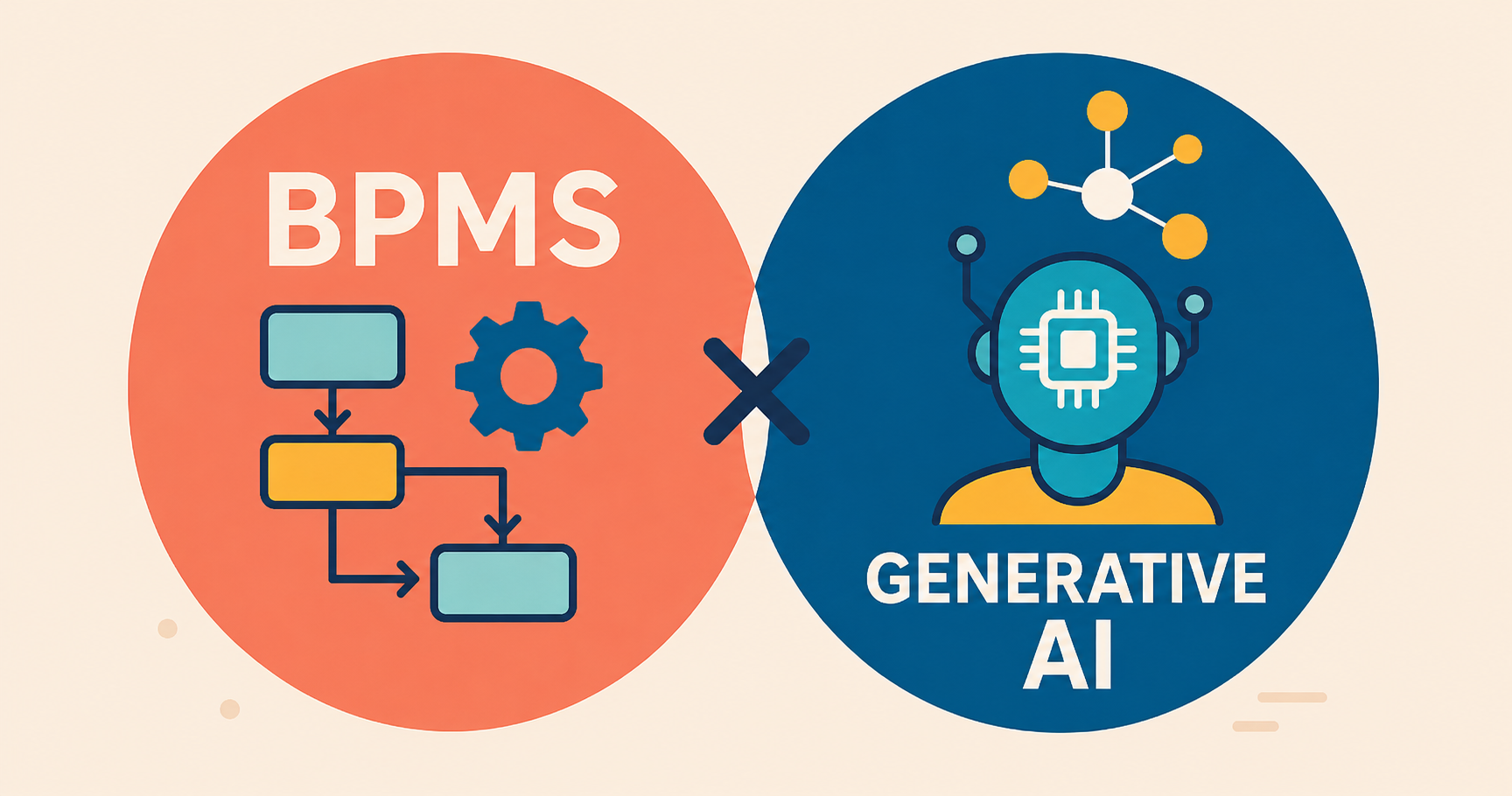

SaaS BPMS (Business Process Management System) has recently garnered significant attention as a platform that supports the operational improvements essential for every corporate activity. Compared to conventional BPMS, its cloud-based operation offers enhanced flexibility and the potential for substantial reduction in maintenance costs.
Meanwhile, Generative AI has evolved rapidly as a technology capable of creating new content from vast amounts of data, finding applications across various fields, including text, images, video, and audio. Many companies are keen on integrating it into their operations, anticipating significant labor savings and efficiency gains in various processes.
This article will outline the fundamentals of both SaaS BPMS and Generative AI, then broadly explain the benefits of their integration, specific implementation methods, and real-world use cases. If you are looking to deeply improve your company’s operational challenges, please use this guide as a reference.
Table of Contents
What is SaaS BPMS?
Here, we explain the characteristics and implementation benefits of a BPMS that operates on the cloud.
SaaS BPMS is a form of Business Process Management System that runs in a cloud environment. A major characteristic is its ability to reduce initial implementation costs and operational load compared to on-premise BPMS, as it eliminates the need for infrastructure construction and maintenance. Companies can bypass setting up their own servers, offering the advantage of being able to start using the system quickly without needing specialized IT knowledge.
Maintenance, updates, and security measures are flexibly handled by the vendor, not the user. This makes it easier to incorporate the latest features and mitigate security risks. Furthermore, access is possible from anywhere in the world, making it ideal for teleworking and collaboration with overseas offices.
These SaaS characteristics are highly useful for companies that frequently review their business procedures and workflows. SaaS BPMS is a tool that should be actively considered, especially by firms with frequent changes to business rules or startups prioritizing speed of deployment.
The Difference Between BPM and BPMS
BPM (Business Process Management) refers to the methodology and practices used to design, analyze, and improve the entire business process within an organization. In contrast, BPMS (Business Process Management System) is the system—the tool—that supports the BPM concept, facilitating process visualization, automation, and smooth management.
While BPM is a broad management discipline aiming for the optimization of the organizational workflow, BPMS is the specific software that achieves this at an operational level. A key feature is the ability to design the blueprint of the workflow on a management screen and share its real-time status with all stakeholders.
– Features of SaaS BPMS and a Comparison with Conventional Systems
Conventional BPMS was often deployed on-site, placing a significant burden on the implementing company due to server construction, license fees, and system maintenance. SaaS BPMS, conversely, allows immediate use of the system via a web browser, enabling a drastic reduction in initial investment.
Furthermore, the subscription model, where costs are paid based on usage, is prevalent for SaaS BPMS, making costs clearer and easier to manage. Many products are rich in no-code or low-code features that significantly shorten the time required for development and modification, providing the added benefit of being user-friendly for non-IT personnel in various departments.
What is Generative AI?
This section summarizes the overview of the highly-focused Generative AI, its differences from conventional AI, and its application scenarios.
Generative AI is a technology that “generates” new text, images, or audio based on given data and learning models. While previous AI systems excelled at classification and prediction, the key distinguishing feature of Generative AI is its ability to create entirely new content.
In recent years, its application has advanced across various fields, such as chatbots utilizing text generation models and design support using image generation models. Advancements in AI technology have dramatically improved the accuracy with which it can automatically generate natural language expressions and diverse patterns of images and videos, further expanding its potential for business use.
Generative AI is now being introduced across various business scenarios, including customer support, sales activities, and content marketing. Its appeal lies in its potential, when integrated with SaaS BPMS, to broaden the scope of business automation while simultaneously assisting in the generation of improvement strategies.
– Differences from Conventional AI
Conventional AI primarily focused on extracting features from large datasets to perform classification or make judgments. Generative AI goes one step further, producing so-called “creative” outputs. For example, text generation AI can automatically compose a new document while understanding the context of the input text.
Furthermore, image generation AI can analyze existing images and create new ones with similar structures or styles. This capability significantly supports creative tasks that conventional AI struggled with, such as streamlining the creation of marketing materials and product catalogs.
– Advantages and Use Cases of Generative AI
One major advantage of Generative AI is its ability to rapidly output ideas or drafts without requiring human initiation. By having pre-trained models generate these components in a short time—a process that would otherwise be time-consuming and costly when done manually—it improves both work efficiency and productivity.
For instance, utilizing Generative AI for creating customer service scenarios, initial drafts of web articles, or creative assets for social media can significantly reduce the workload of the personnel in charge. It also handles multilingual translation and summarization in a short time, becoming a powerful tool that supports international business expansion.
The Benefits of Combining SaaS BPMS and Generative AI
In this section, we explore the synergy between SaaS BPMS and Generative AI, to simultaneously achieve business process visualization and advanced automation.
SaaS BPMS is a platform that digitizes various internal corporate flows and integrates the management of workflows such as approvals and notifications. Combining this with Generative AI extends the scope beyond mere automation to include the suggestion of business improvements and the streamlining of document creation.
When the content creation and novel suggestion capabilities of Generative AI are linked with the visualized business flows provided by SaaS BPMS, the entire organization is empowered to engage in proactive improvement activities. This is particularly effective for processes involving multiple departments, such as customer support and product planning.

– Process Visualization and Automated Improvement Suggestions
A potential mechanism involves feeding business data monitored on the SaaS BPMS into Generative AI, which then identifies bottlenecks and inefficiencies in the process. For example, if an approval step takes too long, the AI could propose features that could automate that specific part.
Furthermore, instead of relying on staff to design a new flow from scratch, it is becoming possible for the AI to suggest an optimal process prototype based on similar past cases. This makes business improvement—which previously required expert knowledge—more accessible to a wider range of employees.
– Preventing Siloization through Task Management and Automation
By integrating the automation features of SaaS BPMS with Generative AI, tasks can be managed and advanced in a way that is less dependent on the individual skills or workload of specific employees. For example, automating the drafting of routine emails by AI or having the system automatically manage the review workflow can standardize previously siloed processes.
Another benefit is the ease of sharing internal expertise and knowledge. By ensuring the system itself records the process and the AI constantly suggests the optimal solution, the risk associated with personnel turnover or department transfers can be mitigated.
– Efficiency through Integration with External Systems
SaaS BPMS enables centralized data management and integrated workflows by connecting with other systems like CRM and ERP via API. Utilizing Generative AI, this integrated data can be used to automatically generate reports, perform market analyses, or create proposal documents for customers.
Expanding the scope of data utilization boosts efficiency across a wide range of tasks, from sales activities to back-office operations. Especially in areas that enhance customer satisfaction, this allows frontline staff to focus on high-value-added activities, thereby strengthening corporate competitiveness.
Checkpoints for Choosing SaaS BPMS
Here are the criteria you should consider to select the optimal SaaS BPMS for your company.
Numerous SaaS BPMS products have been released, each with different features and target company sizes. It is crucial to define your implementation goals and operating structure, then check whether the necessary functions are available and if the scalability is sufficient.
If Generative AI integration is a consideration, it’s also important to check how low the barrier is to integrating external services later using APIs. By focusing on the following points, you can minimize the risk of failure during system selection.
– Cost Reduction Potential
By addressing siloed work and analog processes, you can reduce unnecessary labor, paper usage, and storage costs. In an era of severe labor shortages, the ability to optimize necessary personnel is a significant strength for business growth.
There are documented cases where companies digitizing expense reports and invoice processing have seen a substantial reduction in per-transaction processing costs. The time and resources freed up by thorough efficiency gains can be redirected toward core business functions or new ventures.
– BPMN Compliance and Workflow Template Richness
BPMN (Business Process Model and Notation) is the international standard for graphically visualizing business processes. A compliant product facilitates smooth process modeling and allows for easy incorporation of templates or examples from other companies.
The richness of prepared workflow templates is also important. Some products offer numerous templates—such as approval flows or invoice management flows—that allow commonly used business processes to be implemented immediately.
– Customizability: The Presence of No-Code/Low-Code Development
Since business specifications are constantly changing, a mechanism that allows for flexible customization as needed is essential. Products that support no-code/low-code development make it easier for non-engineer, frontline staff to modify processes or create simple applications, allowing for a rapid improvement cycle after implementation.
Furthermore, the broader the scope for customization, the easier it is to incorporate the organization’s unique expertise. This should be evaluated not only during the initial adoption but also from the perspective of continuous operation.
– API Flexibility for Generative AI Integration
When considering integration with Generative AI, it is critical to confirm whether the SaaS BPMS has flexible API and Webhook mechanisms that allow for smooth data exchange with external services. A flexible API makes it easier to add and integrate diverse AI services such as chatbots, translation engines, and image generation tools.
For companies with potential future functional expansion or those considering switching between different AI tools, choosing a SaaS BPMS with an open specification can mitigate risks.
Recommended SaaS BPMS Products
While numerous SaaS BPMS products are available both domestically and internationally, here we introduce a product highly regarded for its track record and functionality.
The optimal product will vary depending on the company’s organizational size, industry, and the external tools it wishes to integrate. Consider the technical requirements alongside the support structure and usage costs when planning your implementation.
– Questetra BPM Suite
Questetra BPM Suite is a purely Japanese-made SaaS BPMS with a robust track record of implementation in many Japanese companies. It emphasizes no-code development, allowing business users to intuitively build workflows using drag-and-drop.
It is also equipped with a variety of automation features, enabling the unified management of diverse tasks, including internal approval flows, routine form creation, and customer support. Its highly flexible architecture makes it appealing for companies looking to actively pursue integration with Generative AI for tasks like inquiry handling and translation.
Key Use Cases for SaaS BPMS and Generative AI
Here are concrete use cases, spanning internal and external communication to information creation.
Many business tasks can be categorized into routine flows and creative work. By using SaaS BPMS to manage the routine flows and Generative AI to support the creative output, organizations can dramatically boost overall productivity.
We will examine specific use cases that are increasingly being adopted by companies, explaining each in detail. The key is to leverage both the system and AI to streamline processes that were previously reliant on individual employees.
– Automatic Generation of Customer Inquiry Responses
Customer inquiries vary widely in content and language, often becoming a significant burden for support staff. By using SaaS BPMS to automatically capture form submissions and assign them to the relevant staff, and then having Generative AI draft the response text based on escalation content or templates, companies can both reduce response times and maintain quality.
Furthermore, Generative AI can learn common questions and answer patterns from past inquiry histories to suggest more accurate text. Since the staff only needs to focus on the final check and minor adjustments, this setup has a high potential to increase customer satisfaction.
– Streamlining Manual Creation and Translation Tasks
Business manuals and procedure documents are vital organizational knowledge assets, but their initial creation, maintenance, and updates require enormous effort. By using SaaS BPMS to manage the approval flow and integrating a Generative AI drafting feature, companies can achieve rapid creation and updating of both new and existing manuals.
For companies requiring multilingual expansion, translation tasks can also be a major challenge. While expert review remains necessary, entrusting the initial bulk translation to Generative AI can significantly speed up the international business process by completing the initial stages in a short amount of time.
– Workflow Automation for Image and Video Utilization
In tasks that frequently use images and videos, such as product design or advertising creative, combining SaaS BPMS and Generative AI offers significant advantages. By centralizing the review and approval flow for concepts within the process management system, and integrating AI for the automatic generation and editing support of images and videos, both the quality and speed of creative production are improved.
For example, by managing the PR video creation flow for a new product on the BPMS while having the AI create a preliminary video draft, an environment is established where human efforts can be concentrated on high-value-added activities. This also facilitates smoother cross-departmental communication, making it easier to aim for project completion in a shorter timeframe.
Summary
The combination of SaaS BPMS and Generative AI realizes an unprecedented level of flexibility and business efficiency. By selecting the optimal tools for your company’s challenges and establishing a robust operating framework, you can advance your business improvement efforts to the next stage.
SaaS BPMS serves as the foundation for process visualization and automation, while Generative AI promotes the efficiency of manual tasks and the utilization of knowledge. The synergy between the two expands the potential for further strengthening corporate competitiveness.
During implementation, it is crucial to select a BPMS that offers easy visualization and an AI that can be flexibly integrated, and to commit to continuous improvement even after deployment. By incorporating new technologies to build a process optimal for your company, you can establish a powerful competitive advantage.
Questetra BPM Suite, which we introduced, offers numerous examples of business improvement utilizing Generative AI. You can also try the product for free for 60 days, so we encourage you to experience the benefits of Generative AI-powered business improvement firsthand.