
The flow of re-production that was undefined. Should be systematized when the number of cases increases.
1. Issue: Frequent unexpected rejections
The Taketori Company is a small business with five employees that sells bamboo crafts by order.
The sales guy takes the orders, and Grandpa the craftsman, is in charge of production. Four to five new orders are added to the Grandpa’s “My Tasks” every week. Most of the orders are small lot orders, such as 100 bamboo combs with names on them, but about once or twice a month, he gets a large order, such as 2,000 deluxe combs.
Takeo is in charge of inspecting the delivered items before shipping, and not only does he check that they match the order, but he also checks that each and every item is clean and not defective. Grandpa’s products have about one defective item in every 100 items.
If there were any defective items among the deliveries, Takeo would verbally inform Grandpa and ask him to reproduce them. However, with the recent increase in orders, Grandpa is no longer able to keep track of the requests for re-production.


- Step1. The sales guy receives the order〔Take processing screen〕 〔Modeling screen〕
- Step2. The accounting lady checks the inventory of materials and parts〔Take processing screen〕 〔Modeling screen〕
- Step3. The Grandpa makes items to order〔Take processing screen〕
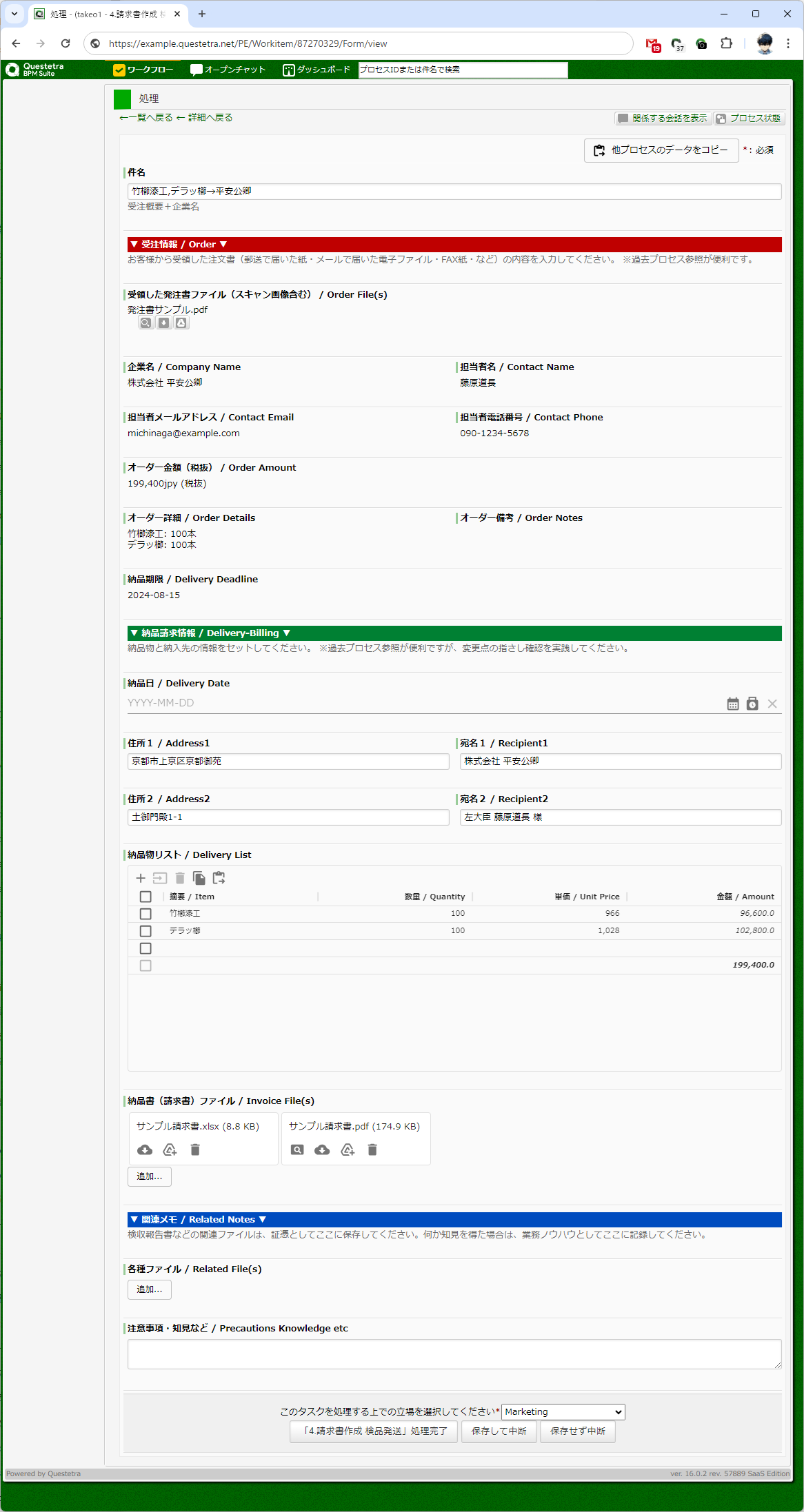
- Step4. Takeo (also the process owner) inspects the product then delivers it〔Take processing screen〕
2. Solution: Task management also includes sending back
The main problem is that reproduction information is communicated verbally. If communication is only verbal, it is very difficult to avoid omissions.
Takeo, the process owner, has given the business system (workflow app) an overhaul.
- Order information is added to “My Tasks”
- Rebuilds (remanufacturing) will be added to “My Tasks” as well
Specifically, we added the Human Task [3b. Handling defective products] to Grandpa’s swimlane so that items can be returned from [4. Invoice creation, inspection, and shipping]. (Addition of a return process)
With this process modification, Grandpa can now see a list of all the jobs he has completed (and the list of reworked jobs) in “My Tasks”.
Workflow Diagram(BEFORE AFTER)


Explanation of each process (click to open)
BEFORE (Advanced edition):
- 1. Enter order: The sales guy receives orders from customers, enters the order information, and attaches the necessary supporting documents.
- (AND Split Gateway): A point where one route branches into multiple routes. In the case of a plus sign (AND), all output routes are selected and parallel processing begins. (AND-Split)
- 2. Check raw materials: The accounting lady confirms the required raw materials and procures them.
- 3. Made to Order: Grandpa produces products based on orders.
- (AND Join Gateway): A point where multiple routes join into one route. In the case of a plus sign (AND), it waits for all concurrent processes to arrive and sends them to a single output route. (AND-Join)
- 4. Invoice creation, inspection and shipping: Takeo creates invoices, inspects the products and ships them.
- 5. Confirm that inspection is complete: Takeo confirms that the customer has received the product and that inspection has been completed.
- 6. Confirm payment received: The accounting lady confirms the receipt of payment from the customer.
AFTER (Advanced edition):
- 1. Enter order: The sales guy receives orders from customers, enters the order information, and attaches the necessary supporting documents.
- (AND Split Gateway): A point where one route branches into multiple routes. In the case of a plus sign (AND), all output routes are selected and parallel processing begins. (AND-Split)
- 2. Check raw materials: The accounting lady confirms the required raw materials and procures them.
- 3. Made to Order: Grandpa produces products based on orders.
- (AND Join Gateway): A point where multiple routes join into one route. In the case of a plus sign (AND), it waits for all concurrent processes to arrive and sends them to a single output route. (AND-Join)
- 3b. Handling defective products: Grandpa will produce additional items that fail inspection.
- 4. Invoice creation, inspection and shipping: Takeo creates invoices, inspects the products and ships them.
- 5. Confirm that inspection is complete: Takeo confirms that the customer has received the product and that inspection has been completed.
- 6. Confirm payment received: The accounting lady confirms the receipt of payment from the customer.
Workflow diagram Before and after slider comparison (click to open)


Workflow app modification video (click to open)
*This process improvement story is fictional and has no relation to any real people or organizations.
3. Effects
The addition of the return process had the following effects on The Taketori Company:
- Significant reduction in remanufacturing errors
- There were no more leaks due to verbal communication, and there were no more oversights in re-production.
- In the past, when there were multiple re-productions required, Grandpa was unable to keep track of them all, and there were times when things were missed.
- However, now that they are displayed in My Tasks, they can be addressed without anything being overlooked.
- Preventing delivery delays
- By eliminating remanufacturing omissions, delivery delays have been significantly reduced.
- In the past, if a part was missed during reproduction, production would be delayed and delivery deadlines could not be met.
- However, now that there are no more omissions and we can produce the necessary products without any omissions, we are able to deliver on time.
- Increase customer satisfaction
- Late deliveries have decreased and customer satisfaction has increased.
- Previously, when delivery delays occurred, customers would complain.
- However, being able to deliver on time has improved customer satisfaction.
- Improve work efficiency
- Grandpa can now check the list of re-production projects in My Tasks, which has improved his work efficiency.
- In the past, Grandpa would spend a lot of time writing down notes and searching for re-production requests that were given to him verbally.
- However, now that it’s displayed in My Tasks, he can immediately check the information he needs, which has improved work efficiency.
- Quality improvement
- Product quality has improved as there are no more remanufacturing errors.
- In the past, if a remanufacturing error occurred, defective products would sometimes be shipped as is.
- However, now that leaks have been eliminated and all products are inspected, no more defective products are shipped.
- Cost reduction
- Delivery delays and quality issues have decreased, resulting in cost savings.
- Previously, late deliveries meant costs associated with reshipping and responding to customers.
- Additionally, if a quality problem occurred, costs for returns and repairs were incurred.
- However, these problems have been reduced and costs have been reduced.
4. Other Business Applications
The addition of a Return Process can be applied to various business processes other than made-to-order production processes.
- Accounting
- When an invoice prepared by an accounting staff member is reviewed by a supervisor or auditor and instructions are given for corrections
- When a supervisor approves an expense report processed by an accounting staff member and issues instructions for correction
- Design work
- When the design manager reviews the design drawings created by the designer and issues instructions for corrections
- When a sales representative reviews a specification created by a designer and gives instructions for corrections
- Development work
- When a tester tests a program created by a programmer and gives instructions for correction
- When a client reviews a design created by a designer and gives instructions for revisions
- Consulting services
- When a client reviews a proposal prepared by a consultant and gives instructions for revision
- When a supervisor reviews materials prepared by a consultant and gives instructions for corrections