
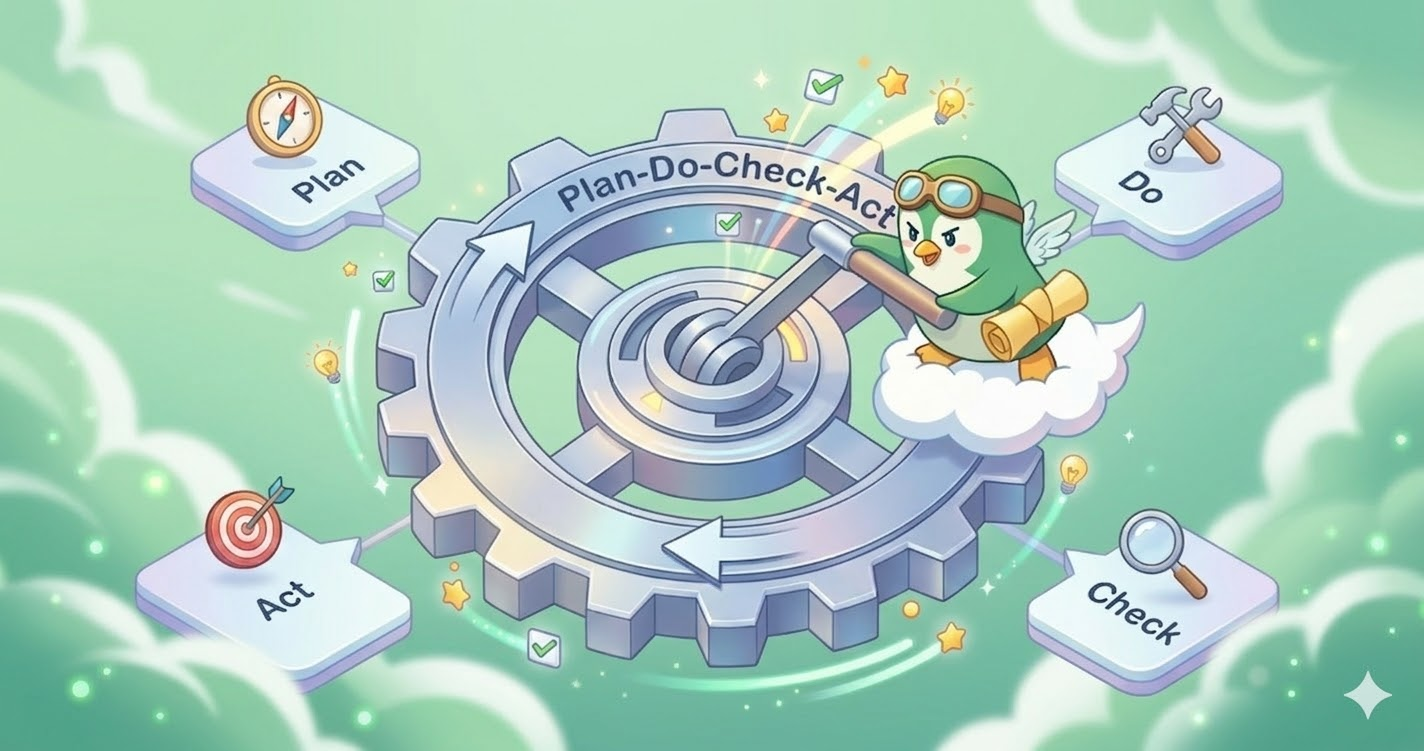

Business process improvement never truly ends. Every improvement reveals the next challenge.
What Is the PDCA Cycle, Again?

The PDCA cycle is a framework for continuous improvement. For example, any of the following concerns could become the focus of an improvement initiative:
- A. A customer has filed a complaint.
- B. The sales team is not achieving better results.
- C. Candidates keep declining job offers.
- D. You waste time looking for your smartphone every morning.
The moment you recognize an issue is the perfect time to start a PDCA initiative. (Plan ⇒ Do ⇒ Check ⇒ Act ⇒ Plan ⇒ …)
Improvement Theme A: Hygiene Management at a Food Processing Plant
- Stage 0 (Define the Issue): A customer complained about finding a strand of hair in a food product. For a food processing plant, this poses a serious risk to customer trust. The primary objective is to prevent the problem from happening again.
- Stage 1 (Plan): Based on the hypothesis that self-checks tend to become less rigorous, the plant designed a buddy-check system in which employees inspect one another. Each pair checks for exposed hair and areas that may have been missed by a lint roller. The goal is to achieve 30 consecutive days with no hair contamination incidents.
- Stage 2 (Do): The buddy-check system was introduced at selected facilities, together with more frequent spot checks.
- Stage 3 (Check): After one month, inspection results and customer feedback were reviewed. No hair contamination incidents had occurred. As an additional benefit, employees developed a culture of checking one another’s appearance, creating an environment in which minor abnormalities and mistakes were easier to point out.
- Stage 4 (Act): The plant formally revised its hygiene management standards and fully incorporated buddy checks into its training program for new employees. This also prompted a discussion about strengthening controls for other foreign materials, such as fibers from workwear and fragments of gloves. The team recognized this as the next issue to address.

Improvement Theme B: Losing Sales Opportunities to Competitors
- Stage 0 (Define the Issue): The proportion of lost opportunities attributed to competitors offering lower prices has been increasing.
- Stage 1 (Plan): The team hypothesized that newer sales representatives were not communicating the product’s strengths effectively. It therefore created a new proposal template designed to present the expected return on investment more clearly. The goal was to increase the close rate from 20% to 25%.
- Stage 2 (Do): Selected sales teams began using the new proposal template. Representatives were also required to quantify the expected cost savings and reductions in working hours for each customer.
- Stage 3 (Check): After one month, the team analyzed the number of opportunities, close rate, and reasons for lost deals. Fewer opportunities were lost because the price was considered too high, indicating that the ROI explanation had been effective to some extent. However, the overall close rate remained at 20%, suggesting that factors other than price were influencing purchasing decisions.
- Stage 4 (Act): The new proposal template and presentation method were rolled out to all sales teams and incorporated into the sales manual. At the same time, the team identified a new issue: the criteria for qualifying and advancing sales opportunities were not applied consistently.

Improvement Theme C: New Graduates Declining Job Offers
- Stage 0 (Define the Issue): The company’s offer-decline rate has remained high in recent years. This year, it was unable to hire the planned number of new graduates.
- Stage 1 (Plan): Based on the suggestion that candidates needed more opportunities to learn about the company after receiving an offer, the recruiting team planned a follow-up initiative. The goal was to reduce the offer-decline rate from 30% to 15%.
- Stage 2 (Do): The company held a workplace tour and employee networking session for candidates who had received job offers.
- Stage 3 (Check): An analysis of the reasons candidates declined their offers showed that the decline rate had fallen from 30% to 20%, although it had not reached the target. However, fewer candidates cited a lack of understanding of the role as their reason for declining.
- Stage 4 (Act): The follow-up event was incorporated into the standard recruitment process for the following year. At the same time, the team discovered that a significant number of candidates still lacked a clear picture of their potential career path after joining the company.

Improvement Theme D: The Morning Rush
- Stage 0 (Define the Issue): The smartphone frequently goes missing, especially in the morning. It may be buried in the bedding, wedged between the sofa cushions, or, on rare occasions, sitting on top of the refrigerator.
- Stage 1 (Plan): A dedicated smartphone tray was placed beside the bed, with a rule that the phone must always be returned to the tray after use. The goal was to reduce the morning search time from three minutes to ten seconds.
- Stage 2 (Do): A note reading “Put it here” was attached to the tray, and the new rule was put into practice.
- Stage 3 (Check): Even after one month, no time was being spent searching for the smartphone. Getting out of the house in the morning had become much smoother. However, another problem had become apparent: the keys were now going missing instead.
- Stage 4 (Act): The tray was expanded into a dedicated tray for the smartphone, keys, and wallet, and the practice was formally adopted as part of the household routine. However, a new concern emerged: having the smartphone within reach until bedtime might be encouraging people to stay up late, which could ultimately be contributing to the morning rush.

Which Stage Matters Most?
The most difficult part of the PDCA cycle is connecting one cycle to the next Plan.
The first Stage 1 (Plan) begins with a clearly recognized issue from Stage 0. By the time the second Stage 1 begins, however, the issue may have become unclear. (Stage 0 ⇒ Stage 1 ⇒ Stage 2 ⇒ Stage 3 ⇒ Stage 4 ⇒ Stage 1 ⇒ …)
The most common reason a PDCA cycle stops is that the issue itself disappears from view. Teams must continually remember that Stage 4 of cycle n, together with Stage 3, also serves as Stage 0 of cycle n+1.
What Is the BPM Cycle?
While the PDCA cycle is a general framework for continuous improvement, the BPM cycle focuses specifically on improving business processes. BPM stands for Business Process Management.
Like the PDCA cycle, the BPM cycle begins by recognizing an issue.
Improvement Theme X: Customer Inquiry Handling Process
- Stage 0 (Define the Issue): An existing customer complained that the company’s response was too slow. The inquiry did, in fact, require urgent attention.
- Stage 1 (Plan): The process owner hypothesized that customer service representatives were assessing urgency inconsistently. An AI-powered urgency classification step was therefore added to the process. For inquiries classified by AI as the most urgent, the goal was to provide an initial response within 60 minutes.
- Stage 2 (Do): All email inquiries were automatically classified by urgency.
- Stage 3 (Check): After two weeks of operation, the team analyzed initial response times and customer satisfaction. Every urgent inquiry had received a response within 60 minutes. Both faster response times and improved customer satisfaction were confirmed.
- Stage 4 (Act): Based on feedback from the employees responsible for responding, the team worked to improve the accuracy of the AI classification. At the same time, a new suggestion emerged: the AI should assess not only urgency, but also the difficulty of each inquiry.

Improvement Theme Y: Internal Approval Process
- Stage 0 (Define the Issue): Requests remain at the human task “Manager Approval” for too long, delaying decision-making.
- Stage 1 (Plan): The process owner suspected that managers were spending too much time drafting approval comments and revision requests. A new step was therefore added before the approval task, allowing AI to prepare draft comments for both approval and return for revision.
- Stage 2 (Do): AI began automatically generating a proposed approval comment and a proposed revision-request comment. Managers could review and edit the appropriate draft as necessary before completing the approval task.
- Stage 3 (Check): After two weeks of operation, the team analyzed approval lead times and the amount of time requests remained pending. The results showed that less time was being spent drafting comments and that approvals were completed more quickly, particularly for straightforward requests.
- Stage 4 (Act): Managers began posting positive comments, such as “This helped me consider the request from a broader perspective.” However, applicants also began submitting occasional negative feedback, such as “Isn’t this comment inappropriate?”

Improvement Theme Z: Web Content Publishing Process
- Stage 0 (Define the Issue): A copy-and-paste error resulted in a blog post being published without its final section.
- Stage 1 (Plan): The process owner concluded that errors were unavoidable as long as content was copied and pasted manually. The creation of WordPress.com drafts was therefore automated, with a goal of eliminating omissions caused by copy-and-paste work.
- Stage 2 (Do): Once a manuscript was approved through the workflow, its title, body, and excerpt were automatically registered as a draft post in WordPress.com. This allowed the employee responsible for publishing to focus on layout and design.
- Stage 3 (Check): After one month, no simple errors such as missing text or omitted sections had occurred. The time required for publishing work had also been reduced significantly.
- Stage 4 (Act): The workflow began to be used for content other than blog posts. Although the publishing process had become smoother, demand for reviews of writing quality increased. Some team members also suggested introducing AI-assisted reviews.

Improvement Theme W: Order Processing
- Stage 0 (Define the Issue): Information from purchase orders is entered manually, resulting in a persistent stream of data-entry errors.
- Stage 1 (Plan): The process owner changed the process so that the workflow would start automatically when an order email was received. An AI task for extracting order details was also added so that the relevant fields would be pre-populated. The goal was to reduce the order-entry error rate from 10% to 4%.
- Stage 2 (Do): Instead of manually entering information from purchase orders, sales representatives began comparing the original purchase order with the order details pre-populated by AI.
- Stage 3 (Check): Errors involving product codes, quantities, and delivery dates decreased substantially, bringing the overall error rate down to 1%.
- Stage 4 (Act): Feedback from sales representatives revealed that some purchase orders contained incorrect information to begin with. The team therefore identified a new issue: comparisons between purchase orders and quotations should also be automated to detect discrepancies.

Which Stage Matters Most?
In the BPM cycle, it is equally important to keep identifying the next issue.
Teams must continually remember that Stage 4 of cycle n, together with Stage 3, also serves as Stage 0 of cycle n+1.
A BPM Suite Is Essential to the BPM Cycle
To keep the BPM cycle running in day-to-day operations, organizations need a platform that supports process design, execution, monitoring, and improvement.
It is certainly possible to run the BPM cycle manually. However, a BPM suite makes the cycle much more efficient by providing an integrated set of functions that support every stage of PDCA. In much the same way, an office suite brings together applications for documents, spreadsheets, and presentations.
Questetra BPM Suite provides the following capabilities:

Plan (Design):
- Process flow design: Process owners model business processes and the business data used within them. This makes workflows and data items visible and easier to understand.
- Examples include branching rules, automated email settings, email-receiving events, form-receiving events, automatic PDF generation, child-process integration, and ECMAScript processing.
- Assignment rule configuration: Process owners define who may be assigned to or take responsibility for the tasks in each process step.
- Business data configuration: Supported data types include strings, numbers, dates, date-times, files, and tables.
- These capabilities may also be described as IT process control or process design functions. BPMN, an international standard notation, is commonly used to define workflow diagrams.
- They may also be referred to more generally as modeling, design-time, design, or development capabilities.
Do (Execute):
- Release management: Process owners deploy models, or workflow apps, as operational business systems and update them as needed.
- Task processing: Employees complete the tasks shown in My Tasks. Tasks assigned to them can be handled directly as part of their day-to-day work.
- These capabilities may also be referred to more generally as workflow, runtime, execution, or operational functions.
Check (Monitor):
- Process status monitoring: Monitor the progress of individual process instances and see which step each one has reached.
- Heatmaps: Monitor the overall distribution of active process instances and identify the steps where work is accumulating.
- Performance data analysis: Review the results of completed processes, including bottlenecks, to identify the next opportunities for improvement.
- These capabilities may also be referred to more generally as monitoring, status monitoring, or performance monitoring functions.
- Although they are used primarily during runtime, they also provide valuable insights for the next design-time review.
Act (Optimize):
- Team Chat: Communicate with other team members and discuss staffing levels and work schedules.
- App Chat: Hold discussions linked to a specific workflow app, making it easier to capture and share ideas for improvement.
- Process Chat: Hold discussions linked to a specific process instance, making it easier to share case-specific circumstances.
- Custom channels: Create focused spaces for discussing specific topics.
- These capabilities may also be referred to collectively as internal chat functions.
- Based on process status and performance data, process owners can optimize runtime resource allocation and staffing levels as needed.
- Process owners can also identify issues within workflow apps and use them as input for the next design-time cycle.
In the field of BPM, “Plan ⇒ Do ⇒ Check ⇒ Act” is sometimes expressed as “Design ⇒ Execute ⇒ Monitor ⇒ Optimize.” The underlying concept, however, remains the same.
Conclusion
Both PDCA and BPM are based on the idea of identifying issues and making repeated improvements. In practice, however, improvement efforts often depend heavily on the awareness and commitment of individuals or teams. Over time, the next issue may become unclear, causing the cycle to stop.
BPM is particularly challenging because it involves improving the business process itself. Organizations must review not only the sequence of work, but also the division of responsibilities and the way data is handled. A process that relies on individual knowledge and manual practices is difficult to improve continuously.
This is why the Check, or monitoring, stage and the Act, or improvement, stage should be supported by an IT system. The next improvement can only begin when organizations have an environment that visualizes process progress and performance data, allowing bottlenecks and other issues to be identified continuously.
A BPM suite provides an integrated foundation for process design, execution, monitoring, and improvement, allowing the cycle to continue as part of everyday operations. Sustainable business process improvement requires more than making changes whenever someone notices a problem. What matters is maintaining a system in which improvement continues by design.